Beyond the Window: Mastering Citrine Gemstone Cuts, from the StarBrite cut and Concave faceting to Emerald cut citrine and Asscher cut aesthetics

Read the Lapidary's Prologue

I still remember the acrid smell of burnt diamond paste from my early days at the lapidary bench. Hold an uninspired, commercially faceted stone to the light, and you'll likely see straight through its center—a lifeless, transparent void known to us as "the window." It is the physical manifestation of compromise.

But step into the bespoke ateliers of 2026, and an aesthetic shift unfolds. We are witnessing a phase where maximizing Gemstone light performance requires brutal sacrifice of the raw material. Psychologically, the human eye is biologically wired to seek out high-contrast micro-movements of light. When a gem is mathematically proportioned to maximize internal reflection rather than simply retaining carat weight, it triggers a profound emotional resonance. Welcome to the discipline of kinetic brilliance.
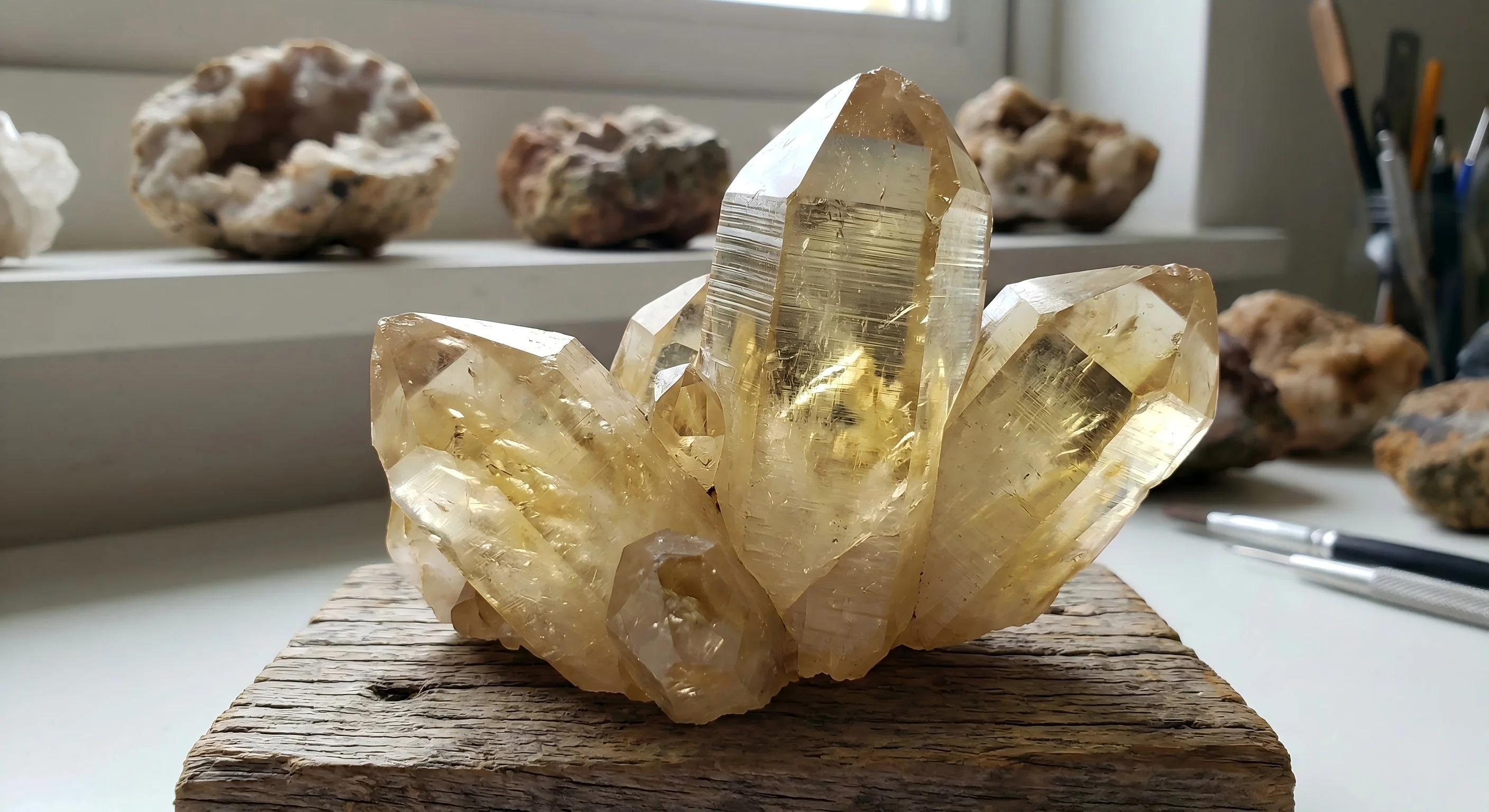

The Optics Engine & Refractive Science

For decades, commercial rough was cut to maximize weight, resulting in "The Window"—a zone of zero light return. Today, lapidaries utilize How 3D Wireframe Modeling Predicts Gemstone Fire Before the First Cut to engineer reflections. Stop chasing carat weight. Start chasing critical angles.

The Physics of Light Return

  • Inclusion Avoidance: The Micro-Chess of Maximizing Face-Up Clarity: Modern lapidaries use spatial geometric layouts to map healed fractures, ensuring an eye-clean state without sacrificing optical symmetry.
  • Essential Gemological Tools to Verify Your Citrine’s Refractive Index: Beyond the standard refractometer, curators utilize digital dichroscopes to verify the physical testing and optical integrity of deeply carved stones.
  • The 3D Coordinate System for Accurate Gemstone Color Calibration: Evaluation maps dynamic brilliance and structural integrity across an exhibition-grade matrix.
The Veteran's Reality Check: The Cost of the Critical Angle

I ruined my first piece of premium imperial rough because I trusted the commercial standard. I cut the pavilion at 40 degrees, chasing a heavier yield to satisfy a client's arbitrary demand for a double-digit carat weight. When I pulled it off the dop stick and wiped away the heavy cutting oil, the center was completely dead. You could literally read a newspaper through it. That transparent void is the reality of compromising physics for scale.

Quartz has a refractive index of roughly 1.544. This mathematical absolute dictates that your critical angle is around 43 degrees. Anything shallower, and light leaks straight through the bottom facets. The ugly truth? Fixing a window means re-cutting the pavilion from scratch, a process that routinely strips away 20% to 30% of the stone's existing weight. Clients despise hearing this. They hand you a 15-carat commercial stone and expect you to "fix the sparkle" while returning a 14-carat gem. I have to tell them: I can give you an 8-carat fireball, or you can keep your 15-carat piece of glass.

A vibrant, precision-cut stone with kinetic brilliance commands far more curatorial respect and visual authority than a massive, lifeless chunk of mineral.

Architectural Symmetry

Why the Asscher Cut is Dominating the 2026 Art Deco Jewelry Revival: The Asscher cut creates a hypnotic, deep-diving optical illusion. Aesthetically, this strict geometry provides a psychological sense of order. Emerald vs. Asscher: Choosing the Right Step Cut for Your Art Deco Piece depends entirely on spatial design.

Mastering the Exact Proportions for a Flawless Step-Cut "Windmill" Effect: This requires absolute mathematical symmetry. A deviation of even 0.5 degrees in the pavilion facets destroys the concentric squares of light.

The Veteran's Reality Check: The Hall of Mirrors vs. The Fragile Edge

If you want to understand the brutality of the Asscher cut, try aligning its concentric squares by eye while the lap is spinning at 600 RPM. The step-cut is profoundly unforgiving. Unlike brilliant cuts that scatter light in a way that actively masks internal inclusions, step cuts act like a rigid hall of mirrors. A tiny healed fracture that goes completely unnoticed in a round brilliant will reflect a dozen times in an Emerald or Asscher cut, ruining the entire spatial geometric layout. The trade-off is stark: you secure that hypnotic 1920s architectural symmetry, but you sacrifice immense amounts of rough material hunting for a flawless, eye-clean section.

Conversely, fantasy cuts—like the StarBrite or concave faceting—abandon flat planes entirely. We swap flat laps for cylindrical diamond mandrels, grinding negative space into the stone. The marketing brochures tell you it's a 10% material loss. That is a best-case scenario fiction. When I am carving a complex optic dish, I routinely grind away 30% to 40% of the crystal to achieve the correct internal focal point.

And let's discuss the nightmare of setting these stones. The sharp, undulating pavilion ridges of a 3D carved gem are incredibly fragile. One slight slip with a steel burnisher on the bench, and the edge chips, destroying weeks of work. Furthermore, applying concave techniques to highly saturated, dark Madeira rough is a fundamental error; the aggressive internal reflections compound the color density, turning the stone into an opaque black hole. Concave cuts require light-toned rough to function properly.

The Curatorial & Geological Landscape

In 2026, the focus has shifted from mere commercial grading to deep geological understanding and structural analysis. We prioritize unearthing the actual history of the crystal.

Institutional Taxonomy

How the GIA’s 2026 Report Overhaul Reshapes Brazilian Citrine Documentation: New reporting formats deeply detail origin and specific macrocrystalline structural traits, redefining curatorial standards and baseline expectations.

Provenance Narratives

Blockchain Traceability: Documenting Geological Provenance: Immutable ledgers map the journey from mine to museum. This pairs with AI-Driven Extraction: The Geological Mapping inside Brazilian Quartz Mines.

Natural vs. Heated

The Geological Reality Behind True Bright Yellow Citrine: Understanding the mineralogical identity and natural radiation processes that distinguish it historically from traditional baked amethyst.

The Veteran's Reality Check: The Brazilian Ovens and Blockchain Myths

Let's strip the romance away from gemstone sourcing. The reality of identifying true unheated golden citrine versus baked amethyst is a cold, strictly scientific process. For decades, the industry turned a blind eye to the 'Madeira ovens'—steel drums where poor-quality, highly included amethyst was heated until its iron impurities oxidized, turning it a burnt, opaque orange. Now, curatorial standards demand rigorous provenance.

When I examine a parcel today, I'm not just holding it up to a desk lamp. We rely on Raman spectroscopy and UV-Vis-NIR analysis to map the internal stress fractures. The extreme thermal shock of the artificial heating process leaves distinct structural scars within the quartz lattice that a standard jeweler's loupe simply cannot detect. The fading sun of Madeira is real; informed collectors no longer want that homogenous, dense orange. They actively seek the subtle, subtly zoned natural yellows that carry a verifiable geological birth certificate.

We must also address the trend of ESG compliance. Blockchain gemstone traceability is an excellent concept on paper, but out in the field, a digital ledger is only as accurate and ethical as the individual logging the initial rough at the mine site. AI-driven extraction models are genuinely helping to minimize environmental scarring in Brazilian macrocrystalline quartz deposits by mapping veins precisely, yet the physical labor remains grueling and analog. Technology assists the narrative, but it does not replace the physical reality of extraction.

Contemporary Art & Spatial Design

The application of these precision cuts extends far beyond traditional personal adornment. Gemstones as Museum Exhibitions: The Rise of Contemporary Optic Art highlights a niche avant-garde movement where surreal visual experiments and giant fantasy-cut citrines are housed as interactive sculptures.

Simultaneously, the high-end interior architecture sector has evolved. Curated Spatial Resonance: The Crossover of Symbolic Objects and Interior Architecture utilizes aesthetic intention. The most sought-after objects include Curating Modern Manifestation Kits with Citrine and Black Tourmaline—meticulously crafted elements designed to anchor the atmosphere of a room with lapidary precision, shifting the focus from wearable items to environmental installations.

The Veteran's Reality Check: The Engineering of Heavy Installations

We are moving past the notion of gems merely as rings or pendants. Large-scale, precision-cut citrines—sometimes weighing in excess of 500 carats—are increasingly commissioned as standalone architectural focal points for galleries or private studies. But mounting a stone of this magnitude is a severe engineering challenge.

You cannot simply drop a half-pound quartz crystal into a standard bezel setting. We routinely design custom mechanical armatures out of titanium or aerospace-grade aluminum that cradle the stone securely without obscuring the intricate optic dish carving on the pavilion. The aesthetic trend of integrating these pieces into mindful spatial design requires balancing heavy physical mass with delicate optical geometry.

It is crucial to understand that this is not about metaphysical guarantees or mystical energies; it is strictly about anchoring a room's atmosphere through calculated, high-contrast light performance. The logistical cost of this integration is significant. These are fragile, high-maintenance optical instruments that demand precise, directional gallery lighting environments to function as intended. Without the correct lux levels and angles, a $20,000 sculpture simply looks like a dull paperweight.

Aurora Vale

Aurora Vale

Hi, I'm Aurora Vale, the founder of Citrinefy and a passionate explorer of crystal energy and spiritual growth. I created this space to share my experiences with citrine, manifestation practices, and the deeper meanings behind crystals. Over the years, I’ve studied how gemstones can influence energy, mindset, and personal transformation. Citrine has always held a special place in my journey because of its strong association with abundance, confidence, and positivity. Through my writing, I hope to help others discover the uplifting energy of crystals, learn simple spiritual practices, and bring more clarity, balance, and abundance into their lives.

Citrine overs