0
The Madeira Premium
Deep reddish-orange "Madeira" citrines are commanding a staggering valuation premium over lighter yellow variants this quarter.
The light does not just pass through a premier citrine; it is captured, distilled, and radiated back as liquid gold. As we step into the new year, defining the pinnacle of Citrine Value and Aesthetics has never been more critical. Master Citrine color grading, understand the critical nuances of Madeira vs Palmeira, and explore our interactive models to navigate the Gemstone collection landscape of 2026.
Executive Summary
Deep reddish-orange "Madeira" citrines are commanding a staggering valuation premium over lighter yellow variants this quarter.
Demand multiplier for bespoke geometric step-cuts and kites over traditional brilliant cuts to maximize light return in dark stones.
Top-tier citrine's current rank among semi-precious quartz varieties in high-end auction retention value and liquidity.
Expand the chapters below to explore our definitive, peer-reviewed market and gemological analysis.
Geological origins, chemical traces, and the exact colorometric coordinates of premium citrine.
To evaluate citrine accurately in the 2026 landscape, we must entirely discard the layman’s assumption that all yellow quartz is equivalent. I have spent decades in sorting rooms from Geneva to Teófilo Otoni, and I can tell you unequivocally: the commercial market is drowning in baked amethyst. True, unheated citrine is an entirely different geological beast. At the apex of high jewelry, the conversation is brutally restricted to naturally occurring Palmeira and Madeira spectrums. This chapter dissects the strict colorometric coordinates and the heavy trade-offs inherent in these premier grades.
Unlike its sister stone, amethyst, which relies on iron impurities and gamma radiation to achieve its purple hue, natural citrine owes its color to a highly specific, sub-microscopic distribution of colloidal iron hydrates. I remember holding a massive piece of rough from the Anahí mine in Bolivia; the physical density and the way it interacted with a simple penlight felt completely foreign compared to standard quartz. When the geological environment provides the perfect storm of trace elements and prolonged, agonizingly slow geothermal heating over millions of years, the crystal lattice stabilizes. The result is the deep, saturated golden-orange characteristic of top-tier material.
The demarcation between Palmeira and Madeira is not arbitrary; it is a rigid boundary dictated by the concentration and valence state of these iron impurities. Palmeira citrine exhibits a highly saturated, pure orange hue with medium-dark tone. It lacks the muddy, brown masking that plagues commercial stones. I have found that Palmeira peaks in the 590-610 nanometer range, delivering a fiery, almost neon brilliance under the harsh tungsten lighting of a jeweler's bench.
Madeira citrine represents the statistical anomaly of the quartz world. It is not simply dark yellow. It is a profound, smoldering reddish-orange that resembles a cooling ember. Gemological laboratories define the strict Madeira grade by the undeniable presence of a red modifier. When observed on a color wheel, Madeira sits firmly between deep orange and red, maintaining a tone level between 75% and 85%. If it crosses into 90%, it becomes opaque and visually dead.
The premium attached to the Madeira grade is driven by severe scarcity, but here is the ugly truth that dealers rarely disclose: to get that depth of natural color, you often have to accept inclusions. A completely flawless, unheated 20-carat Madeira citrine is functionally a myth, or more likely, a lab-grown synthetic. Natural crystals with intense iron concentrations almost always feature microscopic liquid inclusions or two-phase veils. As an evaluator, I look for these inclusions. They are the fingerprints of authentic geothermal birth. While heat treatment can forcefully induce a yellowish-orange color in pale amethysts, it permanently compromises the structural integrity of the stone, making it brittle and prone to thermal shock. When a certified, unheated Madeira citrine enters the market, it is not evaluated as semi-precious quartz. It commands per-carat valuations that aggressively challenge fine imperial topaz.
An overlooked marker of premium natural citrine is its subtle dichroism—the ability to display two different colors when viewed from different crystallographic axes. A masterful lapidary will orient a rough crystal to maximize the deepest reddish-orange hue directly through the table facet. When I examine a suspected premium citrine, I don't just look at the certificate; I pull out a dichroscope. Natural, high-grade citrine will show a distinct shift between pale yellow and deep reddish-orange. In stark contrast, baked amethyst masquerading as citrine generally lacks this dichroic property, appearing monochromatically flat from all angles. Stop relying solely on visual color memory; use optical tools to confirm authenticity.
The physics of light return in quartz and why the round brilliant is failing the modern collector.
In the realm of high jewelry, the cut of a gemstone is the mechanical translator of its inherent beauty. For decades, the commercial market forcefully, and foolishly, applied the cutting parameters designed for diamonds—specifically the round brilliant cut—onto colored gemstones. This is a fundamental misunderstanding of lapidary physics. In 2026, the vanguard of bespoke jewelry has outright rejected this practice for citrine. Stop asking your jeweler to cut citrine like a diamond. This chapter explores the critical shift toward architectural and geometric step-cuts, tailored specifically to the refractive properties of premium quartz.
To understand the architectural shift, we must address the "windowing" phenomenon. A gemstone's Refractive Index (RI) determines how sharply light bends as it enters the stone. Diamonds possess a massive RI of 2.42, meaning a brilliant cut can easily bounce light back to the viewer's eye even if the bottom facets are relatively shallow. Quartz, however, has a significantly lower RI of approximately 1.544 to 1.553.
When I see a citrine cut into a standard round brilliant with diamond-like proportions, it breaks my heart. The light hits the pavilion facets at an angle less than the critical angle required for total internal reflection. Instead of bouncing back, the light leaks straight through the bottom of the stone. The result is a "window"—a lifeless, transparent dead zone in the center of the gem where you can quite literally read text through the stone. The color washes out entirely, leaving only a cheap-looking ring of sparkle around the edges. For a stone valued entirely on the depth of its body color, a window is a catastrophic lapidary failure.
The solution to citrine's optical challenges lies in the geometry of the step cut. Characterized by broad, flat, rectilinear facets arranged parallel to the girdle, step cuts (such as the emerald cut and the Asscher) do not attempt to maximize cheap "sparkle." Instead, they act as a hall of mirrors, pulling the eye deep into the volumetric core of the stone. By utilizing steeper pavilion angles, step cuts force the light to travel a longer path through the crystal before exiting. This longer optical path length dramatically intensifies the perceived saturation of the color. A Palmeira citrine that looks pale in a round brilliant will suddenly appear deeply saturated, almost brooding, when recut into a precise emerald cut.
However, there is a severe trade-off that clients rarely anticipate: the lapidary yield. To achieve these steep angles and perfect geometry, the cutter must sacrifice a massive amount of rough material. We routinely lose up to 75% of the rough crystal mass when executing a high-end geometric cut. When you commission a bespoke kite cut, you are paying not just for the beautiful gem in your ring, but for the hundreds of carats of premium quartz ground into dust on the lapidary floor.
Moving beyond classic emerald cuts, 2026 has seen an explosion of "fantasy cuts"—avant-garde geometric shapes that treat the gemstone as a sculptural medium. Influenced heavily by the pioneering techniques of Bernd Munsteiner, modern cutters are utilizing concave faceting and aggressive asymmetry.
The "Kite" cut has emerged as a dominant force. By elongating the stone into a sharp diamond silhouette, cutters eliminate windowing while providing a vast surface area. The "Munich Shield," a five-to-seven-sided geometric marvel, is being deployed for masculine signet rings. But be warned: these cuts introduce acute angles and sharp points that are structural nightmares. A beautiful kite cut is entirely useless if the point chips off within a week of wear. They demand heavy, defensive settings—full bezels or heavy V-prongs—which entirely changes the aesthetic profile of the finished piece. It is a constant negotiation between showcasing the geometry and protecting the fragile corners.
Fashion theory, color palettes, and the psychological impact of amber hues in modern styling.
Jewelry does not exist in a vacuum; it is the punctuation mark on the broader narrative of personal style. In the sartorial landscape of 2026, the overarching aesthetic has pivoted sharply away from the stark, hyper-digital cool tones of the early 2020s. We have entered an era defined by tactile warmth, organic textures, and a profound desire for grounded luxury. The cold, digital aesthetic is dead. I've spent the last three seasons watching private clients literally tear down their platinum suites to remount stones in warmer metals. At the absolute center of this chromatic shift is premium citrine, serving as what we now refer to as the "Warm Anchor."
To understand citrine's current styling dominance, look to the macro-color trends dominating Milan and Paris. 2026 is dominated by "Cloud Dancer"—a complex, creamy off-white that avoids the clinical harshness of pure optic white. This foundational color is supported by a heavy palette of rich neutrals: mushroom taupe, deep espresso, and unbleached linen.
Against this backdrop, traditional white diamonds feel icy, disconnected, and overly formal. Citrine, particularly in the Palmeira and Madeira grades, provides the perfect chromatic counterpoint. When I place a substantial Madeira pendant against a Cloud Dancer cashmere knit, it does not scream for attention; instead, it hums. It acts as a visual hearth fire, drawing the eye and adding a layer of deep, saturated complexity to an otherwise minimalist ensemble. This transition marks the evolution from invisible "quiet luxury" to "curated warmth," where bold, singular elements carry the heavy lifting of the look.
The styling of citrine extends beyond the wardrobe to the metallurgical choices of the setting itself. For years, there was a terrible, misguided trend of setting warm stones in platinum or white gold to create "contrast." I view this as a fundamental error in color theory. White metals reflect cool, bluish light. When this cool light hits the golden-orange internal reflections of the citrine, they actively clash, routinely making the stone look muddy, greyish, or completely disjointed from its setting.
The definitive standard is now strict tonal cohesion. Premium citrines are almost exclusively set in massive 18k or 22k yellow gold. There is a specific tactile pleasure here: the heavy, buttery drape of a 22k gold chain paired with a dense quartz crystal feels ancient and substantial. The yellow gold serves as an optical extension of the stone, catching the golden flashes exiting the pavilion and reflecting them back into the gem, artificially amplifying its perceived saturation. The trade-off? High-karat yellow gold is soft. It scratches easily and develops a patina quickly. If you demand pristine, highly polished metal forever, this aesthetic will frustrate you. But for those who appreciate the lived-in texture of true luxury, it is the only viable path.
The cultural perception of citrine has been irrevocably altered by its aggressive presence on the international red carpet. Stylists for major film festivals have shifted from defaulting to predictable diamond suites to sourcing massive, 50-carat-plus architectural citrines. These stones communicate a different kind of luxury: one of esoteric knowledge and a connection to raw geology. A heavy Munich Shield citrine worn on the index finger communicates a specific brand of avant-garde confidence. It says the wearer is beyond the need for traditional diamond validation.
Gemological durability, protective architecture, and the truth about abrasive degradation.
As premium citrine transitions from occasional cocktail wear to central, everyday statement pieces (and increasingly, alternative engagement rings), a pragmatic understanding of its physical limitations is mandatory. Ignorance of gemological physics leads to the tragic degradation of world-class stones. Citrine is a macrocrystalline variety of quartz, meaning it sits firmly at a 7 on the Mohs scale of mineral hardness. This chapter strips away the marketing rhetoric to provide a realist's guide to the daily wear, structural protection, and maintenance of high-value citrine. Stop treating quartz like diamond; it will not survive.
The Mohs scale is frequently misunderstood by consumers. It is not a linear scale of overall strength or shatter-resistance; it is strictly a relative scale of *scratch resistance*. A diamond is a 10, corundum (sapphire/ruby) is a 9, topaz is an 8, and quartz (citrine) is a 7. The critical, everyday danger to your citrine lies not in banging it against a desk, but in the invisible dust floating in the air around you.
Standard household and atmospheric dust contains a significant percentage of microscopic silica particles—which is, chemically, quartz. The fundamental rule of mineralogy is that a material can be scratched by anything of equal or greater hardness. Because dust is often quartz, dust can scratch citrine. Over years of daily wear, simply wiping a citrine ring on a dry shirt to clean off a fingerprint will cause micro-abrasions across the table facet. If you wipe it with your shirt, you are literally sandpapering your own gem. Over a decade, this "papering" effect dulls the luster completely, requiring the stone to be professionally dismounted and repolished by a lapidary to restore its crisp facet junctions. You must abandon dry wiping and rely strictly on warm water, mild surfactant, and a soft-bristle brush.
While citrine's hardness is a 7, its *toughness* (resistance to chipping) is rated as "Good." It lacks the severe cleavage planes that make diamonds surprisingly easy to split if struck at the exact wrong angle. However, the modern shift toward architectural step-cuts, kites, and shields has introduced incredibly sharp, vulnerable corners to the stone's physical profile.
The traditional four-prong airy setting is utterly inadequate for a high-value geometric citrine. I refuse to set a kite-cut quartz in delicate prongs; it is malpractice. In 2026, defensive architecture is the hallmark of fine craftsmanship. Sharp corners must be protected by solid "V-prongs" or heavy corner caps. Better yet, the heavy full-bezel setting has become the gold standard for daily-wear citrines. A thick rim of 18k gold wraps the entire girdle of the stone, absorbing physical shocks that would otherwise chip the quartz. The trade-off? A heavy bezel blocks light from entering the sides of the stone, meaning the gem must rely entirely on its top-down light return. This is why only the highest quality, masterfully cut stones can survive being bezel-set without looking dead.
The most common cause of catastrophic failure in premium citrines is improper cleaning by well-meaning owners or careless jewelers. Many high-end, unheated Madeira citrines contain microscopic fluid inclusions or negative crystals (tiny hollow voids inside the gem) formed millions of years ago. I once watched a junior jeweler drop a client's 40-carat Palmeira shield into a commercial ultrasonic cleaner. The sound was like a snapping dry twig. Sickening.
Subjecting a citrine to an ultrasonic cleaner blasts the stone with high-frequency sound waves, causing these internal inclusions to vibrate violently, leading to massive internal stress fractures. Even more dangerous is the high-pressure steam cleaner. The sudden, extreme shift in temperature (thermal shock) causes the quartz lattice to expand unevenly. The result is an immediate, audible crack that splits the stone in two. The absolute rule for maintaining a Madeira piece is strictly manual cleaning at room temperature. The preservation of the gem relies entirely on respecting its fragile physics.
Macroeconomic forces, auction house dynamics, and the historical trajectory of alternative gem assets.
The classification of gemstones into "precious" (diamonds, rubies, sapphires, emeralds) and "semi-precious" (everything else) is an antiquated marketing construct born in the 19th century. In the modern evaluation landscape of 2026, sophisticated collectors evaluate gemstones based on verifiable scarcity, market liquidity, and historical value retention. Let’s be brutally honest: you aren't 'investing' in standard yellow quartz. You are buying decoration. However, under rigorous metrics, top-tier, unheated Madeira citrine has completely decoupled from the commercial quartz market, emerging as a highly viable, high-growth micro-category.
The core driver of citrine's shifting valuation is a fundamental supply-side reality. For decades, the global appetite for yellow quartz was sated by the industrial-scale heat treatment of Brazilian and Uruguayan amethyst. By baking amethyst at temperatures between 470ºC and 560ºC, the iron impurities alter their absorption spectra, turning the purple stone a burnt yellow. Today, an estimated 98% of all "citrine" on the global market is actually heat-treated amethyst. It possesses zero secondary market liquidity.
However, the discerning ultra-high-net-worth (UHNW) collector base demands geological authenticity. Natural, unheated citrine—particularly the deeply saturated Palmeira and Madeira grades—is exceptionally rare, mined primarily from dwindling pockets in Rio Grande do Sul and specific deep deposits in Madagascar. Because the supply of natural Madeira cannot be artificially increased to meet the surging demand from bespoke jewelry houses, a massive "Natural Premium" has been established. An SSEF-certified unheated Madeira citrine currently commands a wholesale price multiplier of 3x to 5x over a visually similar heat-treated stone. If you cannot prove it is unheated, the market assumes it is baked, and its value collapses accordingly.
In 2026, the valuation of a premium gem is inextricably linked to its paperwork. It is no longer sufficient for a dealer to verbally claim a stone is unheated. The trade demands proof. Institutional buyers and premier auction houses (such as Sotheby's and Christie's) require comprehensive gemological reports from tier-one laboratories like the GIA (Gemological Institute of America), SSEF (Swiss Gemmological Institute), or Gübelin.
These reports confirm the absence of thermal enhancement and analyze trace elements to establish geographical origin. Furthermore, the highest tier of the market now utilizes blockchain-backed provenance tracking, tracing the rough crystal from the specific mine tunnel through the lapidary process to the final setting. This unimpeachable chain of custody provides the confidence necessary for citrine to function as a store of value. Buying a major stone without a tier-one lab report is a critical financial error.
The financial trajectory of citrine is violently stratified. Commercial lemon quartz and standard heat-treated material remain flat, functioning merely as fast-fashion commodities. However, the upper 2% of the market—unheated, architectural step-cuts exhibiting flawless clarity and Madeira saturation—has recorded significant historical appreciation over the past three years.
As traditional white diamonds face immense valuation pressures from the flawless lab-grown sector, veteran collectors are aggressively diversifying into rare colored stones where natural origin acts as an impenetrable moat. For the strategic collector in 2026, acquiring a 15-carat, unheated Madeira shield-cut citrine is not merely an aesthetic choice; it is a calculated acquisition in the restricted market of tangible, geologically rare artifacts. The possibility of long-term retention is strong, provided the stone is accompanied by flawless provenance and maintained with extreme care.
The value of a citrine is inexorably tied to its saturation and the absence of brown modifiers. Select a specimen grade below to run a real-time market and aesthetic analysis.
Palmeira citrine bridges the gap between commercial yellow and the ultra-rare Madeira. It features a rich, fiery orange hue without the deep red flashes. Highly sought after for contemporary, bold jewelry designs.
The true mark of a premium Madeira or Palmeira citrine is how it behaves in low light. Lesser quartz varieties go "dead" or grey in the evening. Use the slider to dim the ambient light and observe how the virtual stone retains its inner fire.
High-net-worth collectors are diversifying into premium colored stones, driving up the specific valuation of Madeira grades versus the standard amethyst baseline. Hover over the timeline to uncover the market catalysts.
Alternative asset funds begin holding premium unheated citrine. The "Madeira Premium" solidifies as a defined collection class, detaching from the baseline quartz market.
Evaluate your acquisition strategy. Select a citrine asset class and adjust the volume weight to calculate historical trajectories based on our proprietary market algorithms.
The round brilliant is giving way to geometric cuts that emphasize the deep, pooling colors of premium citrine. Initialize the geometry scanner below to uncover the aesthetic strategy behind each silhouette.
Elongates the form; prevents "windowing".
Avant-garde framing for deep centerpieces.
Linear facets for a "hall of mirrors" effect.
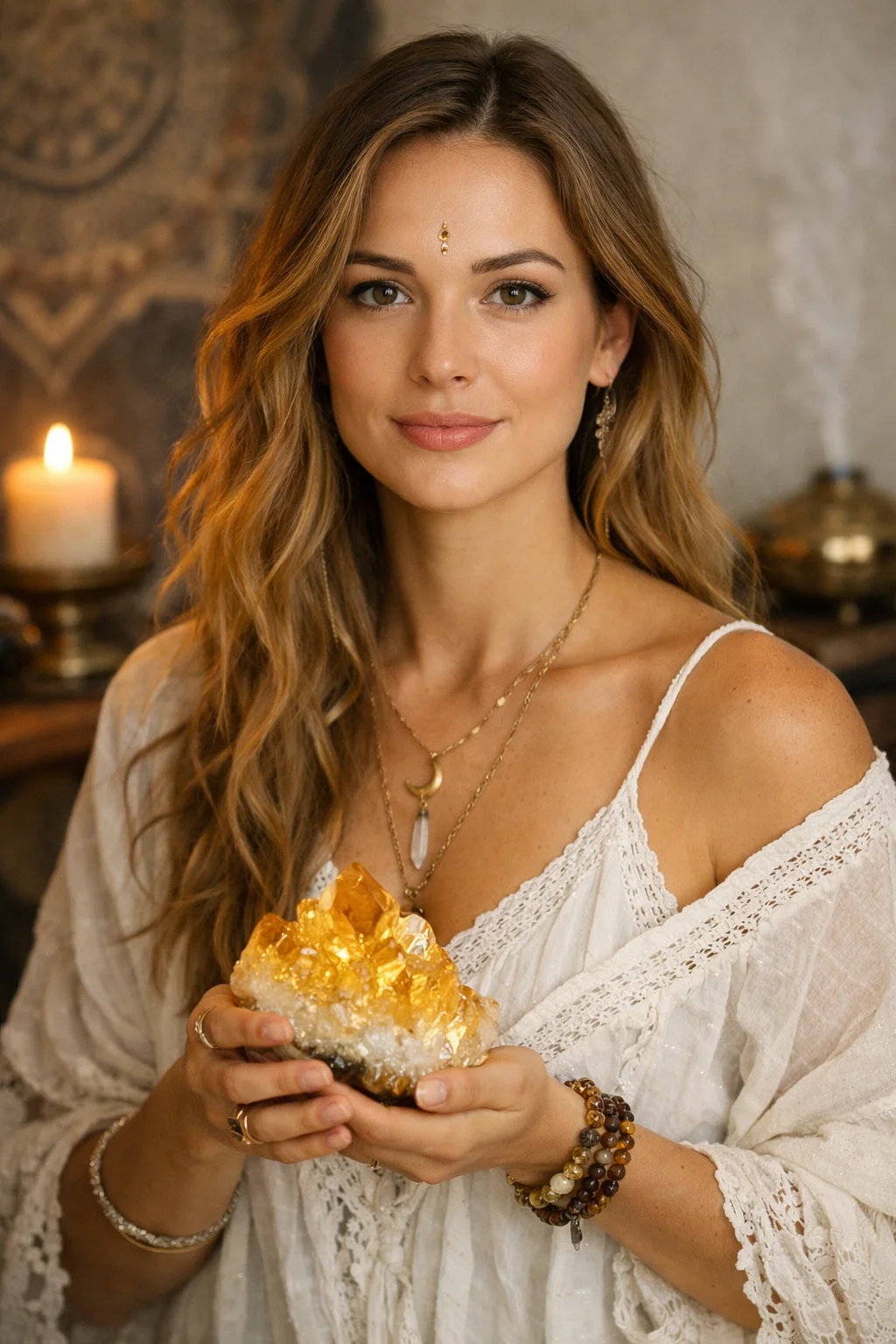
Aurora Vale
Hi, I'm Aurora Vale, the founder of Citrinefy and a passionate explorer of crystal energy and spiritual growth. I created this space to share my experiences with citrine, manifestation practices, and the deeper meanings behind crystals. Over the years, I’ve studied how gemstones can influence energy, mindset, and personal transformation. Citrine has always held a special place in my journey because of its strong association with abundance, confidence, and positivity. Through my writing, I hope to help others discover the uplifting energy of crystals, learn simple spiritual practices, and bring more clarity, balance, and abundance into their lives.