1. Under the Loupe: Dismantling the Geode Myth
The massive orange caverns dominating legacy markets are almost exclusively the result of industrial heat treatment (the Basaltic Geodes illusion). Use the Micro-Scanner below to physically explore the definitive structural differences between artificial baking and natural hydrothermal crystallization.
Industrial Heat Treatment (Baked Amethyst)
Visual Tell: Opaque white base transitioning abruptly to burnt orange tips. Under magnification, thermal shock reveals chaotic glass bubbles and stress fractures.
Natural Hydrothermal Crystallization
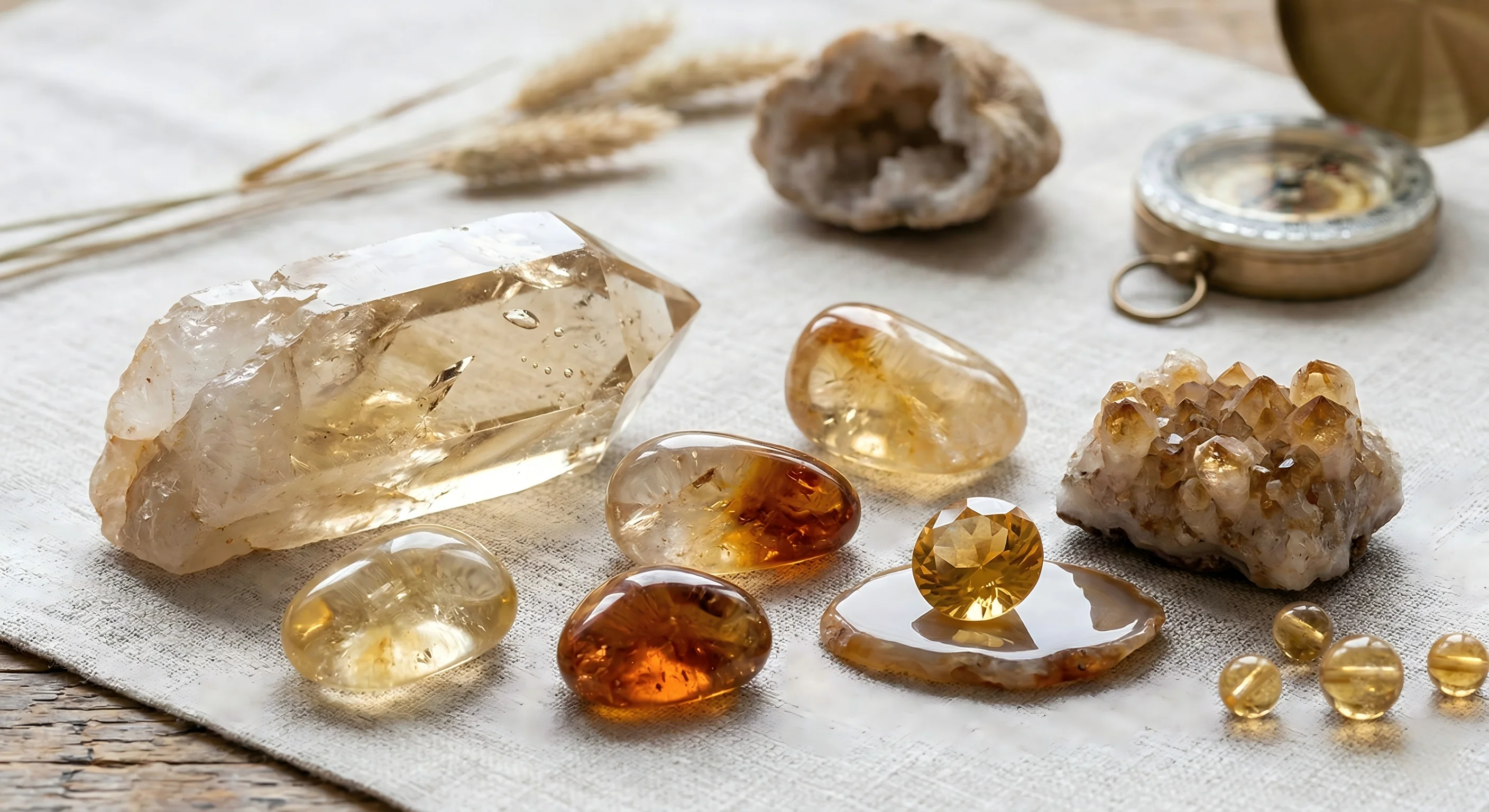
Visual Tell: Uniform, smoky-gold to amber transitions. Magnification reveals undisturbed parallel growth planes and complete absence of thermal stress.
Reality Check: The Ugly Truth About Commercial Ovens ▼
Let’s talk about the ovens. The standard industry practice, primarily localized in southern Brazil, involves taking low-grade amethyst geodes—those with pale, unmarketable purple hues—and heating them to roughly 470°C to 560°C. At this specific thermal threshold, the iron (Fe4+) impurities within the quartz lattice undergo a violent oxidation state change. The color flips to orange. It is highly efficient, highly scalable, and fundamentally destructive to the stone's integrity.
When you handle thousands of these specimens, as I have, you notice the tactile degradation immediately. You touch a baked tip, and it feels fundamentally different—brittle, almost chalky at the fracture points compared to the dense, slick conchoidal fracture of unheated quartz. The rapid heating causes microscopic water inclusions to boil and expand rapidly, creating thousands of microscopic stress fractures and glass-like bubbles inside the apex. This is exactly what the interactive scanner above simulates.
The tradeoff here is brutal. You are exchanging structural integrity for a cheap, highly saturated color. If you are sourcing for a high-traffic architectural installation, these baked geodes are a liability. I've watched the tips of massive commercial geodes sheer off under minimal impact during installation because the internal lattice was completely compromised by the thermal shock. Furthermore, natural crystals exhibit a phenomenon called pleochroism—they show slightly different colors when viewed from different crystallographic axes under polarized light. Baked amethyst is universally isotropic in its color zoning; it is a flat, dead orange from every angle. If you are aiming for sophisticated biophilic design, relying on these compromised structures is a foundational error.