Full Moon Purge Rituals: Releasing Ancestral Patterns
A full moon purge ritual is a symbolic reflection practice. You use the full moon as a clear marker to name what you are ready to stop carrying, write it down, release it through a simple action, and choose one grounded next step.
Here, Full Moon Subconscious Purge does not mean the moon cleanses your mind or proves that inherited patterns have been removed. It means you are giving language to beliefs, family stories, emotional habits, and repeated choices that may be shaping your life beneath ordinary attention.
Use this as self-inquiry, not as medical or mental-health advice. If the process brings up intense distress, traumatic memories, self-harm thoughts, addiction concerns, family violence, or difficulty functioning, pause and contact a qualified mental-health professional or appropriate crisis support.

broader context
Citrine verification note
This narrower page works best after the broader citrine reference page.
What “Full Moon Subconscious Purge” Means
“Subconscious purge” is strong ritual language. It can feel useful because it suggests that something hidden is finally being brought into view. Still, it is not a formal clinical method.
For this ritual, treat the phrase as spiritual shorthand for a reflective sequence:
- noticing a repeated pattern;
- naming the belief beneath it;
- asking where that belief may have been learned;
- choosing a symbolic release action;
- replacing the old story with a practical intention.
The full moon is used as a ritual cue, not as proof that lunar energy is causing change. Its brightness and monthly rhythm make it a natural symbol for illumination, completion, and release. That symbolism is enough for a personal practice.
“Ancestral patterns” also needs careful wording. In this article, it means inherited stories, family expectations, emotional scripts, money fears, loyalty binds, survival habits, or unspoken rules you may have absorbed from your family or cultural environment. It does not mean every pattern can be verified as biologically or spiritually inherited. It also does not mean blame belongs to your ancestors.
The purpose is simpler: bring compassion and choice to what has become automatic.
A Simple Full Moon Purge Ritual for Ancestral Patterns
You do not need elaborate tools. A candle, notebook, pen, water, and a safe way to dispose of paper are enough. If you use citrine, quartz, herbs, incense, or other symbolic objects, let them serve as focus points rather than proof of an outcome.
Choose a quiet time on or near the full moon. If exact lunar timing makes the practice stressful, use the nearest evening when you can be present.
1. Prepare the space
Clear a small surface: a desk, windowsill, table, or floor space. Place your notebook and any symbolic object nearby. If you light a candle or incense, do so safely.
“I am here to notice what I have been carrying, release what I no longer choose to repeat, and return to my body with one honest next step.”
This opening sets the scope. You are not trying to solve your entire lineage in one night. You are creating a contained moment of attention.
2. Name one pattern
Choose one pattern only. A full moon reflection ritual becomes muddy when it tries to release everything at once.
You might choose:
- a limiting belief such as “I am always behind” or “I have to earn love”;
- a vow of poverty such as “money makes people unsafe,” “I must struggle to be good,” or “wanting more is selfish”;
- a negative behavioral cycle such as overgiving, avoidance, emotional spending, silence during conflict, or returning to the same draining dynamic;
- an ancestral-pattern theme such as “women in my family carry everything,” “success creates rejection,” or “rest is only allowed after exhaustion.”
Write the pattern at the top of the page. Keep the wording plain. The clearer the sentence, the easier it is to work with.
3. Journal the inherited story
Now ask where the pattern may have come from. Do not force certainty. You are looking for possible roots, not courtroom evidence.
Use prompts like:
- “When did I first learn this might be true?”
- “Who modeled this belief, fear, or survival strategy?”
- “What did this pattern protect in my family system?”
- “What did people before me have to do to survive?”
- “How has this belief cost me energy, intimacy, money, creativity, or peace?”
- “What part of me still thinks this pattern is keeping me safe?”
For vows of poverty journaling, be specific. A “poverty vow” does not need to be a literal spoken oath. It may be a symbolic contract with struggle: a belief that safety, belonging, morality, or loyalty require you to stay small, underpaid, indebted, unseen, or afraid of receiving.
Write without turning the ritual into self-attack. Many limiting beliefs began as attempts to adapt. A pattern can be outdated and still deserve compassion.
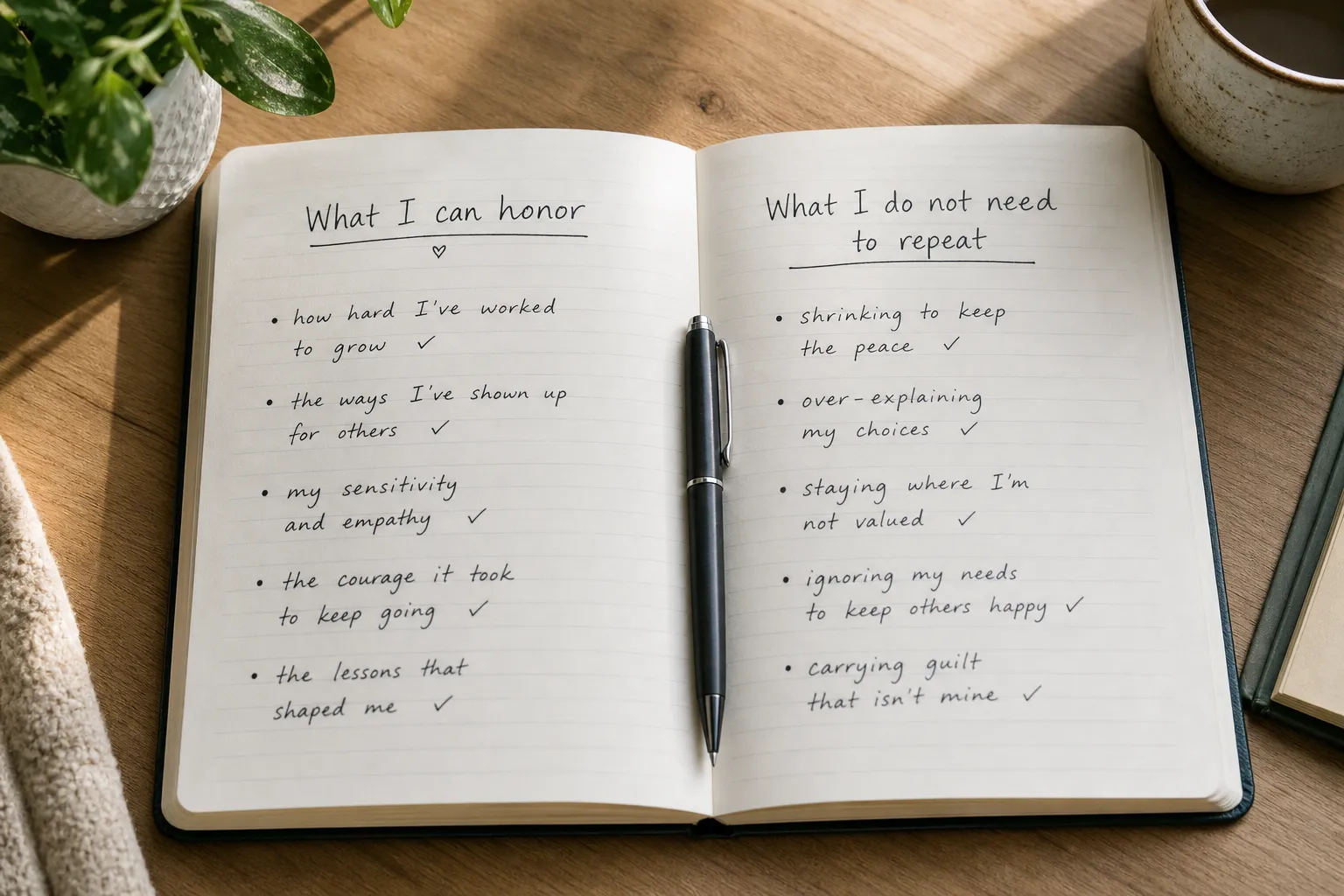
4. Separate the ancestor from the pattern
This step keeps ancestral work from becoming blame.
Write two short lists.
First: “What I can honor.”
- their endurance;
- their resourcefulness;
- their grief;
- their labor;
- their desire to protect the family;
- the conditions they survived.
Second: “What I do not need to repeat.”
- silence as loyalty;
- scarcity as identity;
- overwork as worth;
- fear of being visible;
- conflict avoidance;
- emotional numbness;
- passing shame forward.
This distinction is the heart of an ancestral patterns ritual. You are not rejecting your people. You are refusing to make repetition the only form of belonging.
5. Choose a symbolic release action
A symbolic full moon release should be physical enough to mark the moment and safe enough not to create harm.
You can:
- tear the paper into small pieces and place it in the trash;
- bury the paper in a plant pot if the ink and paper are safe for that use;
- fold the page away in an envelope labeled “released”;
- place your hand on your heart and exhale slowly while reading the release aloud;
- pour a glass of water into the sink while naming what you are letting go.
If you burn paper, use a fireproof container, stay present, keep water nearby, avoid windy spaces, and do not burn anything indoors without proper ventilation. Tearing paper is just as valid. The point is not drama; it is embodied completion.
“I release my agreement with this pattern as my only way to survive. I honor where it came from, and I choose not to keep feeding it.”
For a limiting beliefs ritual:
“I release the belief that I must remain small to stay safe.”
For a negative behavioral cycles ritual:
“I release the cycle of noticing too late, staying too long, and calling exhaustion devotion.”
For vows of poverty:
“I release the story that struggle is the price of belonging.”
Use language that feels true enough to say without forcing yourself to believe it perfectly.
6. Set a replacement intention
Release without replacement can leave the mind circling the old story. After the symbolic action, write one new intention that is emotionally honest and behaviorally possible.
Avoid declarations such as “I will never repeat this again.” Choose something you can practice.
Examples:
- “I allow stability to feel unfamiliar without calling it wrong.”
- “I can receive money without abandoning my values.”
- “I can rest before collapse.”
- “I can pause before saying yes.”
- “I can belong without carrying everyone’s pain.”
- “I can notice the pattern sooner next time.”
This is full moon intention setting in a release context: not a demand for instant transformation, but a direction for your next choices.
7. Ground after the ritual
Grounding after ritual matters because naming heavy patterns can stir the body, even when the practice is symbolic.
Try one or more of the following:
- drink water;
- eat something simple;
- wash your hands;
- press your feet into the floor;
- name five ordinary objects in the room;
- step outside and notice temperature, sound, and light;
- place the notebook away and do one practical task.
Then choose one small next action within 24 hours. This is where the ritual becomes integrated.
Examples:
- decline one unnecessary obligation;
- move a bill, budget note, or money task out of avoidance;
- send a clear message instead of staying silent;
- schedule rest before you are depleted;
- remove one object connected to an old identity;
- write one sentence you will practice when the pattern returns.
The ritual is the marker. The next action is the bridge.
When to Keep the Ritual Small
The practice changes depending on the intensity of the material you bring to it.
If you are working with a mild limiting belief, such as fear of visibility or a habit of procrastination, journaling and symbolic release may be enough for a meaningful evening of reflection.
If you are working with family grief, abuse history, addiction, self-harm thoughts, severe anxiety, or memories that overwhelm your body, do not try to force a “purge” alone. A spiritual reflective practice can sit beside qualified support, but it should not replace it.
If you are using “ancestral pattern” to describe cultural, racial, religious, migration, war, poverty, or family-violence history, move slowly. Keep your claims personal. You can say, “This story appears in my family,” or “I notice this fear in myself,” without making broad claims about an entire lineage or culture.
If you feel nothing during the ritual, that does not mean it failed. Some people experience symbolic work quietly. A calm realization, a practical decision, or a single honest sentence can be enough.
If you feel a rush of emotion, that also does not prove that something permanent has been cleared. It may simply mean the topic matters. Let emotion be information, not proof.
Common Confusion Around Full Moon Purge Rituals
One common confusion is treating the full moon as the active force doing the work. A clearer framing is this: the moon gives the practice rhythm and symbolism; your attention, language, choices, and follow-through give it personal meaning.
Another confusion is treating “vows of poverty” as if every money struggle comes from a hidden spiritual contract. That can become simplistic and unfair. Financial patterns may involve family beliefs, education, wages, debt, discrimination, health, local costs, caregiving, and many other real-world conditions. In ritual language, a poverty vow is best used as a journaling symbol for internalized scarcity, shame around receiving, or loyalty to struggle—not as a complete explanation for material circumstances.
A third confusion is assuming that shadow work, ancestral release, and therapy are interchangeable. They are not. Ritual can help you reflect, grieve, mark a transition, or choose a new behavior. It is not the same as professional mental-health care, medical care, trauma care, or crisis support.
Finally, a full moon subliminal, affirmation track, or guided audio should not be treated as a shortcut that bypasses discernment. If you use audio, choose words that support agency and grounded reflection. Avoid anything that encourages fear, dependency, grand promises, or pressure to override your own judgment.
A Compact Ritual Script
If you want the simplest version, use this sequence.
- Light or mark the beginning. “I enter this practice for reflection, release, and grounded choice.”
- Name one pattern. “The pattern I am noticing is…”
- Write the inherited story. “I may have learned this from…” “It may have protected…” “It now costs me…”
- Honor and separate. “I honor the survival behind this pattern. I do not choose to repeat it as my future.”
- Release symbolically. Tear, fold, discard, pour water, or speak the release.
- Set one replacement intention. “The new practice I choose is…”
- Ground and act. Drink water, feel your feet, put the materials away, and take one small real-world step.
That is enough. A full moon purge ritual does not need to be elaborate to be sincere.
The Real Limit of the Practice
The available sources do not show that full moon rituals cause subconscious change, clear ancestral patterns, remove poverty vows, or stop negative behavioral cycles. Contemporary moon-circle research can describe how some people use moon-aligned rituals for meditation, bodily attention, discussion, and self-reflection. Spiritual and transpersonal writing can show that people use lineage language to explore grief, compassion, and meaning. Those contexts help explain why the practice feels resonant for some readers, but they do not make it a guaranteed process.
The strongest version of this ritual is modest: it is a structured way to notice what you have been repeating, give symbolic form to what you are ready to release, and choose a next action that does not feed the old pattern.
That modesty does not make it empty. Naming a limiting belief can interrupt automatic behavior. Writing an inherited story can soften shame. A symbolic release action can mark a threshold. Grounding can bring the practice back into the body. A small next step can keep the ritual from becoming only atmosphere.
Use the full moon as a mirror, not a promise. Let it illuminate the pattern. Let the page hold the words. Let the release be symbolic. Then let your next ordinary choice show what you are no longer willing to carry.