The 2026 Color Metrics: Distinguishing Madeira vs. Palmeira Citrine
In seller language, Madeira vs Palmeira citrine is usually a color comparison, not a formal gemological grade.
Madeira citrine generally means a deeper warm-orange look: golden orange, amber orange, reddish orange, or sometimes reddish brown. Palmeira citrine—also written as Palmeria in some listings—usually means a brighter orange look with less brown in the face-up impression.
That is the useful distinction. The limit matters just as much: neither name proves natural origin, untreated status, locality, rarity, or value.
A practical 2026 reading is simple: Madeira describes a darker, richer orange color branch; Palmeira/Palmeria describes a brighter orange color branch; both are trade shorthand.
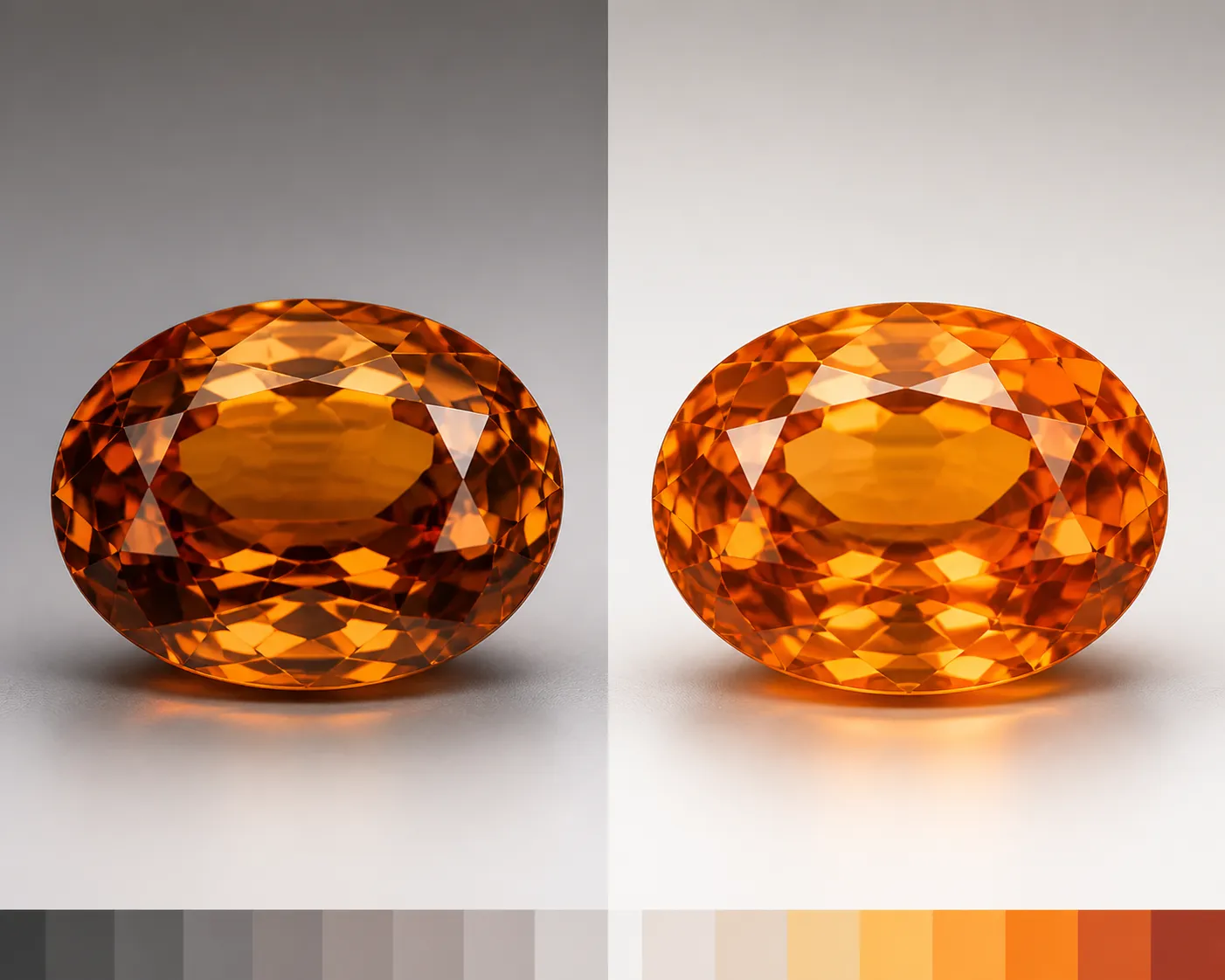
Quick visual comparison
| Label in a listing | What sellers usually mean | Common color impression | What the label does not prove |
|---|---|---|---|
| Madeira citrine | Deeper warm-orange branch | Golden orange, amber orange, reddish orange, reddish brown | Natural origin, untreated status, geographic source, fixed grade |
| Palmeira / Palmeria citrine | Brighter orange branch | Vivid orange, clearer orange, less brown than Madeira | Official category, higher value, untreated status, rarity |
The Madeira citrine color difference is mostly about depth and warmth. It may look autumnal, burnished, reddish, or brown-orange, especially in darker stones or deeper cuts.
The Palmeira citrine color difference is mostly about brightness and orange clarity. The seller is usually trying to describe a livelier orange rather than a smoky, ambered, or brownish-orange look.
This is where citrine hue saturation is more useful than the name alone. Hue tells you whether the stone leans yellow, orange, red-orange, or brown-orange. Saturation tells you how strong that color appears. Tone tells you whether the stone reads light, medium, or dark. Madeira and Palmeira compress those qualities into retail-friendly names, but they do not replace direct color observation.
Why these names work better as color branches than grades
A grade needs shared rules, repeatable boundaries, and consistent use. Public reference coverage does not support treating Madeira and Palmeira citrine as official universal grades.
What is better supported is a looser trade pattern. Sellers use named color branches to make citrine colors easier to describe. Madeira is the better-known trade name and is commonly attached to deeper orange, reddish orange, or reddish-brown citrine. Palmeira or Palmeria appears less consistent and is usually used around bright orange material.
The spelling variation is worth noticing. If one listing says “Palmeira citrine” and another says “Palmeria citrine,” that does not automatically mean two different gem categories. It may reflect seller wording, translation, branding, or simple inconsistency.
For this page’s question, the useful framework is:
- Madeira citrine trade name: usually deeper golden-orange to reddish-brown.
- Palmeira citrine trade name: usually brighter, vivid orange.
- Neither label: a verified laboratory category.
- Neither spelling: proof of source, treatment, rarity, or value.
What can change the apparent color difference
The Madeira-versus-Palmeira distinction sounds clean until the stone is photographed, cut, lit, and described by a seller. Several ordinary factors can make the same citrine look closer to one branch or the other.
Lighting can shift the impression
Warm indoor light can make citrine look more amber, honeyed, or reddish. Cooler daylight may make the same stone look yellower or less dense. A Madeira-labeled stone can look richly reddish in one image and simply dark orange in another. A Palmeira-labeled stone can look vivid in a bright product photo and softer in diffuse natural light.
That does not automatically mean the label is wrong. It means color names are sensitive to viewing conditions.
Cut depth affects tone
A deeper cut can concentrate color and make citrine look darker or more reddish-brown. A more open cut may make orange appear brighter, lighter, or clearer. That can push the visual impression toward “Madeira” or “Palmeira” even when the underlying material is not dramatically different.
When comparing two stones, do not compare label to label only. Compare the face-up color, the edge areas, and any darker zones where the cut gathers color.
Brown modifiers matter
A bright orange stone and a deep amber-orange stone may both be called “rich” in sales copy. The more useful question is: does the color stay clearly orange, or does it move into brownish orange?
Madeira language often allows, and sometimes emphasizes, deeper amber-to-reddish-brown warmth. Palmeira language usually points toward a cleaner, brighter orange impression.
Product photos can over-flatter color
Gemstone photos are often made under controlled lighting with favorable backgrounds. Color can look more even, more saturated, or less brown than it appears in hand. A trade name should be read as a clue, not as a measurement.
If a listing gives only a romantic color name, with no neutral photos, no treatment disclosure, and no documentation for stronger claims, the name is carrying more weight than it should.
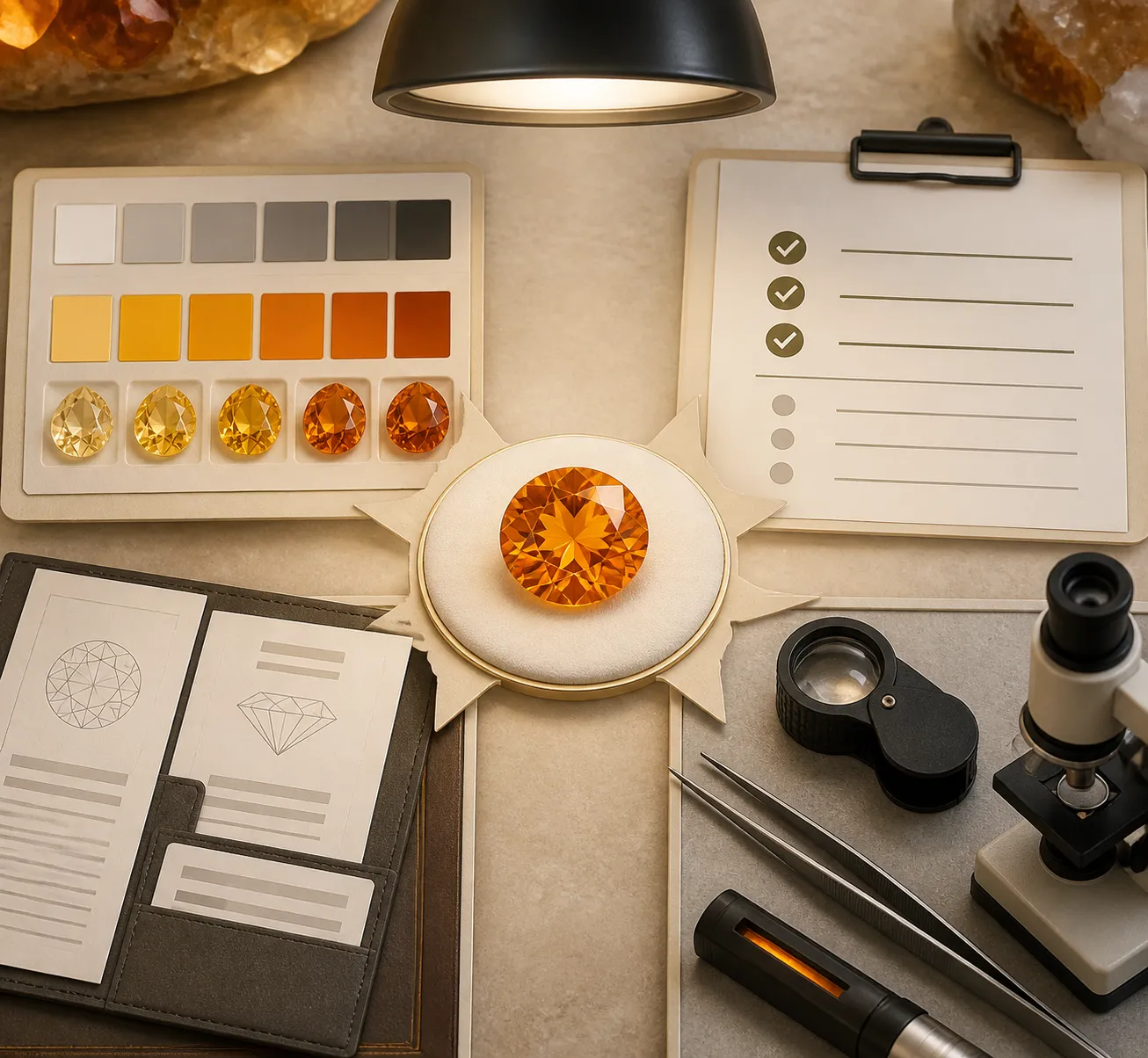
Treatment, origin, and value are separate questions
One common mistake is to treat a darker or more desirable color name as proof that the stone is natural or more important. A Madeira label does not establish that. A Palmeira label does not establish the opposite.
Citrine color in quartz is tied to color centers and can also be affected by heating processes. Gemological education sources note that natural citrine is relatively uncommon in the market and that much commercial citrine is produced by heat treatment of amethyst or smoky quartz. For a shopper, the key point is straightforward: color appearance alone cannot tell you whether citrine is natural, treated, synthetic, or misrepresented.
A Madeira color branch may be natural or treated. A bright orange Palmeira/Palmeria-labeled stone may also be natural or treated. The label does not settle that question.
The same applies to origin. “Madeira” should not be read as proof that the citrine comes from Madeira, Brazil, Portugal, or any particular mine. In this context, it is best handled as a trade color name. If a listing makes a geographic claim, it needs separate support.
Value is separate too. Color can influence appeal and pricing language, but a fixed hierarchy cannot be inferred from Madeira versus Palmeira alone. Size, clarity, cut, color distribution, treatment disclosure, documentation, and seller context all affect how a stone is presented in the 2026 gemstone market.
Common naming traps
“Madeira Topaz” can create confusion
Citrine and topaz are different gem materials. If a citrine listing uses topaz-like wording, the safest reading is that the seller may be using a color comparison or older-style trade language, not identifying the stone as topaz.
If a listing blurs citrine and topaz, clarify the gem identity before relying on any value or authenticity claim.
“Madeira citrine vs citrine” is not species versus species
Madeira citrine is not a separate mineral species from citrine. It is a named color style within citrine market language. A pale yellow citrine and a Madeira-labeled citrine may both be quartz-family citrine; the difference being described is the visible color branch.
“Palmeira” may be a label, spelling variant, or sales convention
Because Palmeira/Palmeria is not consistently established as a formal category, ask what the seller means in visible terms: bright orange, vivid orange, medium tone, high saturation, or low brown modifier. The plain color description is more useful than the name.
Symbolic language does not verify the stone
Some listings mix Madeira citrine meaning, mood language, or symbolic descriptions with color names. That may explain the marketing tone, but it does not verify identity, treatment status, origin, or quality.
A compact checklist for comparing listings
Use this when a listing gives you Madeira or Palmeira but little else.
- Start with the color branch. Madeira should read deeper, warmer, amber-orange to reddish-brown. Palmeira/Palmeria should read brighter orange.
- Separate hue from tone. A stone can be orange and dark; another can be orange and bright.
- Look for brown modifiers. Brownish orange usually pushes the description toward Madeira language.
- Notice spelling variation. Palmeira and Palmeria may be inconsistent retail wording, not separate official labels.
- Do not infer treatment. Ask for disclosure or verification if natural versus treated status matters.
- Do not infer origin. A color name is not a locality report.
- Treat price language carefully. Premium naming can support a sales narrative, but it is not a standardized market metric.
Bottom line
For Madeira citrine vs Palmeira citrine, the answer is visual but bounded.
Madeira usually means a darker, richer warm-orange branch: golden orange, amber orange, reddish orange, or reddish brown. Palmeira/Palmeria usually means a brighter orange branch with a livelier face-up impression.
The mistake is letting those names do more than they can. They are useful color shorthand, not universal grades, lab determinations, origin labels, treatment disclosures, or value guarantees. If the question is color, the labels can orient you. If the question is naturalness, value, rarity, or authenticity, the answer has to come from disclosure, documentation, and qualified gemological verification—not from the name alone.