Beyond Paper: Holographically Activating Your 2026 Vision Board
To “holographically activate” a 2026 vision board, use the phrase as ritual language, not as a scientific claim. You are giving the board depth, direction, and a way to pull your attention back to what matters.
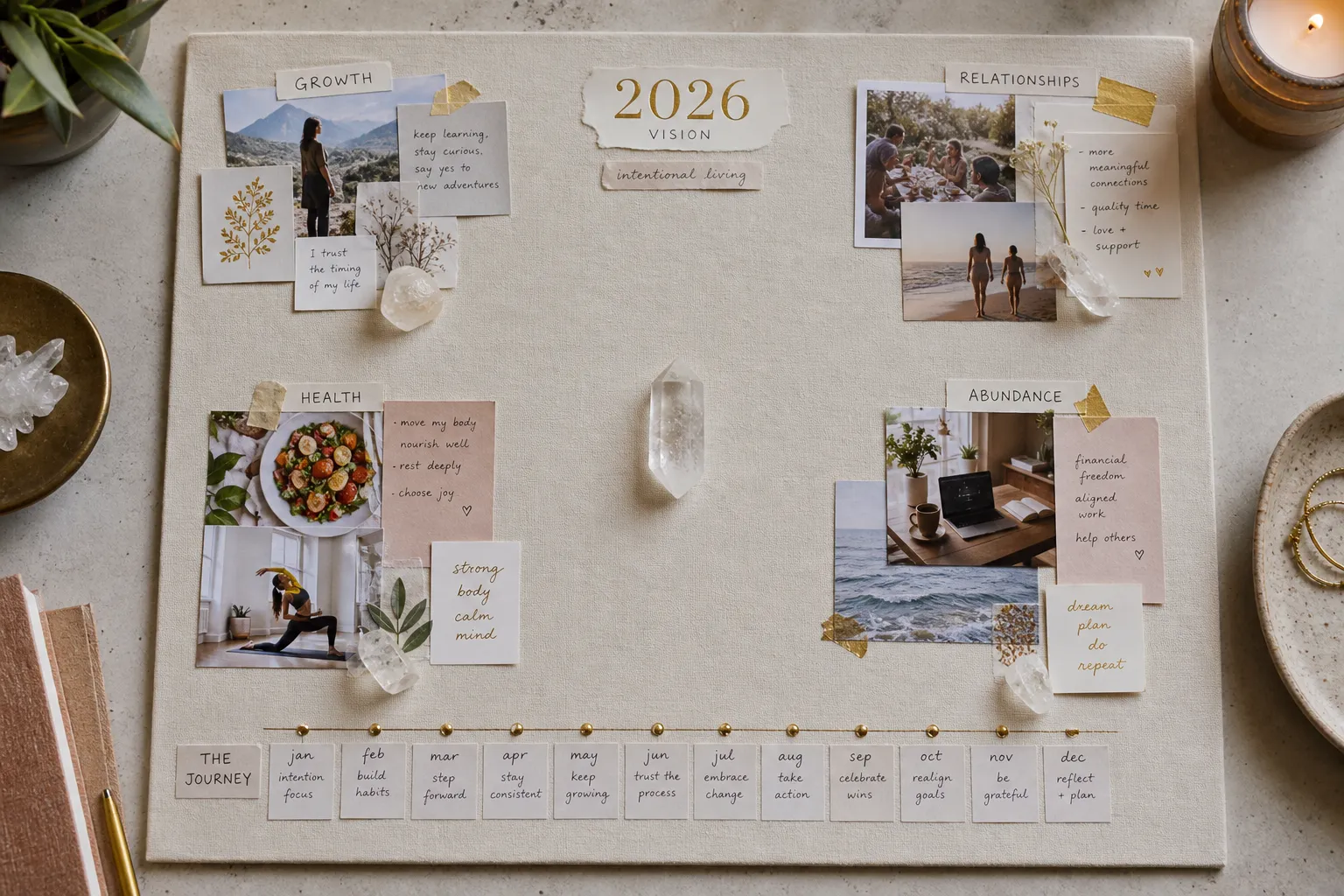
The most useful form of Vision Board Crystal Anchor Placement is simple: place one clear quartz point at the center for your main 2026 intention, use corners or edges for major life areas, add smaller anchors only near priority images, and connect each anchor to one small action. The crystals become symbolic focal points and visual cues. The board works best when it is clear enough to review, meaningful enough to return to, and flexible enough to change.
broader context
Citrine verification note
This narrower page works best after the broader citrine reference page.
The placement map: center, corners, timeline, priority images
A crystal-anchored vision board does not need to become a complicated grid. The placement should help your eye know where to land.
Start with a 2026 vision board theme before you attach anything. It might be “steadier creative work,” “home and belonging,” “cleaner money habits,” “study and skill,” “more spacious relationships,” or “a year of rebuilding energy.” The theme is not a prediction. It is the sentence the board keeps returning you to.
1. Center anchor for the main intention
Place one clear quartz point, tumbled quartz, citrine, or another personally meaningful stone near the center of the board. If you use a clear quartz point, aim it toward the image or phrase that represents your main intention.
This is your center anchor: the first place your eyes return.
Clear quartz points are often used in crystal communities as symbols of clarity, focus, and amplification. For this board, keep that meaning symbolic. The point does not make the goal happen; it marks the goal so your attention can find it quickly.
Under or beside the center anchor, write one sentence:
- “In 2026, I am practicing…”
- “This year, I return to…”
- “My main intention is…”
That sentence keeps the center from becoming decoration only.
2. Corner anchors for life areas
Use the four corners for broad categories such as work, home, body routines, relationships, money, learning, creativity, travel, or inner life. You do not need four if your year is quieter. Two strong corners are better than four vague ones.
Top left
Anchor role: Growth or learning
Example: A small quartz chip near a book, course, or skill image
Top right
Anchor role: Work, visibility, or creative output
Example: A point aimed toward a project, portfolio, or studio image
Bottom left
Anchor role: Home, grounding, or relationships
Example: A rounded stone near a room, table, family, or community image
Bottom right
Anchor role: Money, logistics, or body routines
Example: A small marker near a budget note, calendar, walking path, or meal image
Corner anchors help the board become a spatial map instead of a random collage. When you look at the board, each corner has a job.
3. Edge or timeline anchors for transitions
If your 2026 has phases, place small anchors along one edge as a timeline. For example:
- January–March: clearing, planning, recovery
- April–June: learning, testing, outreach
- July–September: building, travel, visible work
- October–December: integration, review, simplification
These timeline anchors work well with small stones, beads, crystal chips, metallic dots, or drawn crystal shapes. The point is not to predict the year perfectly. It is to give transitions a visible place.
If an anchor marks a transition, add a verb beside it: “apply,” “practice,” “save,” “rest,” “edit,” “ask,” “publish,” “repair,” or “visit.” A timeline with verbs becomes easier to use during review.
4. Small quartz points for priority images
Not every image needs a crystal. Reserve smaller anchors for the images that carry emotional weight and practical relevance: the studio you want to use, the trip you are preparing for, the walking trail that represents consistency, the dinner table that represents connection, the desk that represents study.
A clear quartz vision board anchor can sit beside a key image, point toward it, or be represented as a flat drawing or sticker. Each priority image should answer two questions:
- Why does this matter to me in 2026?
- What is one micro-action that supports it?
That second question is where the board becomes useful.
Choosing crystal anchors without overstating them
The best anchor is not the rarest or most expensive stone. For this purpose, it needs to be visible, meaningful, and practical to place.
Clear quartz points work well because their shape gives direction. A point can aim toward a phrase, image, or zone. If the board is framed behind glass or kept vertical, use flat quartz chips, printed crystal images, metallic stickers, or drawn point shapes instead of heavy loose stones.
Other crystals can work if their symbolic meaning helps you remember the board’s structure:
- Smoky quartz for grounding
- Citrine for value, visibility, or confidence
- Rose quartz for tenderness or relationship repair
- Amethyst for reflection or quiet
These meanings are cultural and personal. Treat them as symbolic language, not as evidence that a stone produces an external result.
For a clean board, use fewer anchors than you want to. A strong arrangement might include:
- 1 center clear quartz point
- 2–4 corner anchors
- 3–5 priority-image markers
- 2–4 timeline markers, if your year has phases
That is enough. If every image has a stone, no image is truly prioritized.
Also keep the physical board sensible. Do not overload paper with heavy crystals. Use a corkboard, shadow box, shelf ledge, or small pouch attached near the board if you want real stones. If the board hangs above a bed, desk, or walkway, avoid anything that could fall. A crystal anchor can be symbolic and still work as a visual cue.
“Cognitive anchoring,” said plainly
In wellness and manifestation spaces, “cognitive anchoring” is sometimes used in very expansive ways. For this board, keep it modest: a repeated visual cue can help you notice, remember, and return to a chosen intention.
That is enough.
A vision board is a visual environment. Placement, proximity, size, contrast, and personal meaning can affect where your eye returns. A central stone, a bright label, or a repeated marker can make a priority easier to find again. Grouping related images near the same anchor also makes the board easier to read.
This does not mean the board changes reality on schedule. It means the board can serve as a designed reminder system. You are using crystal anchors as visual cues: a way to reduce visual noise and create return points.
A useful anchor has three parts:
- 1. A visible marker — the crystal, crystal image, drawn point, or metallic dot.
- 2. A meaning label — a word or short phrase that explains why it is there.
- 3. A next action — one small behavior connected to the intention.
For example:
- Center quartz: “Steady creative work” → write for 25 minutes three mornings a week.
- Corner anchor: “Home” → clear one shelf each Sunday.
- Timeline anchor: “June transition” → review travel documents or savings plan.
- Priority image marker: “Skill” → complete one lesson before adding new courses.
This is the practical heart of visual manifestation as a personal practice: not a promise of results, but a visible bridge between desire, identity, and behavior.
A grounded placement ritual for 2026
If you enjoy New Year ritual, let the process feel beautiful. The boundary is simple: make the ritual support clarity, not replace action.
Before assembling the board, lay out your images and crystals on a table. Remove images that only look impressive but do not feel emotionally meaningful. Aspirational images can be useful, but they become visual noise when they are disconnected from your actual life.
Build the board in this order:
Choose the central sentence.
Write your main 2026 intention before placing the center crystal. If the sentence feels too abstract, revise it until it points toward real life.
Place the center anchor.
Put the clear quartz point beside or above the sentence. If the point has a direction, aim it toward the strongest image.
Group the life areas.
Arrange the board into clear zones. Keep related images close together so each anchor “holds” a category.
Add only the most important crystal markers.
Mark the images that deserve repeated attention. Leave supporting images unmarked.
Label each anchor.
A small label can do more than a dramatic caption. Try words like “practice,” “home,” “repair,” “publish,” “save,” “ask,” “move,” “study,” “rest,” or “finish.”
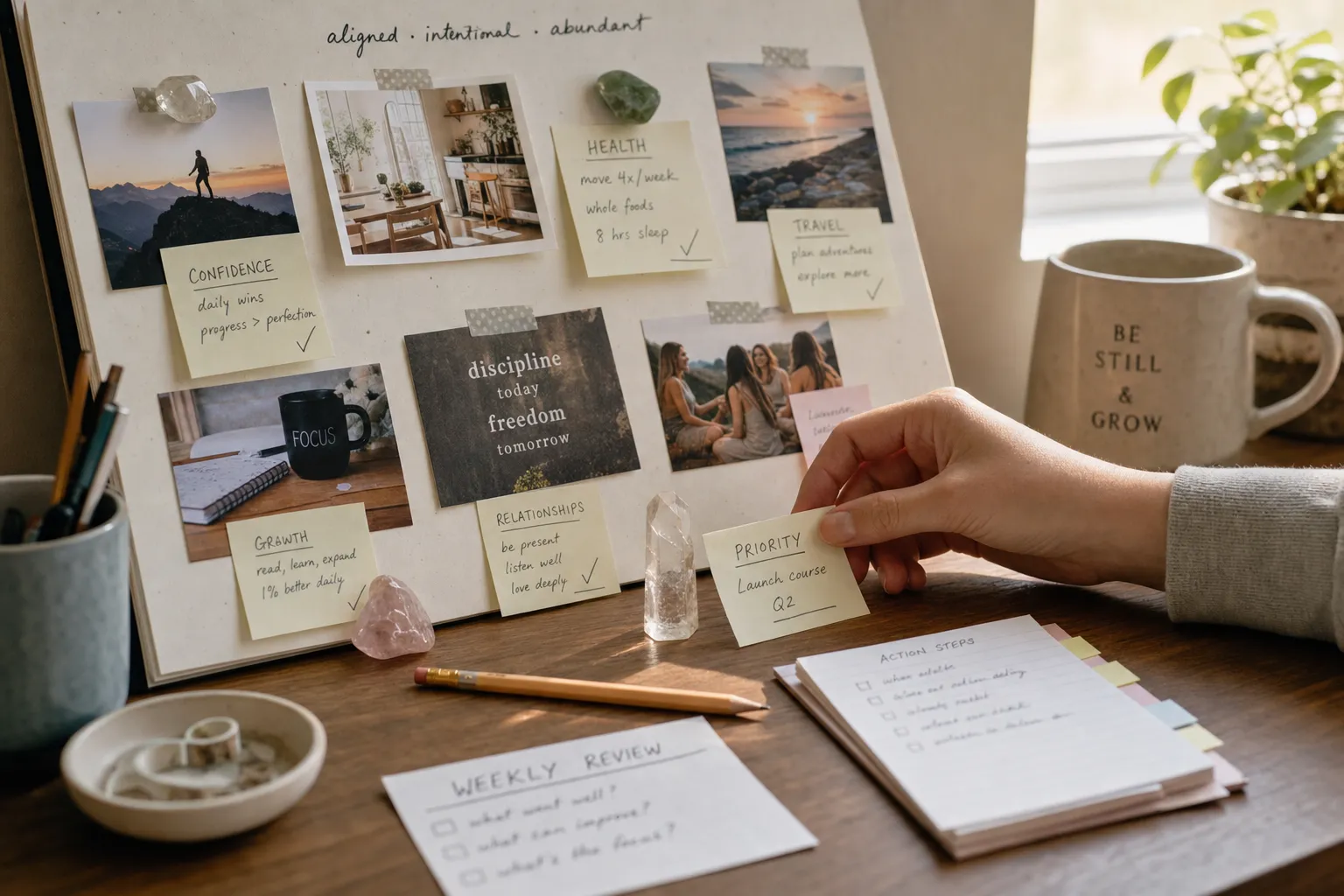
Pair anchors with micro-actions.
Under each major anchor, write one step concrete enough to do within a day or a week.
This keeps the board from becoming passive. The crystals are not doing the work for you; they are helping you remember where your work, care, or attention belongs.
What changes the best layout
There is no single correct visual manifestation board layout. The best placement depends on how you read images and what kind of year you are planning.
If your 2026 has one dominant theme, use a strong center and fewer corner anchors. A board for “finish the manuscript,” “build a home routine,” or “restore financial steadiness” may need one main image cluster rather than many categories.
If your year has several parallel priorities, a quadrant layout may work better. Each corner can hold one life area, with the center crystal reminding you of the theme connecting them.
If your year is likely to change in stages, use a timeline edge. This works for school years, moving plans, launches, seasonal work, travel planning, or any goal with visible transitions.
If your goals feel tender, make the board quieter. Use softer colors, fewer images, and fewer stones. A board does not have to be loud to be meaningful.
If you are easily overwhelmed by visual clutter, choose one anchor per zone and leave more blank space. A simple board you can review daily is more useful than a beautiful board you avoid looking at.
Daily review: how the anchors become functional
A crystal-anchored board becomes more useful through repetition. This does not require a long ceremony.
A daily vision board review can take less than a minute:
- 1. Look at the center anchor.
- 2. Read the main 2026 intention.
- 3. Let your eyes move to one corner or priority image.
- 4. Name one micro-action for today.
- 5. Do it, schedule it, or consciously decide why it is not the right day.
A weekly review can go a little deeper:
- Which anchor did I ignore this week?
- Which image still feels alive?
- Which goal has become performative rather than honest?
- What small action actually moved something forward?
- Does any anchor need to move, shrink, or come off the board?
A 2026 vision board should be a living tool, not a sealed contract. If a goal changes, move the crystal. If a priority is complete, shift the anchor to the next step. If an image stops feeling true, remove it without treating that as failure.
Revising vision board priorities is not a lack of faith. It is maintenance.
Common misunderstanding: activation, manifestation, and limits
“Activation” is useful if it means, “I arranged this board so it prompts attention and action.” It becomes misleading if it is treated as a measurable force that produces the outcome.
Likewise, visual manifestation can be a meaningful personal phrase when it describes imagining, symbolizing, and returning to a desired direction. It should not be used as a claim that visualization alone creates career results, relationship changes, health outcomes, or financial success.
The available evidence for this specific practice is limited. There is no strong public evidence base showing that clear quartz vision board anchors create outcomes or that one crystal placement method works better than another. The grounded claims are narrower: visible objects can serve as attention cues; spatial organization can make a display easier to revisit; personally meaningful images can support reflection; repeated review can help keep intentions and next actions visible.
That boundary does not make the ritual empty. It makes it cleaner. Your board can be beautiful, symbolic, and emotionally charged without pretending to be a scientific instrument.
A concise 2026 crystal anchor checklist
Use this before you finish the board:
- Is there one clear center anchor for the main 2026 intention?
- Are the life areas grouped clearly instead of scattered?
- Do corner anchors mark real categories, not vague aesthetics?
- Are timeline anchors used only if the year has meaningful phases?
- Do small quartz points highlight true priorities rather than every pretty image?
- Does each anchor have a label or reason?
- Is each major anchor paired with one micro-action?
- Can the board be reviewed in under one minute?
- Can stones be safely attached, displayed, or represented without falling?
- Is the board easy to revise as the year changes?
If the answer is yes, your board is “activated” in the most grounded sense: the layout now carries intention, memory, beauty, and follow-through in one visible place.