Stop Buying Fake Natural Citrine: Visual Clues for Heat-Treated Amethyst
If a piece sold as “natural citrine” is vivid orange, burnt orange, or orange-brown, especially with a white quartz base, orange tips, geode form, or a surprisingly low price, slow down before buying. Those clues often fit the market profile of heat-treated amethyst being sold as citrine.
They do not prove misconduct. They also do not mean the stone is worthless. Heat-treated amethyst is real quartz, and many people like its color. The issue is disclosure: a seller should not let buyers believe they are purchasing natural untreated citrine if the material is actually treated amethyst.
Use visual clues as red flags, not final proof. They can help you decide when to ask for clearer labeling, treatment disclosure, or documentation.
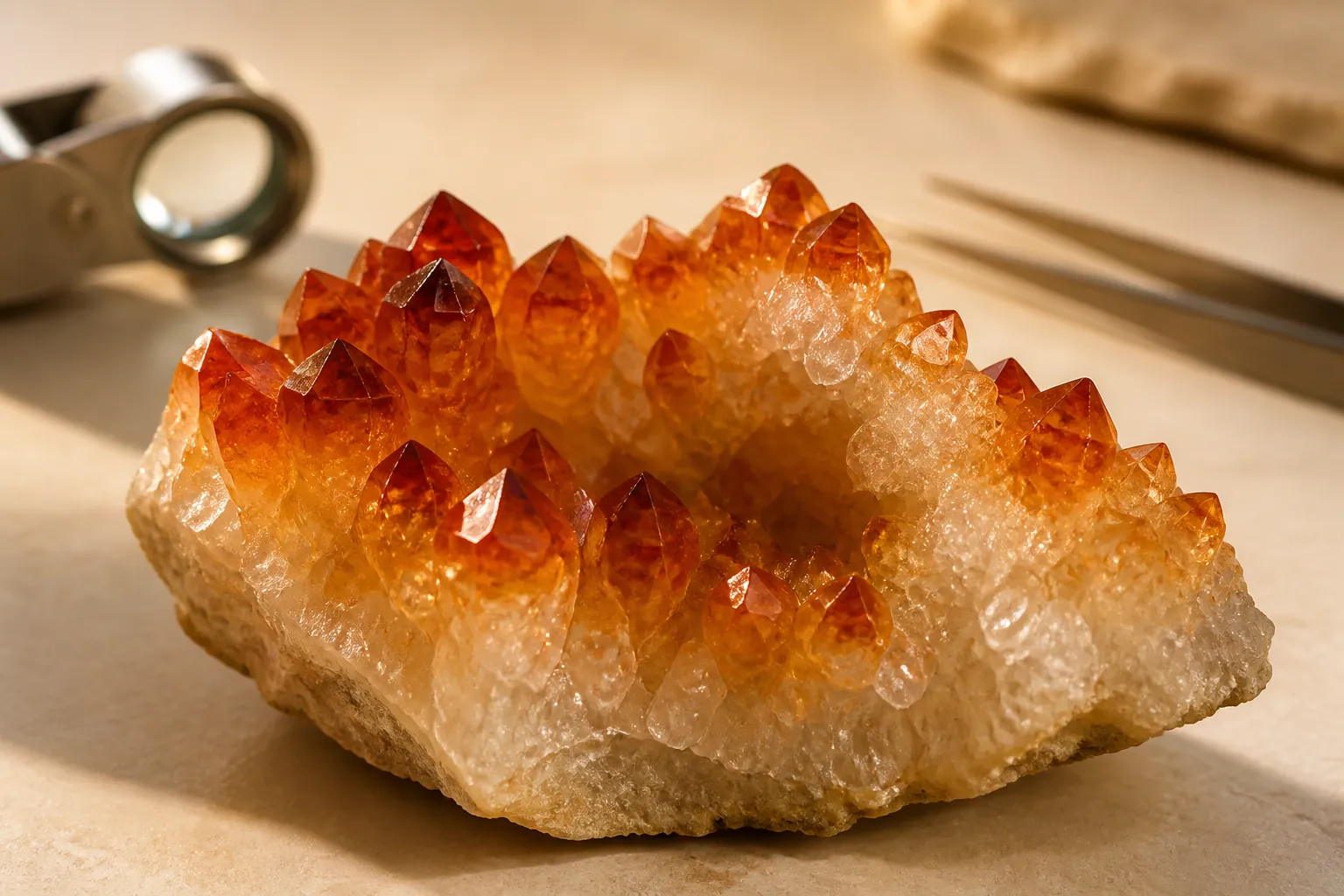
What “fake citrine” usually means here
In this buying situation, “fake citrine” usually does not mean glass, plastic, or resin. More often, shoppers are worried about amethyst that has been heated until it turns yellow, orange, or brownish yellow, then listed simply as “citrine,” “natural citrine,” or “untreated citrine.”
That distinction matters. Heat-treated amethyst and natural untreated citrine are both quartz, but they are different buying claims. A treated quartz specimen can be attractive and legitimate when it is labeled honestly. The problem starts when the listing makes treated material sound like untreated natural citrine.
Practical buying question
Do the visible features and seller wording fit heat-treated amethyst strongly enough that I should ask for disclosure?
The visual red flags to check first
Use these clues together. One feature can be innocent. Several in the same piece should make you more cautious.
1. Vivid orange, reddish orange, or burnt-orange color
Natural untreated citrine is often more restrained in appearance: pale yellow, smoky yellow, golden, honeyed, or brownish golden. It can vary, and color alone is not enough to identify treatment.
Still, very saturated pumpkin-orange, reddish orange, or scorched-looking orange is one of the most common reasons buyers suspect heated amethyst. This is especially true when the color is strongest at the points or looks darker and browner in concentrated zones.
A useful buying rule: bright orange is not proof of heat treatment, but it should cancel automatic trust in the word “natural.”
2. White or colorless base with orange tips
Many rough points and clusters sold as citrine show a familiar pattern: a milky white or colorless quartz base with yellow, orange, or orange-brown concentrated near the tips.
That “white base, orange tips” look is a major red flag in fake citrine identification because it resembles the way some amethyst clusters carry stronger color in selected growth zones. If that amethyst is heated, the new color may remain concentrated in those same areas.
The limit: quartz can naturally show zoning, cloudiness, and uneven color. A white base does not prove treatment. But if a white-based orange cluster is advertised as natural untreated citrine, it is fair to ask what supports that claim.
3. Amethyst-like color zoning
Color zoning identification is one of the better visual habits for citrine buyers. Look for uneven bands, patches, phantom-like zones, or color concentrated near crystal points.
In polished stones, zoning may appear as irregular flashes or deeper yellow-orange areas. In rough clusters, it may look like the color sits mainly where amethyst would often show stronger purple.
Zoning does not give a final answer. Quartz color can be complex, and different histories can lead to similar appearances. But if the piece looks like an altered amethyst cluster rather than evenly colored citrine, the treatment status deserves a direct question.
4. Bright orange “citrine geodes”
A bright orange geode labeled citrine is one of the strongest retail warning signs.
Many shoppers see these as dramatic cave-like clusters: pale or white quartz interiors with intense orange crystal points. They may be sold as “citrine geodes,” “natural citrine caves,” or large citrine clusters.
The concern is form plus color. Geodes and clusters strongly overlap with the way amethyst is commonly sold. When that same form appears in hot orange or orange-brown, the safer buying assumption is not “rare untreated citrine.” It is: this may be heat-treated amethyst, and the seller should say whether it is treated.
5. Low price paired with “natural untreated” claims
Price is not a test. There is no universal price line that separates natural untreated citrine from treated quartz. Size, clarity, cutting, source, seller type, and condition all affect price.
But a very inexpensive orange cluster loudly described as “natural untreated citrine” should raise questions if it also shows the visual red flags above.
A low-cost orange piece honestly labeled as heat-treated amethyst is one thing. A similar piece promoted as natural untreated citrine, with no disclosure and no documentation, is making a stronger claim.
Heat-treated amethyst vs natural citrine: quick comparison
Think of this table as a triage tool. It helps you decide whether to trust the listing, ask follow-up questions, or walk away.
Seller wording that deserves a second look
Many confusing listings are vague rather than openly hostile to the buyer. A seller may use “citrine” as a broad retail label for yellow-orange quartz, while the buyer reads it as natural untreated citrine.
Watch for wording such as:
- “Natural citrine” with no treatment information
- “Heat-treated citrine” without saying what material was heated
- “Citrine from amethyst” hidden low in the description
- “Baked amethyst” or “cooked amethyst” used casually while priced like natural citrine
- Color trade names presented as if they prove natural origin
- “Genuine citrine” without clear untreated or treatment-disclosed language
The phrase “heat-treated citrine” is especially unclear. It might mean citrine that has been heated, or it might mean amethyst heated until it resembles citrine. For this buying problem, clearer language would be “heat-treated amethyst sold as citrine” or “heated amethyst citrine.”
If the seller knows the material is treated, the listing should say so plainly. If the seller does not know, that uncertainty should be reflected instead of replaced with confident wording.
What visual clues cannot prove
Visual identification has a hard ceiling. It can point toward likely heat-treated amethyst, but it cannot reliably confirm natural untreated origin.
Two quartz pieces can look similar while having different histories. Treated material can sometimes look subtle, and natural material can show uneven color. That is why serious identification may require seller disclosure, supporting documentation, or professional gemological testing.
Be careful with shortcuts. A phone flashlight, casual color check, or quick optical trick should not be treated as a decisive answer. Dichroism and pleochroism are sometimes mentioned in buyer discussions, but they are not reliable do-it-yourself shortcuts for this specific purchase decision.
Do not heat your own stone to test it. That can damage the specimen and still may not answer the origin question clearly.
For ordinary buying, the practical limit is simple: visual clues are enough to challenge the label, not enough to certify the stone.
Better questions to ask before buying
If a piece looks suspicious, keep the question neutral. You do not need to accuse the seller. Ask for the exact identity and treatment status.
Useful questions include:
- “Is this natural untreated citrine, or is it heat-treated amethyst sold as citrine?”
- “Has the stone received heat treatment, irradiation, dyeing, or another color treatment?”
- “If it is described as natural citrine, what supports that identification?”
- “Is the white-based orange cluster form disclosed as treated amethyst?”
- “Do you have gemological documentation for the untreated claim?”
- “If the treatment status is unknown, can the listing say that clearly?”
For lower-cost decorative pieces, clear disclosure may be enough. For a higher-value faceted stone, jewelry piece, or collector specimen sold as natural untreated citrine, documentation becomes more important.
The goal is not to reject every treated stone. The goal is to avoid paying for an untreated natural-citrine claim when the visible evidence and seller wording do not support it.
Quick decision checklist
Before buying a piece labeled “natural citrine,” ask:
- Is the color very bright orange, reddish orange, or burnt orange?
- Is there a white or colorless base with orange tips?
- Does the color zoning look like altered amethyst zoning?
- Is it a bright orange geode or cluster?
- Is the price unusually low for the strength of the “natural untreated” claim?
- Does the listing avoid direct treatment disclosure?
- Does the seller use color names instead of clear origin and treatment language?
- For a premium purchase, is there credible documentation?
If several answers are yes, treat the piece as a likely heat-treated amethyst candidate unless the seller can support a different claim.
The bottom line
Heat-treated amethyst is not “fake” in the same way an imitation material would be fake. It is real quartz whose color has been changed or produced through treatment.
The misleading part is nondisclosure, especially when it is sold as natural untreated citrine.
The strongest visual red flags are vivid orange or burnt-orange color, white bases, orange tips, amethyst-like zoning, bright orange geodes, and bargain pricing paired with confident natural claims. Use those clues to ask better questions. If the answers stay vague, do not let the word “citrine” do more work than the evidence can support.