Raw Citrine vs. Heated: Identifying True Manifestation Quartz
Raw Natural Citrine is best understood as quartz with a naturally developed yellow, smoky-yellow, honey, or golden-brown body color. It is not simply any orange quartz sold in rough form.
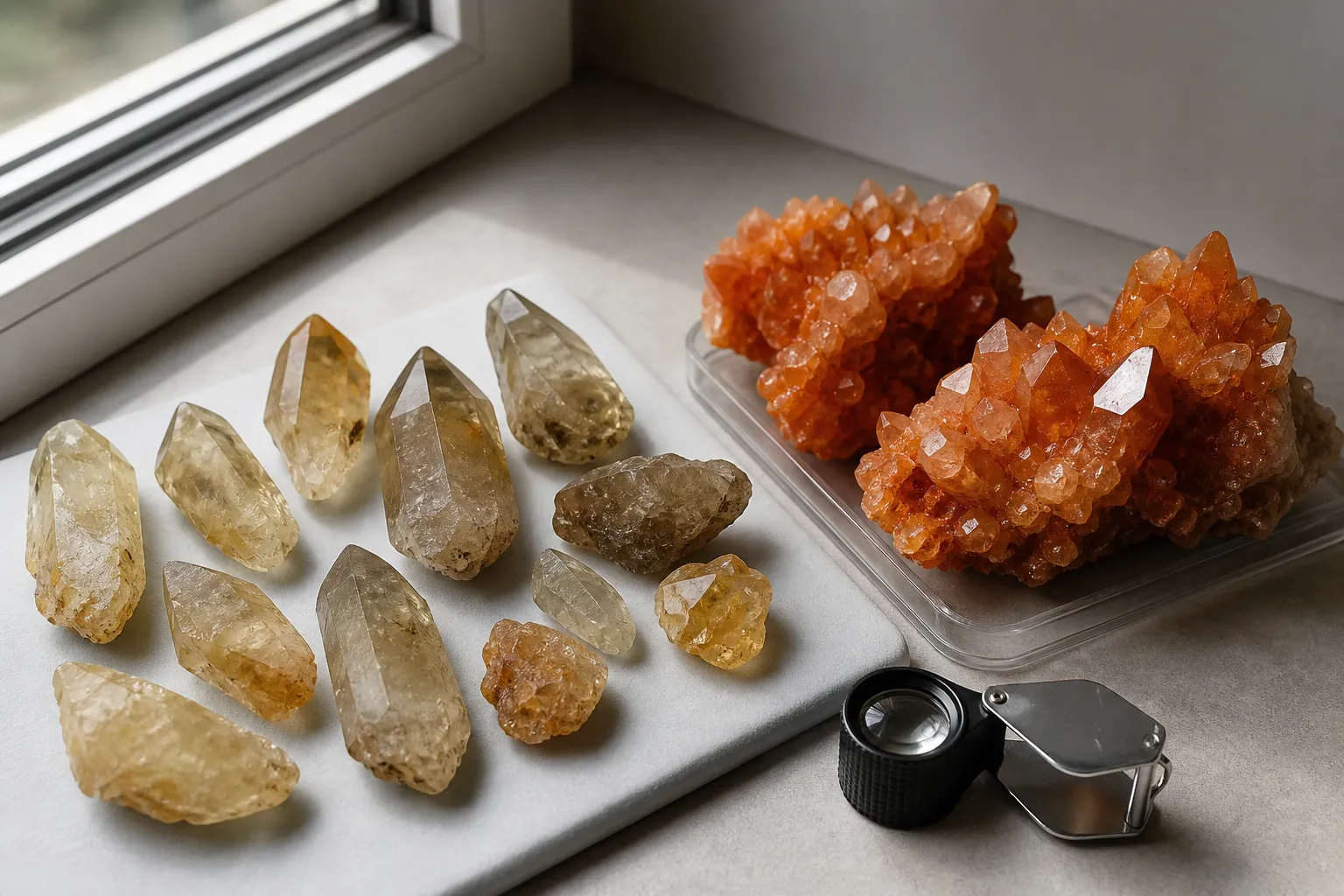
The practical answer is this: pale to smoky golden material with believable quartz growth features may be more plausible as natural citrine than vivid orange-brown clusters, but appearance alone cannot prove natural origin. Heated amethyst, treated quartz, synthetic quartz, and regrown material can all complicate the label.
If the question is “Is this true manifestation quartz?” separate the two parts. Mineral identification can look at quartz type, color origin, treatment clues, provenance, and testing limits. “Manifestation quartz” and “Jupiter energy” are symbolic or metaphysical phrases; they do not authenticate a stone.
broader context
Start with the main citrine page
This narrower page works best after the broader citrine reference page.
What a raw citrine piece can actually tell you
A raw citrine crystal is still quartz, specifically a macrocrystalline quartz variety when it forms visible crystals. Its color is tied to impurities, defects, growth conditions, and color-center behavior inside the crystal structure. That is why the word “raw” is not enough. A rough point, cluster, pendant chip, bead, or broken crystal can look natural while still being heated, irradiated, coated, synthetic, regrown, or mislabeled.
For a shopper, visual inspection is a probability screen, not a verdict.
More plausible signs for natural citrine can include
- subdued yellow, smoky-yellow, honey, tea-brown, or golden-brown color;
- color that looks integrated through the quartz rather than concentrated only at tips or cracks;
- ordinary natural quartz growth features rather than a uniformly “burnt orange” product look;
- seller wording that includes origin, treatment status, and uncertainty where appropriate.
More suspicious signs can include
- very bright orange or reddish-orange clusters sold as “natural raw citrine” without treatment disclosure;
- amethyst-like cluster shapes with orange-brown points and pale or white bases;
- labels such as “real citrine,” “manifestation citrine,” or “energy stone” with no mineralogical detail;
- large quantities of highly uniform orange material presented as untreated natural citrine.
These clues do not prove treatment. They only tell you when to ask harder questions. Research on quartz coloration and heat treatment shows why: amethyst can develop yellow, orange, or brown citrine-like tones under heat, and the change is tied to defects and color centers in quartz. So a stone can be real quartz and still not be naturally colored citrine.
Raw citrine vs. heated citrine
The common confusion is usually not citrine versus glass. It is natural citrine versus quartz that became citrine-colored through treatment, especially heated amethyst.
“Heated citrine” is not necessarily fake in the sense of being plastic or glass. It may be genuine quartz. The issue is disclosure. If a listing says “natural raw citrine” but the material is heat-treated amethyst, the buyer is not receiving the same claim as untreated natural citrine.
The same applies to jewelry. A “raw citrine ring,” “real raw citrine necklace,” or “natural citrine bracelet” may contain genuine quartz, but that does not automatically prove the color developed naturally. “Genuine” can mean “not imitation glass.” It does not always mean “untreated Raw Natural Citrine.”
Why color alone fails
Quartz color is not a simple paint chart. Studies on amethyst, citrine, and related quartz varieties connect color with iron, aluminum, irradiation history, thermal behavior, and defect centers. Heat-treatment research also shows that amethyst can move into yellow to brown citrine-like colors.
For a buyer, the takeaway is simple: the most dramatic color is not always the most reliable clue.
A vivid orange crystal may match what many online listings call “citrine,” but that intensity is also a reason to slow down. A pale smoky-yellow crystal may look less dramatic, yet it may fit the appearance many cautious collectors associate with natural citrine. Neither observation proves origin.
Inclusions and rough texture are not proof either. Natural quartz can be clear or included. Treated quartz can keep natural-looking growth features. Regrown quartz can combine natural and synthetic growth, and identifying that kind of material can require microstructure or spectroscopy work. Even a careful visual review may only narrow the possibilities.
For a modest decorative stone, that may be enough. For a premium “untreated natural citrine” claim, ask for stronger support.
A practical buyer checklist
Use this filter before treating a rough yellow quartz piece as Raw Natural Citrine.
1. Read the exact label
Notice the difference between:
- “natural citrine”
- “heated citrine”
- “heat-treated amethyst”
- “citrine quartz”
- “manifestation quartz”
- “Jupiter citrine”
- “genuine raw citrine”
Only “natural citrine” clearly claims naturally colored citrine, and even that claim deserves provenance or testing if the price depends on it. “Citrine quartz” may describe appearance more than origin. “Manifestation quartz” is a meaning label, not an authentication label.
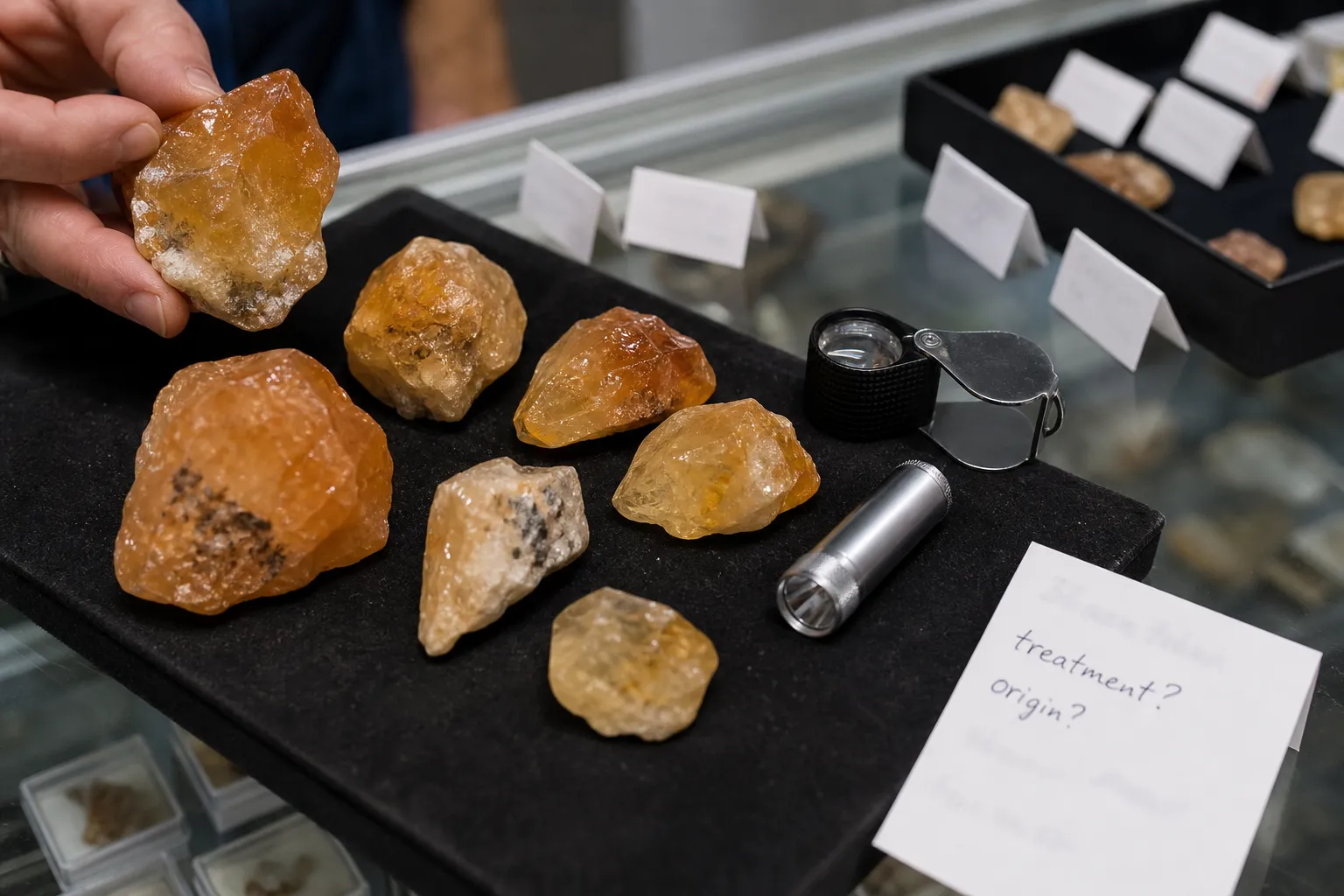
2. Ask the treatment question directly
A useful seller question is:
“Has this quartz been heated, irradiated, dyed, coated, synthesized, or regrown?”
A careful seller may not know everything about older stock, but they should not blur natural color and treatment history. If the answer shifts into vague energy language instead of treatment disclosure, that is a warning about the listing, not evidence about the mineral.
3. Check whether the form matches the claim
Large orange clusters are common in the crystal market under citrine labels. Cluster form plus intense orange color should not be accepted as proof of natural citrine, especially when the specimen resembles amethyst cluster habit.
That does not make every orange cluster treated. It means “natural raw citrine cluster” is a claim worth checking.
Single crystals, points, beads, and jewelry can be harder to read because cutting, drilling, polishing, or setting may remove useful context. A raw-looking citrine pendant may be less visually informative than a well-documented specimen.
4. Treat price as context, not proof
There is no reliable rule that “cheap means fake” or “expensive means natural.” Price can reflect size, clarity, color, workmanship, origin story, seller positioning, or scarcity language.
What price can tell you is how much evidence to expect. A high-priced untreated natural citrine claim should come with more than poetic wording.
5. Know when testing matters
For difficult gemological citrine identification, photo-based certainty is unrealistic. Laboratory work on quartz varieties may use infrared spectroscopy, electron paramagnetic resonance, optical absorption, X-ray diffraction, or microstructure analysis to study natural, synthetic, treated, or regrown material.
A normal buyer does not need to run these tests. Their existence simply explains why a confident-looking online listing can still be uncertain.
Manifestation quartz, Jupiter energy, and mineral facts
Many people meet citrine through symbolic language. In that setting, citrine may be described as manifestation quartz, a prosperity stone, solar-colored quartz, or a crystal associated with Jupiter energy. Those phrases can be meaningful in personal ritual, design, meditation, or tradition.
They should not be used as evidence of authenticity.
A seller saying “strong Jupiter energy” has not answered whether the stone is natural citrine or heated amethyst. A listing that says “true manifestation quartz” has not disclosed whether the color is natural, heated, irradiated, synthetic, coated, or regrown. A bracelet advertised for abundance is not automatically Raw Natural Citrine.
The mineral layer can support statements like
- Citrine is a quartz variety.
- Quartz can occur as visible macrocrystalline crystals, including amethyst, smoky quartz, rock crystal, and citrine.
- Quartz has piezoelectric properties, which explains some of its technical uses.
- Citrine-like color can be natural or treatment-related.
- Lab methods may be needed for difficult origin questions.
The symbolic layer should stay softer: “some crystal traditions associate citrine with confidence, abundance, or Jupiter symbolism,” or “some people use citrine as a manifestation symbol.” That language may describe belief or practice, but it does not authenticate the stone or guarantee an effect.
The clearest decision path
If you are holding or considering a raw citrine crystal, move through this sequence:
- 1. Confirm the material claim. Is it sold as quartz, citrine, natural citrine, or treated citrine?
- 2. Read the color cautiously. Pale smoky-yellow or golden-brown may be more plausible; vivid orange or burnt amber deserves questions.
- 3. Look at the form. Orange cluster material should be checked carefully, especially if it resembles amethyst clusters.
- 4. Check the disclosure. “Natural,” “real,” and “genuine” are not enough without treatment language.
- 5. Separate meaning from identity. Manifestation quartz and Jupiter energy are symbolic descriptions, not gemological evidence.
- 6. Escalate when value depends on it. For premium claims, seek provenance, reputable seller disclosure, or qualified testing.
Raw natural citrine identification is not about certainty from one photo. It is about matching the claim to the evidence.
Short answers
Is heated amethyst still citrine?
It is quartz with citrine-like yellow to orange-brown color produced by treatment. In the market, it is often sold as citrine, but when origin matters it should be disclosed as heated or treated. It is not the same claim as untreated natural citrine.
Do piezoelectric properties prove a citrine is natural?
No. Piezoelectric behavior is a property of quartz. It does not prove that a specific citrine-colored stone is untreated natural citrine, and it does not separate natural color from heated or synthetic material in ordinary buyer use.
Can a crystal be meaningful if it is heated?
That is a personal or cultural question, not a mineral identification question. Some people still value treated quartz symbolically. The important point is not to let meaning language replace accurate treatment disclosure.