Soft Manifestation Protocols: Why the Law of Attraction Causes Discipline Fatigue
Soft Manifestation Protocols may feel less discipline-heavy than Law of Attraction routines because they move the focus away from constant inner correction. Instead of asking you to monitor every thought, mood, doubt, and “frequency,” a softer protocol treats manifestation as reflective self-help: choose an intention, relate to a steadier identity, and return to it without making every emotional shift a test.
That does not mean Soft Manifestation Protocols are a validated mental-health method or a guaranteed path to results. The useful comparison is narrower: strict Law of Attraction routines can feel like performance for some readers, while a softer approach may feel more breathable because it leaves room for uncertainty, pacing, and ordinary human fluctuation.

broader context
Start with the main citrine page
This narrower page works best after the broader citrine reference page.
Why Law of Attraction routines can start to feel exhausting
Many Law of Attraction routines are built around consistency. A reader may be encouraged to affirm, visualize, script, avoid doubt, keep faith, and act as if the desired reality is already true. For some people, that structure feels motivating. It gives shape to a desire and turns it into a repeatable practice.
The strain starts when the routine becomes less like support and more like surveillance.
That can sound like:
- Did I think the wrong thing?
- Did I lower my vibration?
- Did I cancel the desire by doubting it?
- Am I blocking the outcome because I feel tired today?
- Do I need to fix this feeling before it affects everything?
Even when those questions are not part of every Law of Attraction teaching, they can become part of the reader’s inner routine. The practice becomes another place where the self is measured.
That is the discipline fatigue this page is naming. It is not laziness, and it is not a diagnosis. It is the felt strain of trying to hold a preferred inner state too tightly, especially when the routine asks for constant correction. A manifestation practice that began as hope can turn into a checklist of emotional compliance.
The pressure is usually strongest when three ideas get fused together: the desired outcome must be held with unwavering certainty, doubt is treated as failure, and daily practice becomes proof of worthiness or seriousness. Once those ideas combine, the reader is no longer only imagining a desired life. They are managing every inner fluctuation as if it carries immediate consequence.
What “soft” changes in Soft Manifestation Protocols
Soft manifestation does not have to mean passive waiting or vague wishfulness. In this context, it means a lower-pressure way to work with manifestation language. It keeps the spiritual self-help focus, but it does not ask the reader to treat every thought as a crisis.
A soft protocol changes the emotional contract of the practice.
Pressure tone
“I must hold the correct frequency all day.” Alignment becomes a score, and the routine becomes a test of discipline.
Softer tone
“I can return to the direction I care about without forcing myself into a perfect state.” Alignment becomes an orientation.
Instead of making the routine a test of discipline, a softer protocol makes it a place to notice what feels coherent, possible, and honest.
This is where terms like receptive alignment, feminine protocol, and identity state often appear. On this page, those terms are reflective self-help language, not established psychological categories.
Receptive alignment
Receptive alignment can be understood as a softer posture toward desire: less chasing, less constant self-correction, and more attention to where meaning, action, and timing seem to meet. It does not show that an outcome will arrive. It describes a way of practicing that may feel less pressured.
Feminine protocol
A feminine protocol, in this usage, is not a rule about gender. It is commonly used to contrast forceful, hyper-controlling, or overly strategic routines. The useful version points toward receptivity, pacing, embodiment, and allowing. The less useful version becomes another identity to perform. If “feminine protocol” turns into a new standard you must maintain perfectly, it can create the same fatigue it was meant to soften.
Identity state
Identity state refers to the self-image or inner role a person practices inhabiting. A strict routine might say, “Act like the version of you who already has it, all the time.” A softer version might ask, “What is a believable next expression of that version of me today?” The difference is pressure. One asks for total self-replacement. The other asks for a smaller, more livable shift.
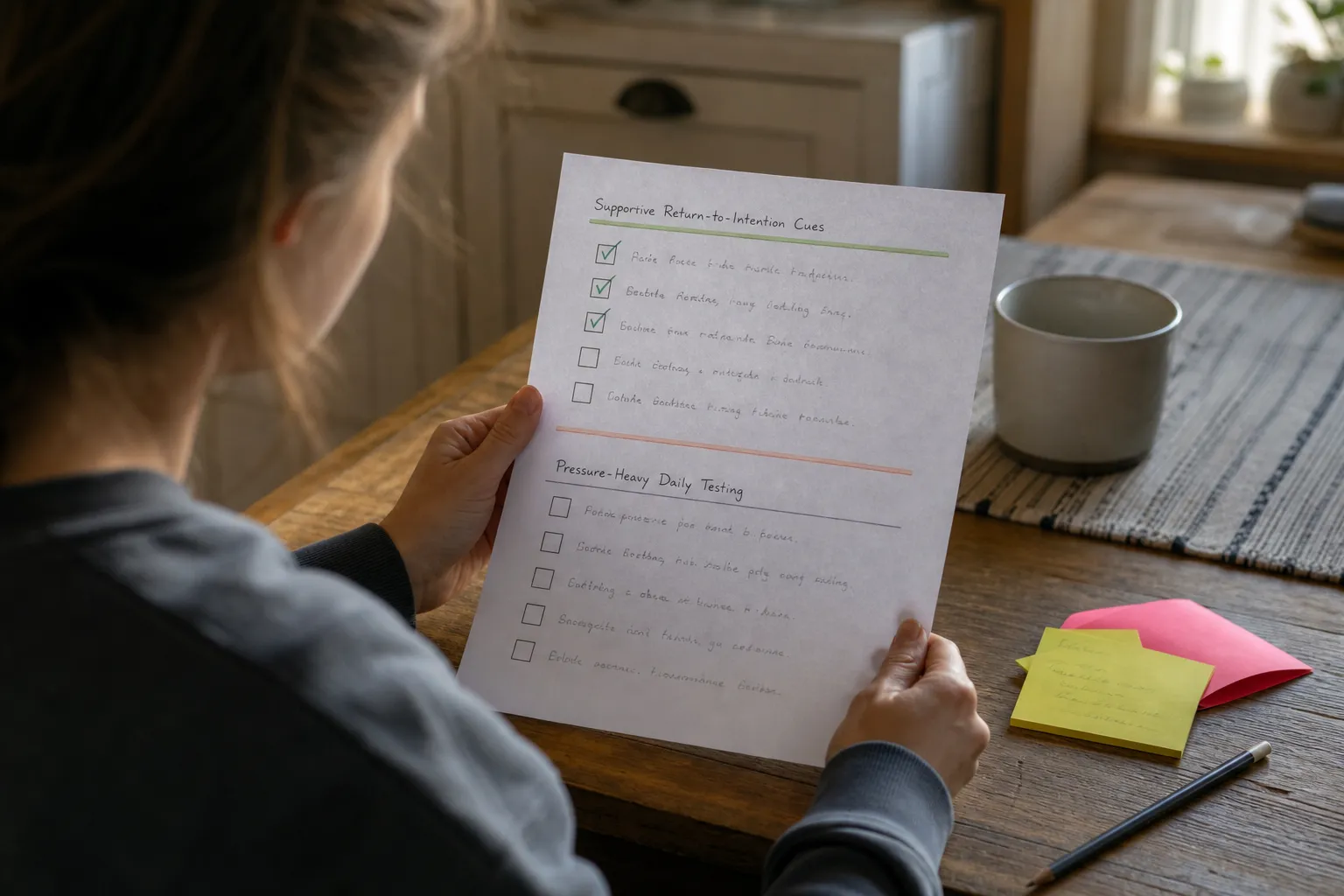
The practical difference: correction versus return
The clearest distinction is not discipline versus no discipline. It is correction versus return.
A discipline-heavy manifestation routine often relies on correction. The reader notices a thought, feeling, or behavior that does not match the desired reality, then tries to replace it quickly. That can be useful in small doses. When it becomes constant, ordinary uncertainty starts to feel like a problem.
A softer protocol relies more on return. The reader still wanders. They still doubt, get tired, compare, feel disappointed, or forget the practice for a while. The difference is that those moments are not automatically treated as failure. They are simply moments to come back to the chosen orientation.
Correction says: “This feeling is wrong; I must replace it.”
Return says: “This feeling is here; I can still choose my direction.”
That small shift explains why soft manifestation may feel less discipline-heavy. It does not demand continuous emotional control. It leaves room for mixed states: wanting something and feeling unsure, practicing hope and feeling impatient, holding a vision and still having a normal day.
For a reader tired of strict Law of Attraction routines, this can be the relief point. The practice no longer has to become an all-day audit of the mind. It can be a short, repeatable way to reconnect with intention without turning the rest of life into a manifestation exam.
When a softer protocol helps, and when it does not
A softer approach may help when the routine itself has become the problem. If the reader spends more energy policing the practice than living, softening the structure can reduce unnecessary strain. If affirmations feel like arguments with reality, a gentler identity statement may feel more honest. If visualization has become a performance, a shorter reflective check-in may be enough.
It may also help when the reader is confusing intensity with sincerity. Wanting something deeply does not mean every practice has to feel urgent. Some desires are easier to hold when they are not handled with pressure every day.
Soft manifestation is not automatically better for every person or every situation. Some readers like structure. A clear routine may help them feel focused, especially when it is simple and not loaded with self-blame. Others may use “soft” to avoid ordinary action, uncomfortable decisions, or practical planning. In that case, the protocol becomes too loose to be useful.
The better question is not whether Law of Attraction or Soft Manifestation Protocols are universally superior. It is: what does this practice ask you to do with your attention?
If it asks you to return to a chosen direction, it may feel supportive. If it asks you to prove your worth through constant emotional discipline, it may become draining. If it asks you to ignore reality, dismiss distress, or treat every difficulty as personal failure, it has moved beyond helpful reflection.
Common misunderstanding: less discipline-heavy does not mean careless
Less discipline-heavy manifestation does not mean having no shape. It means the practice does not depend on constant inner enforcement.
A useful soft protocol might include a brief intention, a grounding phrase, a written identity reflection, a small aligned action, or a pause before reacting from fear. The difference is that the practice is not treated as a moral exam. Missing a day does not mean the desire is lost. Having doubt does not mean you need to panic. Feeling low does not mean you have failed the process.
Another misunderstanding is that softness means better results. This article cannot make that claim. The available material for this page does not support a conclusion that one manifestation style produces more reliable outcomes than another. The responsible comparison here is about how the routines may feel and function as self-help language.
Identity state can also be misunderstood as a magic override. It is most useful when it helps a person ask, “What kind of person am I practicing becoming?” It becomes less useful when it asks the reader to deny current circumstances or perform certainty they do not feel. A believable identity shift is usually quieter: one cleaner choice, one less reactive habit, one more honest boundary, one practical step that matches the desired direction.
Softness should not become endless receptivity, either. Waiting, listening, and allowing can turn into avoidance if they never lead to grounded movement. A balanced soft protocol leaves room for action, but it does not make action feel like punishment for not believing hard enough.
A simple way to tell which style you are using
Listen to the inner tone of the routine.
If it sounds like, “I must fix this thought before it ruins everything,” it is operating through pressure. If it sounds like, “I can notice this thought and still return to what I choose,” it is softer.
If the routine makes ordinary emotions feel dangerous, it may be feeding discipline fatigue. If it allows ordinary emotions while still pointing you toward a chosen identity, it is more likely to feel sustainable.
If the routine keeps expanding until your whole day becomes a test of alignment, it has become too heavy. If it has a beginning, an end, and a practical next step, it is easier to live with.
A soft manifestation practice might ask:
- What desire am I orienting toward today?
- What identity state feels believable rather than forced?
- What small action would match that identity?
- Where am I adding pressure that does not actually help?
- Can I return without scolding myself?
Those questions do not establish a metaphysical process. They keep the practice reflective, bounded, and less likely to become another form of self-monitoring.
The evidence boundary
The research material available for this page does not include verifiable external sources, public citation candidates, confirmed firsthand experience, or authoritative support for psychological mechanisms behind manifestation language. This article should not be read as clinical guidance, behavioral science, or proof that Law of Attraction routines create fatigue in a measurable way.
Terms such as law of attraction fatigue, discipline fatigue, receptive alignment, feminine protocol, identity state, and soft manifestation are used here as reader-facing self-help concepts. They describe a pattern some readers may recognize: strict routines can feel demanding, while softer routines can feel more spacious. That is a reflective comparison, not a scientific conclusion.
This boundary matters because manifestation language often sits close to emotional well-being, hope, disappointment, and personal agency. If a practice increases distress, obsessive self-monitoring, shame, or difficulty functioning, the answer is not to intensify the routine. Ongoing distress deserves qualified support outside the manifestation framework.
A grounded manifestation practice should leave the reader more honest, not more afraid of their own mind. It can help clarify desire, identity, and action without pretending that every feeling is a command or every outcome is under perfect inner control.
The short answer
Soft Manifestation Protocols may feel less discipline-heavy because they replace constant correction with gentle return. They do not require perfect belief, perfect mood, or perfect symbolic alignment all day. Compared with stricter Law of Attraction routines, they make more room for uncertainty, pacing, and ordinary human fluctuation.
That does not make them established, superior, or outcome-guaranteeing. It makes them a softer style of reflective self-help. For readers who feel tired by manifestation routines that demand constant vigilance, the useful shift is not abandoning intention. It is removing unnecessary pressure around how intention must be held.