Living with Mohs 7: A Realist Guide to Daily Wear & Settings
If you are deciding whether a citrine ring can handle ordinary life, the number “7” on the Mohs scale sounds reassuring. It should—but only up to a point.
Citrine is a quartz variety, and quartz sits at Mohs 7. That gives citrine meaningful scratch resistance compared with softer gemstones. It does not answer every question about daily wear. A raised ring, a pendant tucked against clothing, and a pair of earrings stored in a pouch are not living the same life.
That is the heart of Citrine Durability and Care: Mohs 7 is useful information, not a promise that a piece can be worn through every task without consequence.

broader context
Citrine verification note
This narrower page works best after the broader citrine reference page.
What Mohs 7 tells you—and what it does not
The Mohs hardness scale ranks minerals by scratch resistance. A harder mineral can scratch a softer one; a softer mineral generally should not scratch a harder one through normal direct contact. Citrine, as quartz, is commonly listed at Mohs 7.
That matters. Citrine is not in the very soft gemstone range, and it has a long history of use in jewelry. The common mistake is treating “scratch resistant” as if it means “durable in every way.”
Hardness does not fully measure:
- resistance to chips from impact;
- how exposed facet edges or corners are;
- whether the setting holds the stone securely;
- whether grit or harder stones are rubbing against it;
- whether cleaning habits are gentle or abrasive;
- whether the jewel is worn on the hand, wrist, neck, or ear.
A ring is the hardest test because hands constantly meet tables, bags, counters, door handles, steering wheels, gym equipment, and cleaning surfaces. A pendant usually has less contact. Earrings often have less still.
So the better question is not simply, “Is citrine hard enough?” It is: “Where will the citrine sit, how exposed is it, and what will touch it?”
That is also why sales phrases such as “good for everyday wear” need context. They may point to citrine’s general wearability, but they often leave out the design and habit conditions that decide how a specific piece ages.
Citrine rings, pendants, bracelets, and earrings do not share the same risk
Citrine daily wear is most complicated in rings. Even if the stone resists many casual scratches, the setting can loosen, the stone can take a blow, or fine abrasion can build up from repeated contact with harder materials and grit.
Bracelets are also high-contact pieces. They slide across desks, countertops, clasps, bags, and other jewelry more often than many owners notice.
Pendants change the risk profile. They can still be knocked, stored poorly, or cleaned roughly, but they are less likely to scrape against hard objects all day. Earrings are usually the easiest category for citrine, assuming the mounting is sound and storage is not careless.
Ring
Everyday exposure: Highest
Needs the most setting protection and habit discipline.
Bracelet
Everyday exposure: High
Frequent contact makes abrasion and knocks more likely.
Pendant
Everyday exposure: Moderate to low
Often more forgiving, though storage and cleaning still matter.
Earrings
Everyday exposure: Usually low
Less exposed in wear, but prongs and storage still need attention.
This does not make citrine rings a bad idea. It means a ring asks more from the design and from the wearer. If you want a citrine piece you rarely think about, a pendant or earrings are usually easier. If you want a citrine ring, the setting and wear habits are part of the purchase—not aftercare trivia.
Settings reduce risk; they do not make citrine invulnerable
Setting design changes how much of the stone is exposed. It cannot change citrine’s hardness, and it cannot make the gem immune to impact, but it can reduce common wear risks.
A bezel setting surrounds the stone’s edge with metal. For citrine, that can be useful because the girdle and edges are less exposed to direct knocks than they are in many open prong designs. Bezel set engagement rings are often discussed as protective choices, but for citrine the practical point is not engagement-ring marketing. It is coverage.
Prong settings leave more of the stone visible. They can show more light and more of the gem’s outline, but they rely on small metal points to hold the stone. Tall, open prongs expose citrine to more contact, especially when the ring sits high above the finger. A lower prong setting may be easier to live with, but prongs still need inspection because they can wear, bend, catch, or loosen over time.
Flush and low-profile settings are often described as active-lifestyle friendly because less material rises above the surface. The useful principle is simple: lower and less snag-prone usually means fewer accidental hits. That is risk reduction, not a guarantee.
Setting variables that change the answer
When judging protective citrine settings, look beyond the setting name:
- Height: A high-set stone meets more accidental contact than a low-set stone.
- Edge exposure: Covered edges and corners are usually less vulnerable than exposed ones.
- Stone shape: Sharp corners and broad tables can change practical wear risk.
- Metal coverage: A bezel or partial bezel can shield edges, though it changes the look.
- Wearer habits: A desk-based routine is different from hands-on work, sports, or constant ring wear.
- Maintenance access: A setting that is hard to inspect or clean may create its own problems.
For step-cut citrines, the issue is geometry rather than trend language. Step cuts often have broad, clean planes and crisp edges. They can be beautiful, but exposed corners deserve extra attention in rings. A lower setting, protected corners, or a bezel-like frame is often more practical than a tall, delicate mounting for frequent wear.
When a citrine ring looks cloudy
People often say a citrine ring is “getting cloudy,” but that phrase can point to several different problems: soap film, lotion, skin oils, dust behind the stone, fine abrasion, residue under the setting, or a mounting that no longer lets light move cleanly through the gem. Without examining the piece, “cloudy” is not a diagnosis.
The first step is to avoid making the problem worse. Do not jump to stiff brushes, abrasive pastes, heavy polishing, or aggressive home devices. Conservative gemstone care starts with gentle handling.
A practical cleaning rhythm
- Check the setting first. If a prong looks bent, the stone moves, or the ring catches on fabric, stop wearing it and have the setting inspected.
- Remove loose grit before wiping. If dust or grit is visible, rinse it away gently before dragging a cloth across the surface.
- Clean gently, not forcefully. Mild soap, water, and a soft cloth or soft brush are a conservative starting point for many gemstone jewelry pieces. Scrubbing is not the goal.
- Dry carefully. Moisture and residue trapped under settings can make a stone look dull again quickly.
- Look again in normal light. If the stone still looks dull, the issue may be residue under the mounting, surface wear, or setting condition rather than simple dirt.
The popular “warm soapy water” advice is useful because it keeps the method simple. The real point is avoiding abrasive contact with citrine and protecting the metalwork around it.
The available source set for this page does not support sweeping claims that ultrasonic or steam cleaning will always damage citrine, nor does it support presenting those methods as automatically safe. Vibration, heat, chemicals, treatments, and setting condition all matter. For valuable, sentimental, antique, treated, or visibly fragile jewelry, a qualified jeweler’s inspection is more sensible than trial-and-error cleaning.
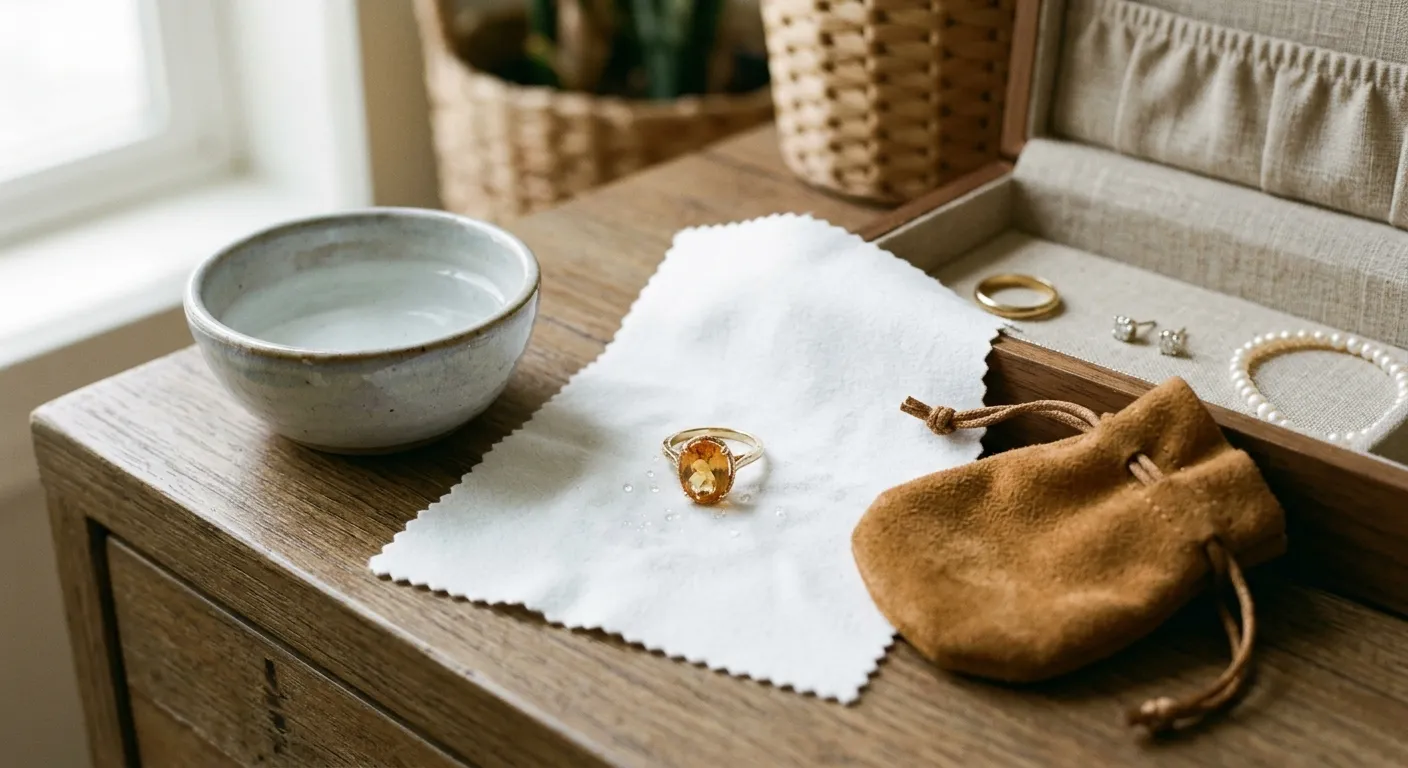
Storage: many scratches begin off the body
Storage is one of the easiest parts of citrine care to improve. Mohs 7 does not mean citrine should be tossed into a dish with diamonds, sapphires, chains, and other rings. Harder materials can scratch softer ones, and repeated rubbing can make even routine storage more abrasive than it looks.
Better habits are simple
- keep citrine jewelry in a separate compartment, pouch, or lined box;
- avoid loose mixing with harder gemstones;
- close chains and clasps so they do not scrape across faceted surfaces;
- keep rings from knocking into each other during travel;
- use a soft pouch when carrying jewelry in a bag.
The “household dust scratches jewelry” idea also needs careful wording. Dust and grit can include hard particles, so dry wiping a dirty gemstone is a bad habit. That does not mean every speck of dust will visibly damage citrine. It means loose particles should be lifted or rinsed away when practical before wiping.
Separate storage matters even more for rings because they already take more contact during wear. A ring worn hard all day and then dropped into a crowded jewelry tray at night never really gets a break from abrasion.
Sunlight, heat, and chemicals: cautious habits without dramatic claims
Many readers search for protecting citrine from sun because they have heard that colored stones may change with exposure. The available material for this page is not strong enough to make precise, source-backed claims about citrine fading behavior, heat sensitivity by treatment type, or exact exposure thresholds.
The practical advice is conservative: do not use a sunny windowsill, hot car, bathroom counter, or display shelf in direct light as your default storage place for citrine jewelry. That is a sensible habit for colored gemstone jewelry generally. It should not be stretched into a promise about exactly what will or will not happen after a specific number of hours.
The same restraint applies to chemicals. Hand sanitizer, chlorine, cosmetics, perfume, lotion, cleaning products, and hair products are common parts of daily life, but jewelry is a combination of stone, metal, setting work, and sometimes treatments or fillers. The risk may involve the mounting or metal as much as the citrine.
A practical rule still holds: put jewelry on after cosmetics, and remove rings before heavy cleaning, swimming, sports, rough work, or tasks where the stone may be hit, soaked, or scraped.
This is not because citrine is too fragile to wear. It is because daily wear is cumulative. Repeated residue, small knocks, poor storage, and rough cleaning are often what make a piece look tired.
A realistic daily-wear framework for citrine
Instead of asking whether citrine is “durable,” judge the whole piece. Mohs 7 is one input. Setting, shape, activity level, storage, and maintenance complete the picture.
A citrine ring is a better daily candidate when:
- the setting sits low on the hand;
- edges are protected by a bezel, partial bezel, metal border, or thoughtful prong placement;
- the stone is not oversized for the wearer’s routine;
- the wearer removes rings for rough work, sports, heavy cleaning, and swimming;
- the ring is stored separately from harder gems;
- the setting can be checked and maintained.
A citrine ring is a poorer daily candidate when:
- it is high-set and catches easily;
- sharp corners are exposed;
- prongs are thin, worn, or difficult to inspect;
- the wearer wants a ring that stays on through every task;
- the piece is stored loose with harder jewelry;
- cleaning habits involve scrubbing, abrasive cloths, or unverified devices.
This framework also helps with citrine rings versus pendants. If you love citrine’s color but do not want to manage hand-level risk, choose a pendant or earrings. If the visibility or symbolism of a ring matters more, design around that choice honestly.
The daily-wear tradeoff is simple: citrine can be wearable and still require lifestyle agreement.
How to inspect a citrine setting before it becomes a loss problem
Setting checks are one of the most useful jewelry maintenance habits for citrine rings. You do not need to become a bench jeweler, and you should not try to repair structural issues at home. You only need to notice early warning signs.
Look for:
- a stone that clicks, shifts, or rotates;
- prongs that are lifted, uneven, flattened, or snagging fabric;
- a bezel rim that appears bent away from the stone;
- visible gaps between stone and metal;
- new rattling sounds;
- a change in how the ring sits on the finger;
- residue that keeps returning under the stone.
If anything seems loose, stop wearing the piece until it can be checked. Mohs hardness will not help if the stone is no longer held securely.
A periodic professional check is especially sensible for a ring worn often, a sentimental piece, or any citrine set in fine prongs. The available sources support general maintenance caution, but not a universal inspection schedule. Frequency depends on wear level, setting style, and how much the piece matters to the owner.
Keep symbolic and marketing language in its lane
Citrine carries plenty of symbolic and cultural language, and some owners use waterless practices such as moonlight placement, sound-based rituals, or placing stones near other minerals as part of personal meaning. From a care perspective, the useful distinction is material contact. A practice that avoids water, heat, chemicals, impact, and abrasion is less likely to create obvious physical risk than one involving soaking, scrubbing, sunny display, or rough handling.
That does not make symbolic practice the same as gemological maintenance. Moonlight does not clean residue. A pouch does not check a prong. A personal ritual does not tell you whether a setting is secure.
Market language has a similar boundary. “Maximum sparkle,” “active lifestyle,” “soft gemstone protection,” and “scratch resistant setting” may point to real design concerns, but they can flatten the details. A setting can reduce exposure; it cannot rewrite the gemstone hardness scale. A bright open design can be beautiful; it may also ask for more caution. A bezel can be protective; it is not a force field.
For citrine, good ownership means separating three things:
- Gemological fact: citrine is quartz, and quartz is Mohs 7.
- Design judgment: some settings expose the stone more than others.
- Personal meaning or marketing: useful for preference, not proof of durability.
The practical answer: wearable, not worry-free
Citrine sits in a middle zone that is easy to oversell and easy to underestimate. It is not a very soft gemstone, and Mohs 7 gives it meaningful scratch resistance in the language of the Mohs hardness scale. But a daily-worn jewel is not tested only by scratches. It is tested by knocks, storage, residue, cleaning habits, setting security, and the wearer’s routine.
For pendants and earrings, citrine can be relatively easy to live with if stored and cleaned sensibly. For rings, especially daily rings, the margin narrows. Choose lower profiles, protected edges, and settings that can be inspected. Remove the ring for high-impact or chemically messy tasks. Store it away from harder stones. Clean gently. Treat sunlight and heat exposure with conservative common sense rather than dramatic certainty.
The realist position is not “never wear citrine daily.” It is also not “Mohs 7 means no problem.” Citrine can fit daily life when the jewelry design and the owner’s habits respect what Mohs 7 does—and does not—mean.