Mechanical distinction
Beyond Flat Facets: The Mechanical Principles of 3D Gem Carving
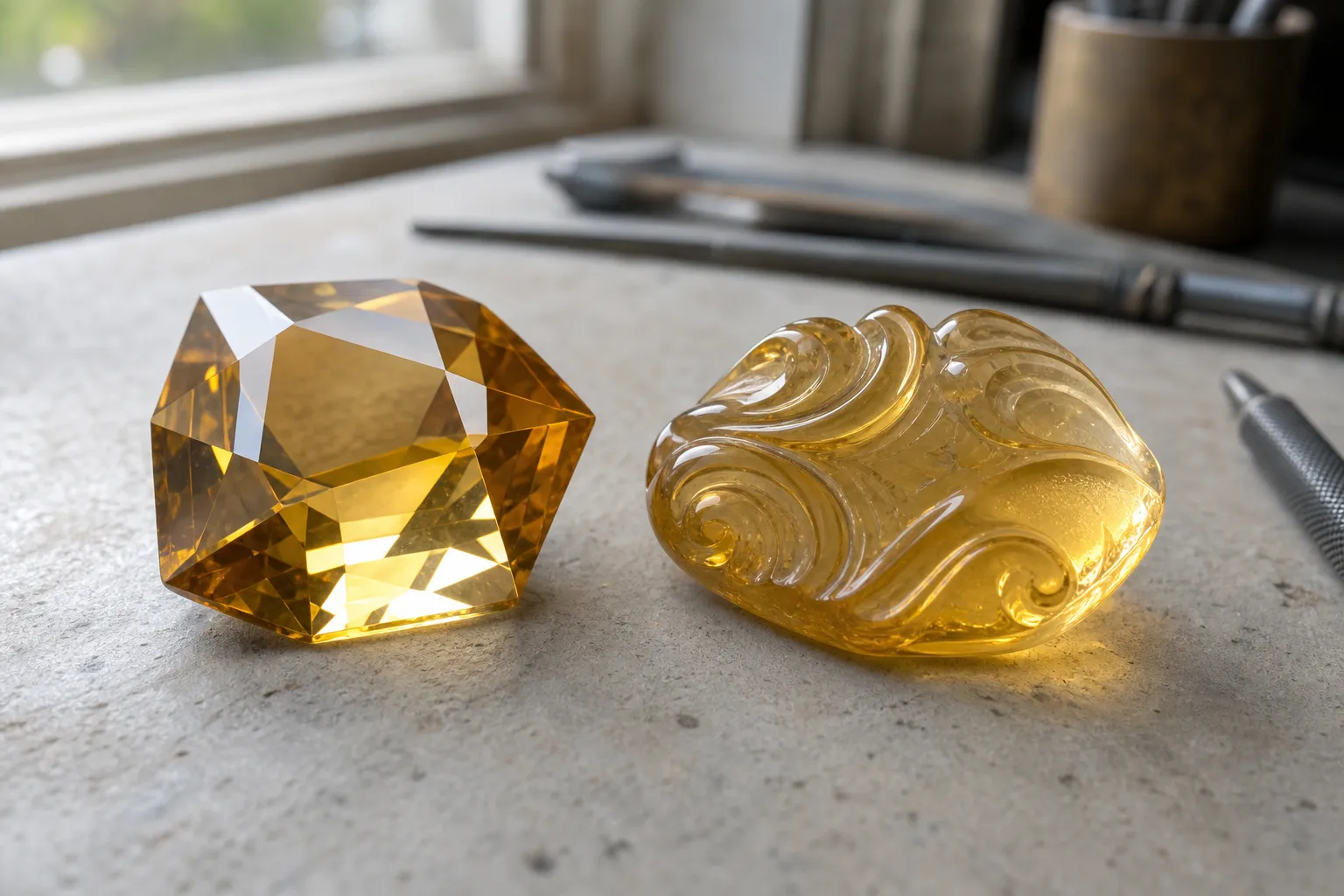
A flat-cut citrine asks light to meet planned planes. 3D Gemstone Faceting works from a different idea: the gem is treated as shaped volume, not only as a set of polished windows. Instead of arranging mostly flat faces across a crown and pavilion, 3D gem carving removes material around curves, ridges, grooves, relief, and sculpted transitions so the stone reads as an object with depth.
The mechanical difference is subtraction in more directions. The visual difference is that light may appear to move through a less regular body, rather than through a simpler face-to-face structure. That does not prove better brilliance, higher value, or natural origin. It only describes a different way of shaping hard brittle gem material.
broader context
Citrine verification note
This narrower page works best after the broader citrine reference page.
The Short Difference: Planes Versus Volume
Flat facet cutting is easiest to picture as a disciplined map of planes. The cutter creates faces at selected angles, then polishes those faces so the gem has a recognizable surface rhythm. For a shopper or collector, this is why many faceted stones feel readable at a glance: table, crown, girdle, pavilion, and point-like geometry create a familiar order.
3D gem carving shifts the emphasis from planar order to shaped mass. A carved gem may still contain polished surfaces, sharp edges, or facet-like cuts, but the main impression comes from dimensional shaping. The stone is not only faced. It is modeled. A ridge may rise from the surface, a curve may pull the eye around the body, or a recessed area may make color look deeper from one direction than another.
That distinction matters because gemstone material is not clay. It is not built up, stretched, or bent into form. It is reduced. Subtractive gemstone carving means the final shape appears through removal; every swell, groove, ridge, and plane depends on what remains.
For citrine, seller language can blur this distinction. A listing may call a golden stone “carved,” “sculpted,” “fantasy cut,” or “3D faceted” without explaining the work behind the appearance. Those words can describe form, but they do not verify citrine authenticity. Natural citrine, treated material, and synthetic material require separate gemological verification; carving style alone cannot settle origin.
What Changes Mechanically When the Gem Becomes Three-Dimensional
Direction
Flat facet cutting usually organizes a gem around clear geometry: surfaces placed to create symmetry, outline, and light return. 3D gem carving works across more of the stone’s body. The form may wrap around the gem, cross from top to side, or use relief that makes the surface feel less like a roof of flat faces and more like terrain.
Material Commitment
In a flat faceted stone, removing material can adjust outline, proportion, and facet placement. In a carved form, one cut may affect silhouette, surface depth, and visual balance at the same time. A small recess can change the apparent thickness of a translucent area; a nearby ridge may then look stronger or more exposed.
Polish and Shape
A flat facet can often be judged as a face: even, reflective, aligned, and consistent with the design. A sculpted gem asks the eye to follow transitions. It notices where a curve turns into a plane, where an edge catches brightness, and where a deeper area looks darker because more material sits between the surface and the viewer.
Careful language matters here. It is reasonable to say that shaped gemstone material may create a different impression of internal light movement. It is not responsible, without stronger source support, to claim a measured optical advantage. Terms such as complex internal refraction and light trajectories can help describe the visual question, but this page does not treat them as laboratory findings. In general terms, shape, polish, color distribution, transparency, inclusions, and viewing angle can all affect what the eye perceives.
Light Movement Is a Visual Question, Not a Proof of Quality
A flat faceted gemstone often invites a familiar expectation: clean flashes, contrast, and a repeatable pattern as the stone turns. A carved or three-dimensional form may instead create wandering highlights, softer transitions, or pockets of color that seem to deepen and release with movement. That perceived movement is part of the appeal. It is also easy to overstate.
Light trajectories in gemstones are not visible tracks drawn inside the stone. What the viewer sees is the combined result of surface shape, transparency, reflection, refraction, absorption, and lighting. Without technical documentation for a specific gem, the safer statement is narrower: 3D carving can complicate the visible path of light. It does not automatically improve optical performance.
For citrine, color adds another layer. A golden or orange body color can make sculpted depth feel warm and liquid, especially where thicker areas appear more saturated. But color impression is not origin. Heat-treated material can be attractive. Natural citrine can be attractive. Synthetic or imitation material may also be presented attractively. Surface design does not replace disclosure, testing, or careful identification.
If a seller describes a carved citrine as “more alive” because of internal light movement, read that as market language unless it is paired with clear gemological information. If the question is beauty, the eye can judge the object. If the question is citrine authenticity, the carving cannot carry the claim.
Material Limits Shape the Design Before Style Does
The romance of carving can make it sound as if the artist simply imagines a form and releases it from the stone. Mechanically, the material limits come first. Gemstones can be hard compared with everyday materials, but hardness does not mean toughness in every direction. A hard brittle gem material may resist scratching while still being vulnerable to chipping, fracture, or weakness along unfavorable features.
Because the supplied research for this article does not include technical lapidary sources, this page should not pretend to teach tool mechanics or workshop method. The concept can still be stated plainly: shaping a gem means removing resistant material while preserving a usable remaining form. Thin projections, sharp undercuts, abrupt transitions, and unsupported delicate areas may look dramatic, but durability has to be judged case by case.
How the constraint changes
Flat facet cutting
Risk is often discussed around symmetry, facet meet points, proportions, and retained weight.
3D gem carving
The remaining body has to support the design, so grooves, ridges, and transitions affect both appearance and exposed structure.
Citrine reading
Admire the surface, then ask whether value is attached to verified material facts, craftsmanship language, or vague emotional effect.
Where “3D Gemstone Faceting” Can Mislead
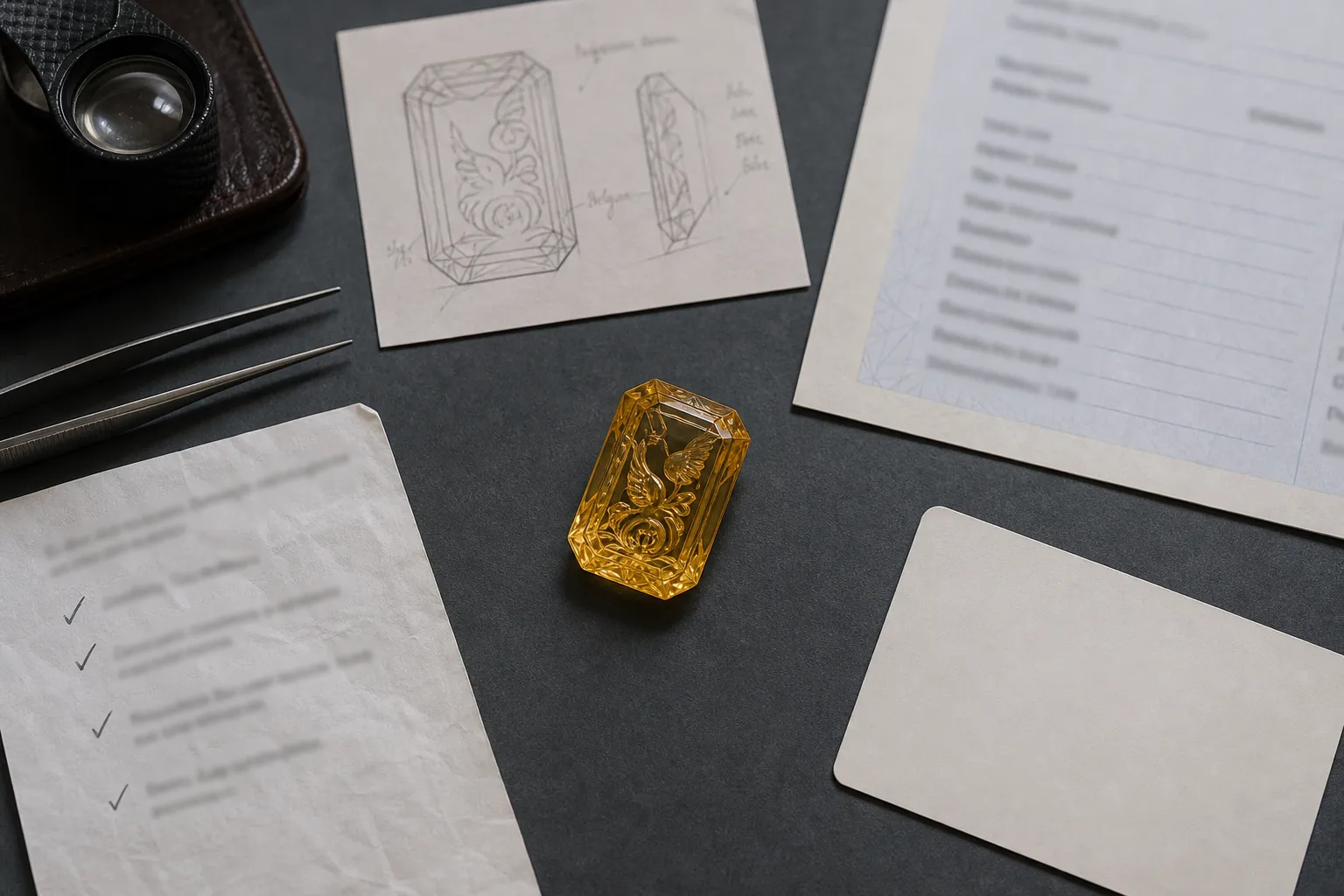
The phrase 3D Gemstone Faceting sits between two ideas. “Faceting” suggests polished faces and controlled angles. “3D” suggests sculpted volume, relief, or dimensional form. Used carefully, the term can help a reader distinguish shaped gemstone material from ordinary flat facet cutting. Used loosely, it can make any unusual cut sound technically superior.
One confusion is that “more complex” can sound like “more valuable.” A carved gemstone may require thoughtful design and careful work, but value also depends on material identity, color, transparency, condition, size, treatment disclosure, maker recognition where relevant, and market context. This article does not provide enough sourced evidence to rank carved stones against flat faceted stones in value terms. Complexity is not verification.
Another confusion is that “three-dimensional” can sound as if flat faceted gems are not dimensional. They are. Every gemstone is a physical object with depth. The difference is not that flat facets are two-dimensional in reality; it is that their design language emphasizes flat planes arranged on a three-dimensional body. 3D gem carving emphasizes the body itself as the design field.
A third confusion involves optical refraction. Carved surfaces can change how light appears to enter, bend, reflect, or scatter from a viewer’s perspective, but this page cannot support precise claims about particular angles, formulas, or performance outcomes. Stronger claims would require proper gemology, optics, materials science, or documented lapidary sources.
The clean answer is enough. Flat facet cutting organizes the gem through planes. 3D carving organizes the gem through volume, relief, and controlled removal.
A Cleaner Way to Read a Carved Citrine Claim
Describe what can be seen
Is the stone mostly flat-faceted, or does it contain sculpted curves, relief, grooves, ridges, or dimensional shaping? Does the color appear even, zoned, deeper in thick areas, or changed by the carving? These are visual observations. They do not require accepting a seller’s conclusion.
Separate design language from identity language
“Carved,” “3D faceted,” and “sculptural” describe form. They do not establish natural citrine. They do not rule out treated material. They do not prove synthetic origin either. They simply do not answer that question.
Look for disclosure
A serious description should not lean only on sparkle, rarity, mood, or a dramatic name for the cut. For a citrine purchase, useful information addresses material identity, treatment context where known, condition, and any documentation offered. If those details are absent, the buyer is left with appearance and seller wording, not gemological verification.
Keep personal meaning in its lane
A carved golden stone may feel more intimate in the hand or more expressive under light, and that can matter to the owner. But meaning should come after material facts, not replace them. A sculpted surface can change how a gem is experienced; it cannot turn an unsupported identity claim into evidence.
The Evidence Boundary for This Page
The source packet supplied for this article contains no confirmed public references, no technical lapidary manuals, no optical studies, no materials-science documentation, and no verified firsthand carving reports. For that reason, this page stays at the level of careful conceptual explanation. It does not give cutting instructions, name a workshop method, claim measured optical results, compare tool systems, or provide safety procedures.
What the page can support is the reader-level distinction: flat facet cutting relies on arranged planes, while 3D gem carving treats the gemstone as shaped volume created by subtractive removal. That difference can affect how the object looks, how the eye follows surface geometry, and how internal light movement is perceived. The exact result depends on the individual material and design.
For citrine, the verification consequence is direct. A carved form may be beautiful, unusual, or skillfully presented, but it is not evidence of natural origin by itself. If the buying question is authenticity, ask for material facts. If the viewing question is design, study the shape, polish, depth, and light response. Keep those questions separate.
Flat facets make order visible. 3D carving makes volume visible. Neither one proves the stone’s identity. The evidence has to do that work.