Bidding on Rarity: Understanding the Dynamics of Gemstone Auctions
Bidding on rare gems is a decision made under pressure, not just a reaction to beauty. The practical gemstone auction dynamics come down to a few linked questions: what the stone is said to be, what documentation supports that description, how the estimate is being used, what the full purchase cost would be, and whether the buyer is comfortable owning the gem if resale is slower or less predictable than hoped.
The safest way to approach a rare gemstone auction is to treat bidding as a verification process before it becomes a buying moment. Rarity can explain why a lot attracts attention. It does not, by itself, prove value, future demand, or the wisdom of raising a bid.
broader context
Broader citrine reference
This narrower page works best after the broader citrine reference page.
What a Rare Gem Auction Actually Asks You to Judge
An auction listing usually gives a buyer a compact set of signals: species or variety, color, size, cut, treatment language, origin wording, provenance, reports, estimates, and sale conditions. Those signals can be useful, but they are not the same as certainty.
The most common mistake is treating “rare” as a single meaning. A gem may be rare because of its material type, color, size, origin claim, untreated status, collection history, or simply because comparable examples are not often seen in public sales. Those meanings are not interchangeable. A small stone with strong documentation, a large stone with unclear treatment history, and a jewel tied to a known collection all ask for different kinds of scrutiny.
A careful bidder slows the listing down
- What exactly is the gem being called?
- What supports that identification?
- Is treatment clearly addressed?
- Is origin stated, attributed, implied, or not discussed?
- Is provenance documented or only suggested?
- What costs sit outside the hammer price?
The auction setting adds urgency, but it does not change the underlying task. The buyer still has to decide whether the object, paperwork, price structure, and personal reason for buying fit closely enough to justify a bid.
How to Read Auction Estimates Without Overreading Them
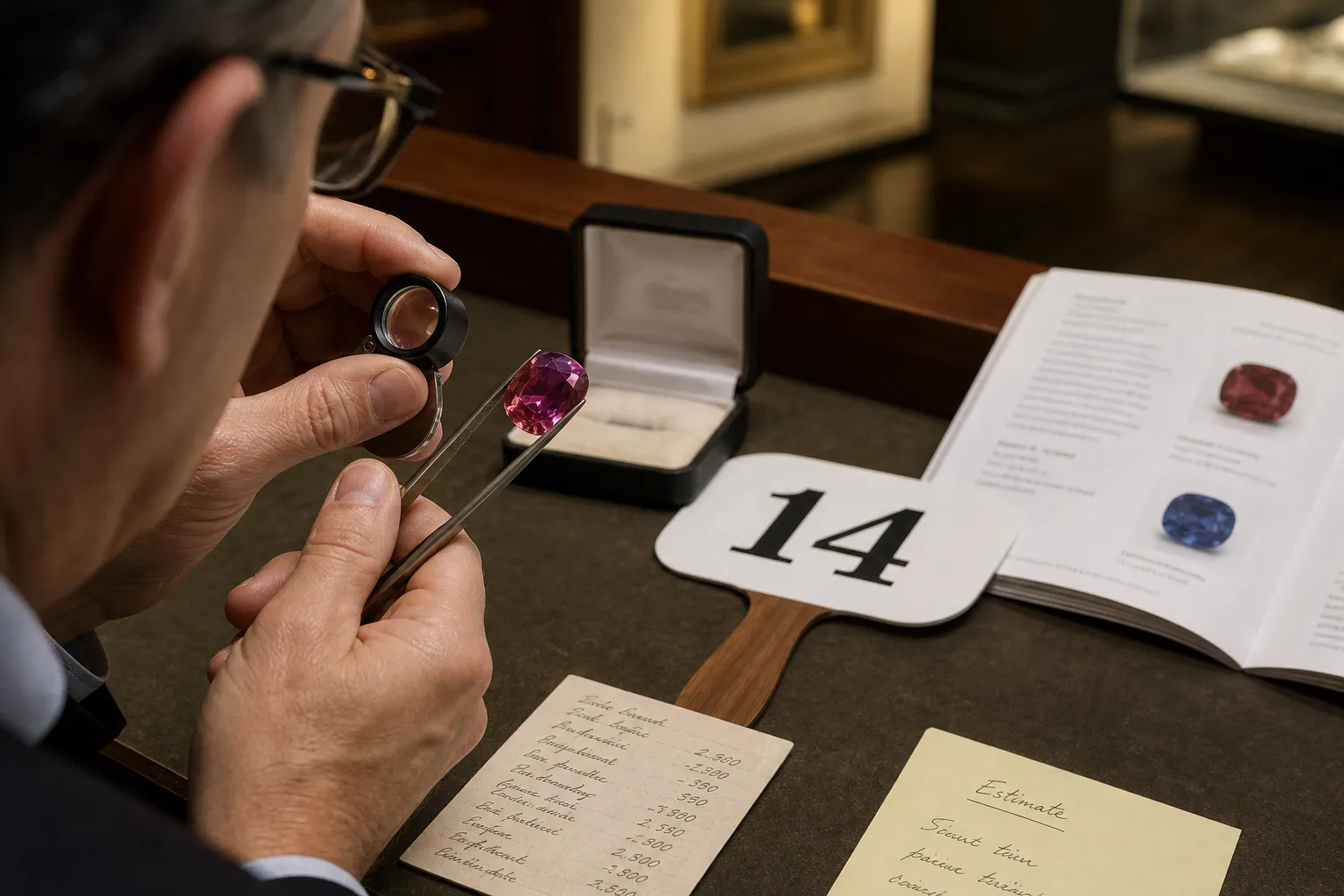
Gemstone auction estimates can help frame a lot, but they should not be read as promises of fair value, resale value, or future appreciation. In plain terms, an estimate is a pre-sale range attached to a lot. It is an auction-context signal, not a substitute for an independent appraisal or a guarantee of what the gem is worth to every buyer.
A low estimate may draw attention. A high estimate may make a stone feel exceptional. A narrow range may suggest confidence; a wide range may leave more room for uncertainty. None of that replaces checking the documents, condition language, sale terms, and total cost.
Final sale prices also need caution. A hammer price may reflect the bidders present that day, the visibility of the sale, presentation, timing, confidence in the listing, or competition between only a few people. It should not be treated as a universal price for every similar gemstone. Rare gems are hard to compare because small differences in color, clarity, cut, treatment disclosure, size, origin wording, and provenance can change buyer response.
If a buyer is thinking in investment terms, the boundary matters even more. A gemstone bought at auction may be beautiful, collectible, or personally meaningful, but that does not make it a reliable financial instrument. Rare gemstone liquidity should not be assumed from a dramatic sale result. Resale depends on documentation, demand, timing, fees, venue, condition, and buyer confidence in the stone’s description.
Useful valuation questions
- Is the estimate responding to the gem, the jewel, the provenance, or the complete presentation?
- What documentation is available, and what does it leave unresolved?
- What would the total price be after buyer costs?
- Would I still want this stone if resale took longer, cost more, or proved uncertain?
That last question keeps the decision honest.
Why Rarity Premiums Are Hard to Separate From Bidding Pressure
Rarity premiums in auctions are often discussed as if they are easy to isolate: a rare stone appears, bidders compete, and the final price shows what rarity is worth. Real bidding is messier. The final price may reflect rarity, but it may also reflect timing, presentation, fashion, collection history, confidence in the documents, and the emotional momentum of the room.
This is what makes bidding on rare gems different from ordinary retail comparison shopping. At retail, a buyer can often pause, compare, leave, and return. At auction, the window is compressed. The buyer may believe that missing the lot means missing a rare chance. Sometimes that feeling is reasonable. It can also push a bidder past the number they set before the sale.
Attractive price
The level where the lot feels like a clear opportunity.
Acceptable price
The level that still makes sense after fees and uncertainty.
Walk-away price
The number that should not move once bidding starts.
This is not a strategy for winning. It is a guardrail against letting the auction set the buyer’s judgment.
Buyer premiums and related costs belong in that guardrail. Fee structures vary, so the relevant auction house’s terms should control the calculation. The simple point is that the hammer price is not always the full amount paid. Taxes, shipping, insurance, import requirements, payment fees, or other sale-related costs may also matter.
Reserves and unsold lots also need careful reading. A lot failing to sell does not automatically prove that the gem was overvalued, undesirable, or misrepresented. A lot selling above estimate does not automatically prove broad market strength. Auction outcomes are signals, not complete explanations.
Documentation Is Part of the Lot
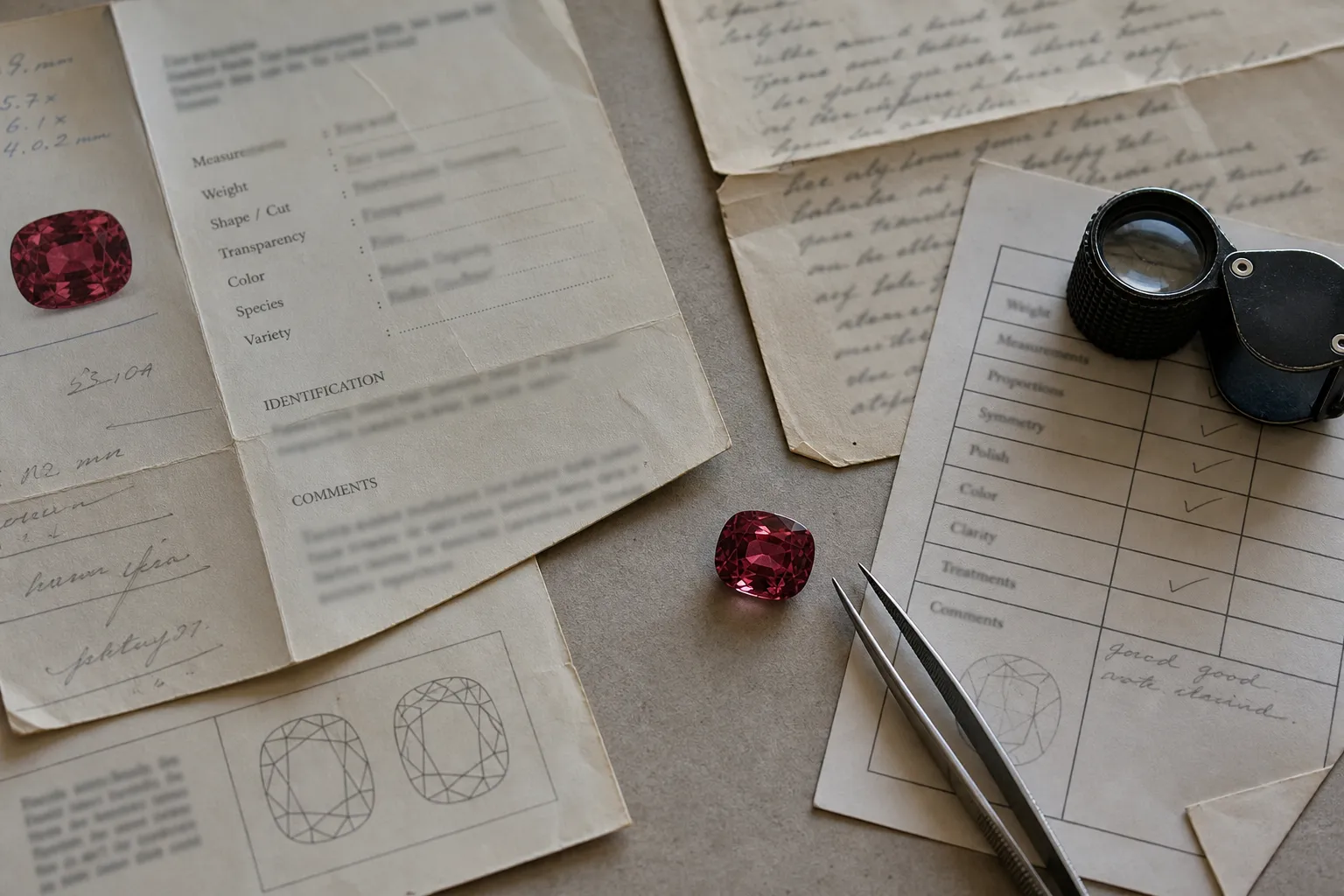
In rare gem auctions, paperwork can shape bidder confidence. A gemological report, treatment disclosure, provenance record, condition report, or prior sale history may clarify what is being offered. But the existence of paperwork should not end the inquiry.
The buyer still needs to understand who issued the document, what it covers, what it does not cover, whether it is current enough for the decision, and whether the auction listing matches it. Small wording differences can matter. Terms such as “natural,” “treated,” “heated,” “untreated,” “origin,” “attributed,” “type,” “variety,” and “provenance” are not decorative. They can change how the stone is understood.
Condition is also more than surface beauty. A gemstone may have chips, abrasions, recutting concerns, mounting limitations, durability issues, or setting-related complications that are not obvious in a polished catalog image. A jewel containing a rare gem adds another layer: the stone, mounting, craftsmanship, period style, and wear condition may each affect the decision.
This is especially important in secondary market purchasing. A prior owner, old collection note, or historic setting can add interest. It does not replace gemological verification or a clear understanding of current condition.
Common Misunderstandings About Auction Value
Auction visibility is not full market authority
A stone appearing in a notable sale may deserve attention, but the sale setting does not answer every buyer question. The listing, documents, and conditions of sale still need to be read closely.
One result is not a universal price guide
Rare stones are not standardized units. Even gems with the same mineral name can differ sharply in color, clarity, cut, size, treatment, origin wording, and documentation.
Competition does not prove investment quality
Competition may show that at least two bidders wanted the same lot at that moment. It does not establish future demand, simple resale, or a favorable outcome after costs.
A pre-sale estimate does not protect the bidder
Estimates frame expectations. The bidder’s own ceiling still has to include uncertainty, buyer costs, and purpose.
A Practical Way to Prepare Before Bidding
A buyer does not need to become an auction specialist to bid more carefully. The preparation can stay narrow.
- First, name the reason for interest. Is the goal personal ownership, collection building, study, design use, symbolic meaning, or financial exposure? The same gem may make sense as a personal purchase while being a poor basis for investment assumptions.
- Second, read the lot description as a set of claims. Separate what is clearly stated from what is implied. If treatment, origin, provenance, or condition matters, do not rely on photography or elegant shorthand.
- Third, request and review available documentation before the sale when possible. If a report or condition statement is mentioned, check what it actually says. If something important is missing, treat that absence as part of the risk.
- Fourth, calculate the full cost. Include the bid limit, buyer premium, and any other sale-related costs that apply to the venue and location.
- Fifth, set the walk-away price before bidding begins. That number should reflect the gem, the documents, the uncertainty, and the reason for buying. If the lot passes that number, losing may be the more disciplined outcome.
This preparation does not guarantee a good purchase. It simply moves the buyer from reactive bidding toward a clearer decision.
Where This Answer Stops
This page can explain the buyer’s decision points in general terms, but it cannot verify specific auction-house valuation methods, typical premium levels, resale timelines, rare-gem investment performance, or liquidity patterns. Those questions require auction-specific documents, qualified gemological review, and, where money or tax treatment is material, appropriate professional advice.
For most readers, the practical answer is simple: approach rare gem auctions as a disciplined evaluation of object, paperwork, price, and purpose. Rarity may explain why a lot attracts attention, but it should not be the only reason to raise a paddle.