Cracking the AAA Code: What Makes a Flawless Madeira Citrine?
An AAA Madeira citrine is best read as a retailer’s premium label for citrine with a rich Madeira-style color: saturated deep red-orange to orange-red, usually in a medium-dark tone, with enough transparency and brightness to avoid looking muddy.
The word “flawless” needs more caution. It is not an official citrine grade. In retail copy, it usually means the stone looks eye-clean, has lively cutting, and is presented with clear treatment and origin information when those claims affect price.
The key point: AAA is not a universal citrine grade, and Madeira is a trade/color term, not automatic proof of natural color, untreated status, or a specific mine.
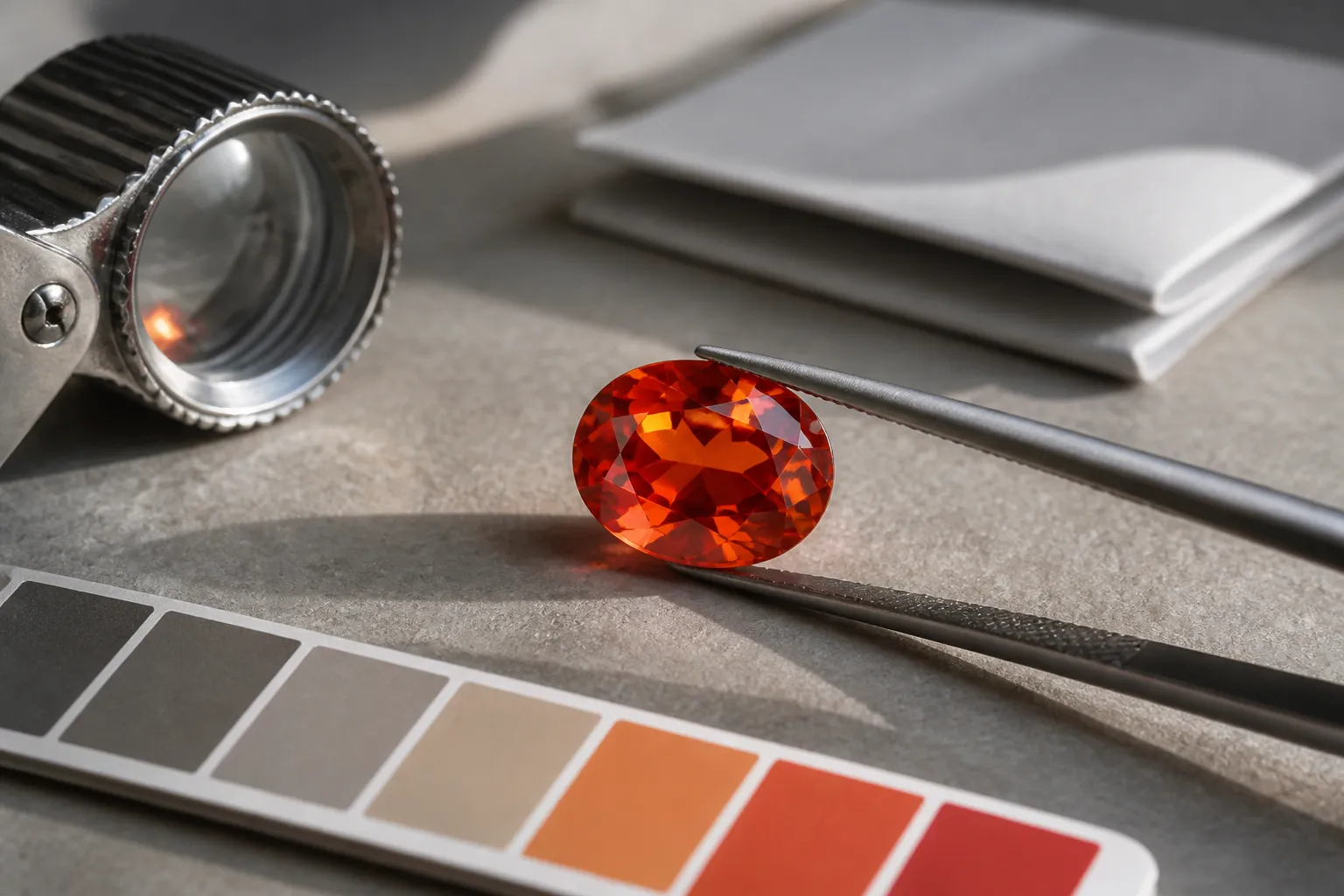
What “AAA Madeira citrine” usually means
Sellers are combining two ideas when they use the phrase AAA Madeira citrine:
AAA
A seller’s quality tier, often meant to signal high-grade or near-top-grade material.
Madeira citrine
A warm color description for citrine with orange-red, reddish-orange, deep amber, tea, whiskey, honey, or ember-like tones.
That shorthand can be useful, but it is not the same as a standardized laboratory grade. The available higher-quality references do not establish an official “AAA Madeira citrine” threshold, a universal Madeira color chart, or a single citrine color grade that all sellers must follow.
Better buying question
Does the stone actually show the visual and documentation qualities that make a premium Madeira label believable?
For a faceted Madeira citrine, that usually means:
- Saturated orange-red or reddish-orange body color
- Medium-dark tone that still stays bright
- Good transparency, not a cloudy or opaque look
- Eye-clean appearance in normal viewing
- A cut that returns light instead of flattening the color
- Clear disclosure about treatment, natural-color claims, and origin claims
If one of those pieces is missing, the label may still reflect the seller’s internal opinion, but it becomes weaker as a quality signal.
The Madeira color should be deep, warm, and still alive
Color is the center of Madeira citrine quality. In retail language, Madeira citrine is usually separated from pale lemon-yellow citrine by its warmer, deeper, more autumnal appearance. A strong example may look orange-red, reddish-orange, deep amber, or glowing whiskey-orange with red flashes.
The most convincing Madeira citrine color is not just “dark.” It should have a clear warm hue and visible saturation. A stone can be medium-dark and lively, or it can be dark in a way that swallows light. Those are very different looks.
Hue
Orange with a red or reddish-brown modifier, not greenish yellow or flat brown.
Tone
Medium-dark enough to feel rich, but not so dark that the stone looks closed.
Saturation
Strong color concentration, not washed out or grayish.
Brightness
Visible light return through the stone, especially when it moves.
Scientific work on citrine and quartz color uses technical ideas such as lightness, hue, and chroma. That does not create a consumer-facing AAA standard, but it supports a practical point: color quality is not one trait. Hue, tone, saturation, and brightness all shape how the gem appears.
This matters in jewelry. A deep red-orange citrine may look dramatic in a close-up product photo but much darker once it is set in metal. If the setting blocks light or the cut is too deep, the finished ring may look brown, smoky, or dull rather than glowing.
Medium-dark is desirable only before it turns muddy
The phrase medium-dark tone is useful when shopping for Madeira citrine because the color is not expected to look pale. It should have body and warmth. But medium-dark should not be confused with over-dark.
A stone starts to lose its premium look when it enters the muddy zone. Watch for color that reads as:
- burnt brown rather than orange-red
- smoky or grayish instead of warm
- opaque or cloudy instead of transparent
- so dark that the facets disappear
- flat under ordinary indoor lighting
- lively only in seller lighting but dull elsewhere
This is where many “AAA citrine grade” claims deserve a second look. A seller may describe darkness as intensity, but a better Madeira citrine still has brightness inside the color. The stone should let light move through it.
A simple check: view the gem in more than one lighting condition. It may look richer under warm lighting and slightly different under daylight-equivalent light. That is normal for colored gems. What you do not want is a stone that collapses into dull brown as soon as the lighting becomes less flattering.
For online purchases, ask for more than one image or a short video. One saturated product photo cannot show whether the stone has lively Madeira color or only a dark face-up appearance.
What “eye-clean Madeira citrine” should imply
For a faceted citrine sold as AAA, eye-clean usually means there are no obvious inclusions or internal features visible to the unaided eye in normal viewing. It does not necessarily mean the stone is literally flawless under magnification.
That distinction matters because retail descriptions often use words like flawless, clean, crystal clear, or exceptional clarity. For a shopper, the useful questions are more practical:
- Do inclusions distract from the face-up beauty?
- Do they interrupt transparency?
- Do they make the stone look cloudy?
- Are there visible cracks, chips, or surface-reaching features?
- Are internal features hidden near the edge or obvious in the center?
Madeira citrine clarity should be judged together with transparency and light return. Rich color can hide small inclusions, but it can also make the interior look murky. A lighter, brighter stone may reveal more internal detail while still looking cleaner overall.
In most jewelry use, a premium-looking Madeira citrine should appear clean to the unaided eye when viewed face-up. If a seller calls a stone AAA but the photos show cloudy zones, fractures, or dark internal distractions, the grade is worth questioning.
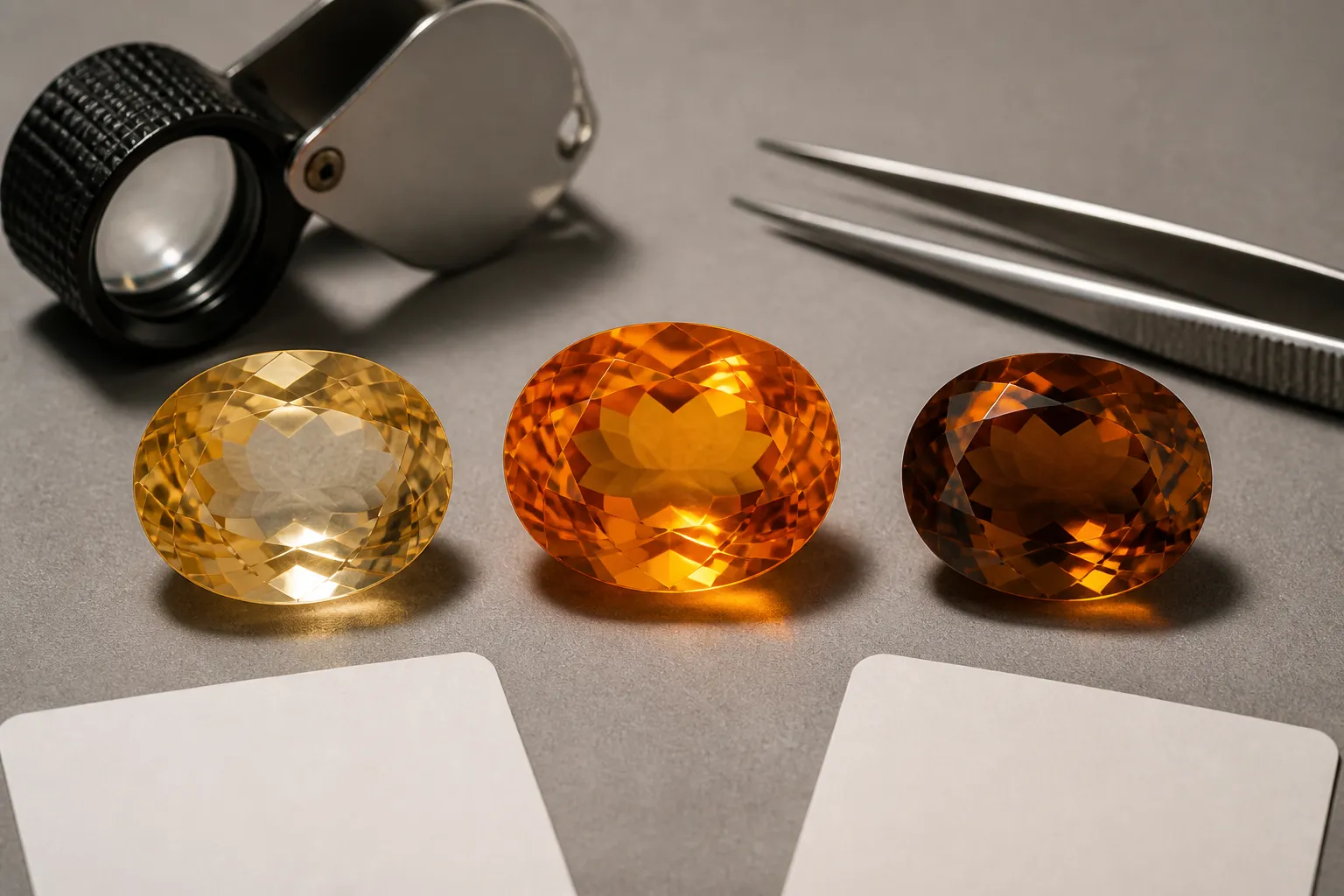
Cut decides whether the color glows or goes flat
Color may be the first thing you notice, but cut is what makes that color perform. A saturated orange-red citrine can still disappoint if it is poorly cut.
A well-cut Madeira citrine should show:
- even face-up color without a large dead center
- good symmetry for the chosen shape
- enough depth to hold color without blacking out
- enough light return to create movement and brightness
- polished facets that look crisp, not tired
Two cut issues matter especially for deep citrine.
Window
The center looks pale or see-through because light leaks through instead of returning to the eye. In a Madeira stone, a window weakens the saturated red-orange look that made the gem appealing.
Extinction
Areas look overly dark or black because the cut does not return light well. Some contrast can make a colored gem lively, but too much darkness makes it look heavy and closed.
That is why the strongest Madeira citrine quality is not simply the deepest possible color. It is saturated color supported by a cut that keeps the stone visually alive.
Treatment and origin disclosure matter
Citrine belongs to the quartz family, and quartz color can be influenced by structural defects, color centers, and heat-related change. Research on amethyst-to-citrine color change also shows that heating can produce citrine-like colors under certain conditions.
For a buyer, the key point is not that treatment automatically makes a citrine unattractive. The key point is disclosure.
A Madeira citrine listing should be especially clear when it uses terms such as:
- natural
- untreated
- heat-treated
- genuine
- Brazilian
- Santa Ana
- mine-origin
- certified
- appraised
Those words are not interchangeable. “Madeira” does not prove natural color. “AAA” does not prove untreated status. “Santa Ana” or a country name does not prove origin unless the seller provides documentation that supports the claim.
U.S. jewelry marketing guidance and gem trade disclosure practices support the broader principle that gemstone descriptions should not mislead buyers, especially when treatments or identifying claims affect value or expectations. Those sources do not define AAA Madeira citrine, but they do reinforce why clear, non-confusing descriptions matter.
For a higher-value Madeira citrine or an important ring purchase, ask for written answers. If natural color, untreated status, or specific origin is part of the price story, it should be documented rather than implied through romantic naming.
A practical checklist for judging an AAA Madeira citrine claim
Use the label as a starting point, not a final verdict.
Visual checklist
A strong AAA-style Madeira citrine should show:
- Saturated orange-red, reddish-orange, or deep amber-orange color
- Medium-dark tone without turning dull brown
- Brightness when the stone moves
- Transparent body, not cloudy or opaque appearance
- Eye-clean face-up look in normal viewing
- Cut that avoids a large window or overly dark center
- Color that remains attractive in more than one lighting condition
Be cautious if the stone shows:
- muddy Madeira citrine color
- burnt or smoky brown appearance
- flat color with little light return
- obvious internal distractions
- exaggerated color in only one product photo
- unclear treatment language
- origin claims without supporting documentation
Seller-question checklist
Before treating the AAA label as meaningful, ask:
- What does “AAA” mean in your grading system?
The seller should be able to explain whether it refers to color, clarity, cut, size, or an internal quality tier. - Is the color natural, heat-treated, or otherwise treated?
The answer should be direct, not hidden inside vague wording. - Is “Madeira” being used as a color term or an origin term?
In most shopping contexts, it is safest to treat Madeira as a trade/color term unless documentation says otherwise. - Is the stone eye-clean, and under what viewing conditions?
Ask about unaided-eye appearance, not only magnified photos. - Can I see the stone in daylight-equivalent and indoor lighting?
This helps separate rich orange-red color from over-dark brown. - If origin or untreated status affects the price, is there a report or written documentation?
Documentation matters most when the claim is part of the value story.
Common confusion around AAA, Madeira, and “flawless”
The biggest misunderstanding is treating AAA Madeira citrine as a code with one fixed meaning. It is not. The AAA part usually changes from seller to seller because it is a retail grade, not an external standard.
Another common mistake is assuming Madeira citrine must be rare, natural, untreated, or from a particular location. The available evidence does not support using the Madeira name that way by itself. It is more reliable to read it as a color and trade description unless stronger documentation is provided.
Some listings also mix gemstone quality with symbolic or prosperity-related marketing language. Those associations are separate from grading. They do not establish color grade, clarity, treatment status, origin, or price.
Finally, “flawless” should be read carefully. In retail copy, it may simply mean visually clean and attractive. For a buying decision, translate it into observable features: eye-clean appearance, transparency, lively cut, strong Madeira color, and clear disclosure.
The bottom line
A convincing AAA Madeira citrine is not defined by a universal grading authority. It is a market phrase that should point to a saturated deep red-orange citrine with medium-dark tone, good transparency, eye-clean appearance, lively cutting, and clear treatment or origin disclosure.
The strongest stones are not just dark. They stay bright. They do not turn muddy, smoky, or burnt-looking. They show red-orange warmth without losing transparency. And the seller can explain exactly what “AAA” means instead of relying on the label to do all the work.