The Trap of Perfection: Why Flawless Citrine Should Make You Suspicious
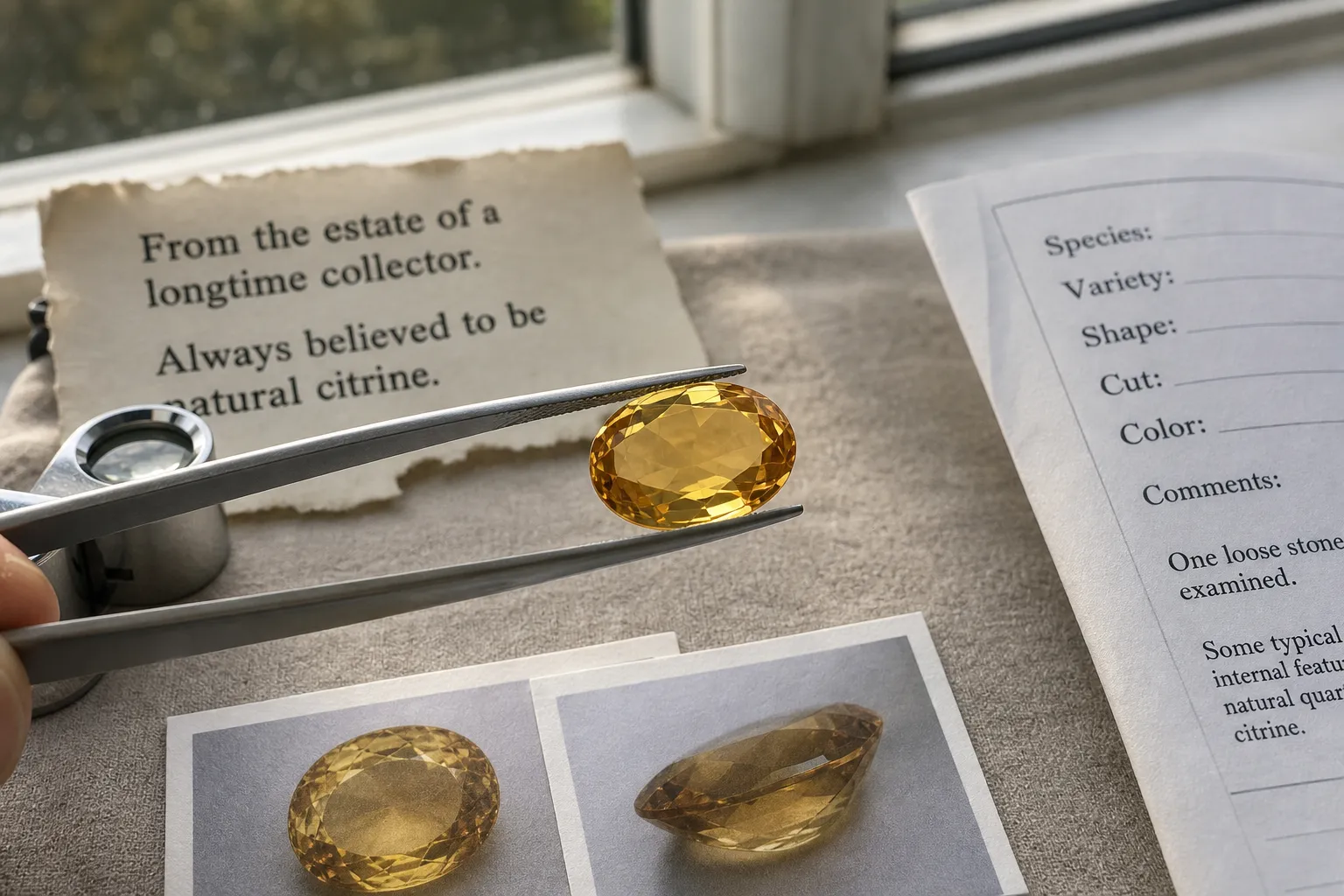
A flawless-looking citrine should make you pause because perfect clarity can hide a weak story. The stone is not automatically fake, synthetic, treated, or mislabeled. For practical flawless citrine identification, clarity works best as a warning light: it tells you to inspect the claim, the price, the photos, the seller’s wording, and any documentation before trusting the presentation.
The better question is not “Can real citrine ever look clean?” It is “Does this clean appearance make sense with everything else I can verify?”
If the stone looks glassy, evenly colored, unusually inexpensive, vaguely described, and sold with little disclosure, caution is reasonable. If the seller gives clear context and the stone’s appearance fits that context, clarity alone is not enough to judge it.
broader context
Start with the main citrine page
This narrower page works best after the broader citrine reference page.
Why a “Too Perfect” Citrine Raises a Flag
People usually call citrine “too perfect” when it looks almost empty inside: no obvious internal features, smooth color, strong shine, and a polished listing photo that makes the stone look effortlessly flawless. In everyday shopping language, that may be described as glass-like, suspiciously clean, eye clean, or perfect clarity quartz.
Those impressions matter, but not because beauty is suspicious by itself. They matter because a very clean stone gives you fewer visible clues to compare. When casual visual inspection tells you little, the burden shifts to context:
- What exactly is the seller claiming?
- Is the wording specific or just flattering?
- Are the photos informative, or only attractive?
- Is the price consistent with the claim?
- Is there any documentation or testing language?
- Can the seller explain what is known and what is not known?
That is the trap of perfection. A seller can point to brightness and clarity as if they settle the question. They do not. A flawless-looking citrine may be appealing, but appearance cannot replace disclosure.
This matters even more online. Photos can flatten internal detail, exaggerate color, hide small features, or make a stone look cleaner than it appears in hand. A perfect orange-yellow gem in bright lighting may be attractive, but it is not a complete identification record.
What Clarity Can and Cannot Tell You
Clarity is one visible clue, not a final answer. It can help you decide whether a citrine deserves closer inspection, but it cannot prove origin, treatment status, authenticity, or value on its own.
A flawless or eye clean citrine may simply be a clean-looking stone. “Eye clean” usually means obvious internal features are not visible to the unaided eye. That does not prove the stone is natural, and it does not prove the opposite either. A stone can look clean for more than one reason, and ordinary viewing cannot reveal every part of its material history.
A citrine clarity warning sign becomes meaningful when it clashes with the surrounding story. One clean stone is not enough. A clean stone plus vague claims, pressure selling, no documentation, and a price that seems too convenient is a different situation.
Use clarity as a prompt for better questions, not as a verdict.
The Context That Changes the Answer
The same flawless-looking citrine can feel more or less suspicious depending on the evidence around it.
Seller language
Seller language matters first. “Natural,” “genuine,” “real,” “untreated,” and “authentic” are not casual synonyms when money depends on them. If a listing uses strong words without explaining how they are supported, perfect clarity should make you more cautious.
Documentation
Documentation matters next. Not every small decorative purchase needs a formal report. But if the claim is expensive, rare, or central to the price, the absence of meaningful support matters. A flawless-looking citrine sold with a confident origin story should have more behind it than attractive photos.
Price
Price is not proof, but it is a useful pressure test. If the stone looks perfect, the claim sounds premium, and the cost feels surprisingly low, slow down. The mismatch does not settle the answer, but it gives you a reason to ask more.
Inventory patterns
Inventory patterns can also change your confidence. One clean-looking stone may not mean much. A whole group of near-identical stones with the same color, same clarity, and the same vague description deserves more scrutiny.
Purpose
Your purpose matters too. If you only want a yellow-orange decorative piece and the seller makes modest claims, the risk may be about expectations. If you are paying a premium for natural origin, treatment status, or collectible value, visual clarity is not enough.
“Flawless” Is Not the Same as “Fake”
The biggest mistake is turning suspicion into certainty. A flawless-looking citrine is not necessarily fake. A suspiciously clean stone is not automatically synthetic. A stone with perfect clarity is not automatically treated or misrepresented.
The opposite mistake is assuming that beauty proves quality, and quality proves authenticity. A bright, clean, well-cut stone can still leave important questions unanswered. Appearance can attract your attention; it cannot do the work of disclosure.
There is also a wording problem. In casual shopping, “flawless” may mean “I cannot see anything inside it.” In stricter gem language, clarity can involve more careful examination and clearer standards. If a seller says “flawless,” ask what they mean. Do they mean no visible inclusions to the eye, no marks visible in photos, or something examined more carefully? Those are different claims.
The careful position is simple: this citrine looks clean enough that I need more context before trusting the claim.

A Simple Inspection Path
You do not need a laboratory mindset to respond wisely to a too-perfect citrine. You need a clean decision path.
- Start with the claim. “Citrine pendant” is different from “natural untreated citrine.” A vague decorative description is different from a premium origin claim. The stronger the claim, the stronger the support should be.
- Then look at the images. Are there neutral photos from more than one angle, or only beauty shots? Is the stone shown in lighting that helps you judge color and transparency, or only in flattering conditions? Photos do not prove identity, but they can show whether the seller is trying to inform you or simply impress you.
- Next, read for what the description avoids. A transparent seller can say what is known, what is unknown, and what has not been tested. A weak description often uses broad reassurance while skipping origin, treatment, testing, or uncertainty.
- Then compare price, claim, and support. Do not use price as proof. Use it as a consistency check. If the answer to every concern is basically “look how clear it is,” you do not have enough.
- Finally, decide whether professional evaluation is worth it. For a low-cost decorative item, you may simply choose not to pay extra for unsupported claims. For a higher-value stone, a gift sold with a stated origin, or a purchase where natural versus synthetic citrine matters to you, visual inspection should not be the final step.
When Suspicion Is Reasonable
Suspicion is reasonable when perfect clarity appears alongside weak signals: confident claims with no basis, unusually uniform color across many pieces, overly polished photos, emotional sales language, missing treatment or origin details, or a price that does not seem to fit the story.
Suspicion is also reasonable when your question is specific. If you only want something attractive, clarity may be a style preference. If your question is “Is this natural citrine?” or “Is this worth a premium?” then clarity becomes part of a broader evidence problem.
Keep the suspicion disciplined. Do not accuse a stone or seller based on clarity alone. Do not make a final judgment from one photo. The useful conclusion is narrower: the cleaner the citrine looks, the more carefully the surrounding claim should be checked.
The Limit of This Answer
This page is intentionally narrow. The available reference set for this article does not support lab-level identification rules, market statistics, treatment frequency claims, or a definitive natural-versus-synthetic checklist.
The practical answer is still useful: unusually flawless-looking citrine can be a warning sign because it should push you to inspect the story around the stone. Ask for clearer wording, better images, meaningful documentation, and professional evaluation when origin or treatment status affects the purchase.
Clarity alone does not prove the answer. It tells you when the answer is not yet supported.
FAQ
Does flawless citrine mean it is fake?
No. Flawless-looking citrine is not automatically fake. It is a reason to look more closely at the seller’s claim, documentation, photos, and price.
Can natural citrine look eye clean?
A citrine may look eye clean in ordinary viewing, but that observation alone does not establish origin or treatment status. It only describes what you can see without deeper evaluation.
What should I ask a seller about a perfect-looking citrine?
Ask what is being claimed, whether origin or treatment status is known, whether any testing or report exists, and what the seller cannot confirm. Clear limits are more useful than broad reassurance.
Should I avoid every citrine that looks too perfect?
No. Avoid treating clarity as proof either way. A clean stone can be acceptable if the claim is modest or well supported. The concern begins when perfect appearance is used to cover weak disclosure.