Sacred Geometry Grid Boards
The Anatomy of a High-Frequency Grid: Birch Wood vs. Selenite Bases
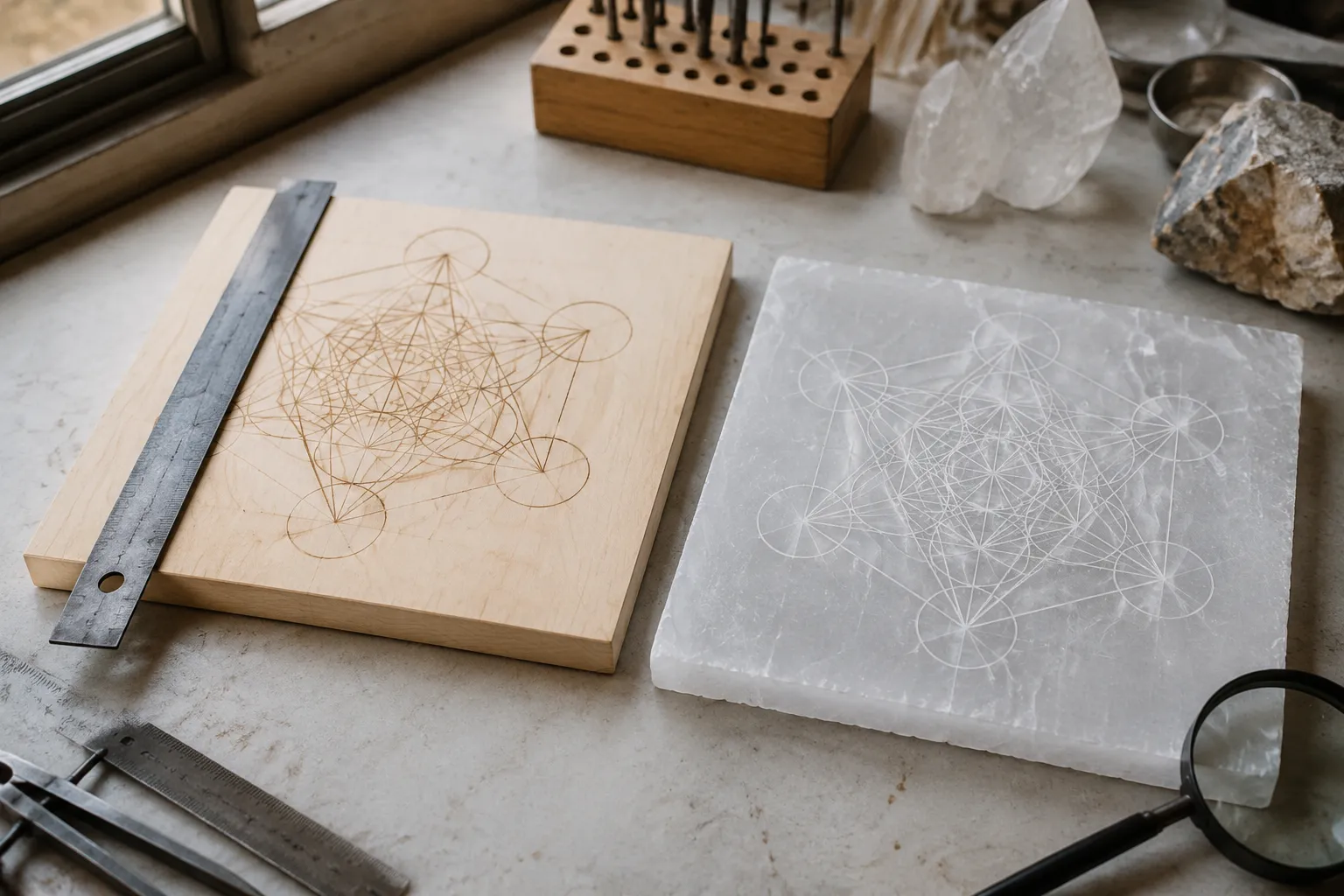
For Sacred Geometry Grid Boards, birch wood and selenite represent two different kinds of physical foundation. Birch is a wood product whose usefulness depends on construction, flatness, finish, moisture response, dimensional movement, and care. Selenite is a mineral material associated with gypsum; the available evidence does not establish that it emits, stores, amplifies, or changes electromagnetic frequencies.
The practical choice is not a proven contest between two “high-frequency” substances.
It is a comparison between physical infrastructure and symbolic interpretation. A birch base may suit a board intended for ordinary handling and a finished, readable surface. A selenite base may carry stronger mineral or ritual meaning for some readers, but its product-level behavior as a grid-board base is not sufficiently documented in the supplied evidence.
broader context
Broader citrine reference
This narrower page works best after the broader citrine reference page.
What the Base Material Changes
A grid board is first a physical object. Its base affects whether the working surface remains usable, how the geometry is presented, how the board is handled, and what care it may require. The material may also influence appearance and the meaning a reader assigns to the ritual setting. These are separate questions.
General wood-engineering principles provide useful context for birch. Wood responds to environmental conditions; moisture can affect its dimensions, while construction quality influences the stability and serviceability of a finished wood product. The USDA Forest Service’s Wood Handbook supports this broad material context. It is not a controlled comparison of birch and selenite grid boards.
That distinction matters when a listing describes a birch board as “grounding,” “stable,” or “naturally harmonizing.” “Stable” may refer to a level surface or sound construction. “Grounding” and “harmonizing” may describe symbolic language. They are not interchangeable forms of evidence.
Selenite requires the same separation between identity and performance. The U.S. Geological Survey’s gypsum reference supports discussing selenite within mineral and gypsum terminology. It does not establish a measurable spiritual frequency, or provide enough information to make broad claims about a finished selenite board’s durability, water response, scratch resistance, weight, or long-term performance.
The base material changes the object’s physical expectations. It does not, by itself, establish a frequency claim.
Birch Wood Grid Board Bases: Construction Comes First
A birch base is best evaluated through qualities that can be inspected on the object itself.
Flatness and Dimensional Movement
A grid depends on a readable, usable surface. Check whether the geometry sits on a reasonably flat base and whether the board shows visible warping, cupping, cracking, or uneven joins. These observations cannot predict how the board will behave over time, but they can reveal an immediate construction concern.
Wood’s response to moisture is a general material consideration. Changes in moisture conditions can contribute to dimensional movement, so storage, finish, construction, and the surrounding environment all matter. A birch board should not be treated as dimensionally inert simply because it is marketed for ritual use.
This is a practical expectation, not a birch-versus-selenite test result. The supplied research does not establish a specific movement rate or failure threshold for grid boards.
Construction Quality
“Birch wood” does not describe the whole board. The label may refer to a solid piece, laminated construction, veneer, or another wood-based assembly. The available sources do not provide product-level specifications for the boards in question.
Before choosing one, check:
- whether the base is solid wood or a composite construction;
- whether the surface is sealed or unfinished;
- whether the geometry is printed, engraved, painted, or applied as a separate layer;
- whether the board sits level without rocking;
- whether the edges and joins are cleanly finished;
- whether storage and cleaning instructions are provided.
These questions are more useful than treating “birch” as a complete quality guarantee. Material identity is one part of construction; it does not replace inspection or seller disclosure.
Moisture and Care
Keep a wood board away from unnecessary moisture and follow the maker’s care instructions when they are available. Do not assume that every finish offers the same protection, or that a sealed surface is immune to environmental movement.
The evidence supports discussing wood as moisture-responsive and dimensionally active in general terms. It does not support a detailed care schedule for every birch board. When a listing gives no finish or care information, that omission belongs in the buying decision.
Selenite Grid Board Bases: Mineral Identity Is Not Performance Evidence
Selenite is commonly discussed in relation to gypsum and mineral identity. That terminology is more precise than calling it inherently energetic. A mineral label tells you what kind of material is being discussed; it does not establish what a finished object can do in a ritual, electromagnetic, or health-outcome context.
For a selenite-based board, ask similar physical questions:
- Is the board a solid mineral surface or a composite object containing selenite?
- How is the geometric pattern attached or formed?
- Are dimensions, support, finish, and handling requirements disclosed?
- Is the object intended to remain stationary, or to be moved frequently?
- Are care instructions specific to the actual product?
The supplied evidence does not answer these product-level questions. It also does not provide a controlled assessment of selenite fragility, water response, scratch resistance, weight, or long-term stability in grid-board use. Those topics require independent, product-specific research rather than inference from mineral terminology.
Market language can blur this distinction. “Crystal,” “high vibration,” and “amplification” may be meaningful within a reader’s symbolic practice or within a seller’s presentation. They should not be rewritten as established physical properties without a defined measurement and relevant evidence.
“High-Frequency” Language: Symbolic or Physical?
The phrase “high-frequency grid” can function as a spiritual, symbolic, or market-facing description. It becomes a technical claim only when “frequency” is defined in measurable terms and supported by direct testing.
The supplied materials do not show that birch or selenite grid boards emit, store, amplify, transfer, balance, or alter electromagnetic frequencies. They also do not establish that one base produces a stronger vibration than the other. A board’s material, pattern, or ritual association is not enough to demonstrate electromagnetic behavior.
Material Fact
The board is made from, or includes, a stated material. Birch can be discussed as a wood product. Selenite can be discussed in relation to gypsum and mineral identity.
Practical Expectation
A wood board may require attention to moisture, finish, flatness, construction, and dimensional movement. A mineral-based product should be assessed according to its actual construction and the care information supplied by its maker.
Symbolic Association
One reader may connect wood with naturalness, grounding, warmth, or continuity. Another may connect selenite with clarity, light, or purification. These meanings can matter to personal selection without functioning as laboratory measurements.
Unverified Performance Claim
Statements that a base raises frequency, changes electromagnetic output, amplifies intention, or produces a predictable energetic result require evidence that is not present in the supplied research.
This distinction leaves room for ritual meaning while keeping physical and promotional claims in their proper lanes.
Birch Versus Selenite: A Practical Comparison
Decision point
Birch wood base
Selenite base
Material identity
Wood product; exact construction needs seller disclosure
Mineral material discussed in relation to gypsum; exact product construction needs disclosure
Main physical questions
Flatness, finish, moisture response, dimensional movement, joins, storage
Product composition, support, handling, surface condition, care instructions
Construction evidence
General wood guidance is available, but not a birch grid-board test
Supplied evidence does not provide detailed board-performance guidance
Symbolic language
May be described as natural, grounding, or warm
May be described in terms of clarity, light, or high vibration
Electromagnetic claims
Not established by the supplied evidence
Not established by the supplied evidence
Useful verification point
Inspect the surface and ask how it was constructed and finished
Ask whether it is solid, composite, supported, and accompanied by specific care guidance
This is not a ranking. It identifies what each material makes necessary to verify. For a frequently handled board, construction and care information may matter more than symbolic reputation. For a display-oriented or ritual-centered object, appearance and personal meaning may carry more weight; that is a preference, not proof of superior physical performance.
Common Misunderstandings
“Natural” does not mean technically superior. Birch is natural in origin, and selenite is a mineral material. Neither description establishes better stability, stronger electromagnetic behavior, or a more reliable ritual result.
Mineral identity does not prove energetic output. Knowing that selenite is associated with gypsum clarifies terminology. It does not verify claims about vibration, cleansing, amplification, or frequency.
General wood science does not certify a particular board. The USDA reference helps explain why moisture and dimensional movement belong in the discussion. It cannot confirm the construction quality of a specific birch board.
A spiritual phrase is not automatically an engineering specification. Words such as “energy,” “vibration,” and “high-frequency” may belong to a symbolic vocabulary. They should remain in that lane unless a seller provides a defined, measurable claim with relevant evidence.
A boundary source is not product validation. The National Center for Complementary and Integrative Health’s Reiki information can provide limited context for distinguishing complementary-practice language from established physical evidence. It does not validate birch boards, selenite, sacred geometry, or electromagnetic output.
What to Verify Before Choosing a Base
- 1.Confirm the material description. Look for construction details rather than relying on a single material label.
- 2.Inspect the working surface. Check flatness, visible defects, pattern clarity, edge finishing, and whether the board rocks or shifts.
- 3.Ask about finish and care. For birch, moisture response and finish are relevant. For selenite, request product-specific handling information because the supplied evidence does not establish broad care rules.
- 4.Separate preference from proof. Choose symbolic associations because they are meaningful to you, not because promotional language has been presented as measurement.
- 5.Clarify frequency claims. Ask what “high-frequency” means, how it was measured, and whether the statement concerns symbolism or physical electromagnetic behavior.
The cleanest answer is conditional.
Birch offers a comparison grounded in familiar wood-construction questions. Selenite brings mineral identity and a different symbolic vocabulary, but the supplied evidence is too limited for detailed performance conclusions. Neither base has been shown here to possess a measurable energetic advantage.
For Sacred Geometry Grid Boards, assess the surface, construction, finish, handling, and seller disclosure first. Let symbolic meaning remain meaningful, but do not let it stand in for physical verification.
Sources
Sources and further reading
Reference links are limited to sources considered suitable for public citation in this page.