Bounded symbolic placement
Anchoring the 2026 Fire Horse: Using Citrine for Spatial Stability
A piece of citrine on a desk, entry table, or planning shelf can work as a Fire Horse Year 2026 Crystal when it is treated as a visible cue, not as a force that changes the year. Its golden color fits the language many readers already connect with motion, optimism, and expansion. The steadier use is narrower: place the stone where speed tends to scatter your attention, then let it mark the pause before the next action.
That is the direct answer. Citrine can support a room-based reflective practice. It does not prove stability, prosperity, safety, health outcomes, or better luck.

broader context
Broader citrine reference
This narrower page works best after the broader citrine reference page.
What “spatial stability” means here
Spatial stability should stay practical. In this context, it means arranging a room so one visible golden object becomes a point of return: the place where you review priorities, sort decisions, or stop over-expansion before it becomes noise.
The 2026 Fire Horse year is commonly framed through speed, independence, visible effort, and strong movement. Public lunar-calendar summaries place the Year of the Fire Horse from February 17, 2026 to February 5, 2027. Chinese zodiac framing uses the 12-animal cycle; Fire Horse language adds an especially active layer in feng shui and Chinese astrology discussion. That gives cultural context. It does not make personal predictions.
Citrine enters from a different lane. It is a yellow to orange-yellow quartz material, and gemological sources are useful because they keep the object real before symbolic meaning takes over. Natural citrine exists, but the market also includes treated material and synthetic material. A symbolic practice is cleaner when the object is described honestly.
A citrine spatial anchor, then, is not a measurable stabilizer. It is a room cue. It gives the eye a return point and gives the routine a small checkpoint.
Where citrine fits a Fire Horse rhythm
The most useful citrine room placement is usually not the most dramatic one. It is the place where momentum needs pacing.
Desk corner
A desk corner works when the Fire Horse pressure feels like extreme speed: too many launches, tabs, drafts, messages, and half-started plans. Put the citrine near a planner, task tray, or notebook rather than in the middle of clutter. The point is not to cover the work surface with crystals. The point is to let one visible golden object mark the moment before action.
Entry table
An entry table works when the room problem is transition. A small citrine near keys, wallet, or a daily bag can become a pace and focus cue: what are you carrying, what are you chasing, and what actually needs attention before you leave?
Planning shelf
A planning shelf or project zone works when every idea starts to feel urgent. Citrine is stronger beside a written plan than beside a screen. Use it to mark intentional expansion: one project named, one next step chosen, one limit accepted.
Living room
A living room placement can work if that is where conversations, decisions, or household planning happen. Keep the stone visible, but not so central that it becomes a performance object. A golden point on a console, shelf, or side table is usually enough.
Bedroom placement is conditional
If citrine’s bright color and solar associations feel too activating, it may not belong on a sleep-facing surface. For this page’s purpose, bedroom placement makes more sense for morning planning than nighttime escalation. A dresser tray used after waking is more coherent than a bedside arrangement that keeps the mind in motion.
How to use the placement without overloading it
The placement becomes useful when it is tied to a repeatable action. Without that action, citrine becomes a pretty object carrying too much expectation.
A simple practice is enough
- Choose one room where speed regularly turns into scattered attention.
- Place one piece of citrine where your eye naturally lands before action.
- Pair it with one sentence you can actually use, such as “one launch, one limit” or “move after choosing.”
- Review the placement after two weeks. If it has become invisible clutter, move it or remove it.
- Keep financial, health, relationship, and safety decisions in ordinary decision systems, not in the stone.
This keeps crystal practice in a bounded lane. Many readers encounter citrine through market language about prosperity, opportunity, solar energy, joy, and movement. That language explains why citrine feels attractive for a Fire Horse year. It should not be treated as proof that a stone creates financial growth, emotional steadiness, or specific life results.
The same restraint applies to size and pairing claims. Commercial crystal copy often suggests that larger stones or certain combinations increase results. The available sources do not support a size-to-effect rule for spatial stability. A smaller, honestly described citrine placed at the right decision point is more coherent than a larger display piece that adds visual noise.
The citrine verification point
Before assigning meaning to citrine, name what you actually have.
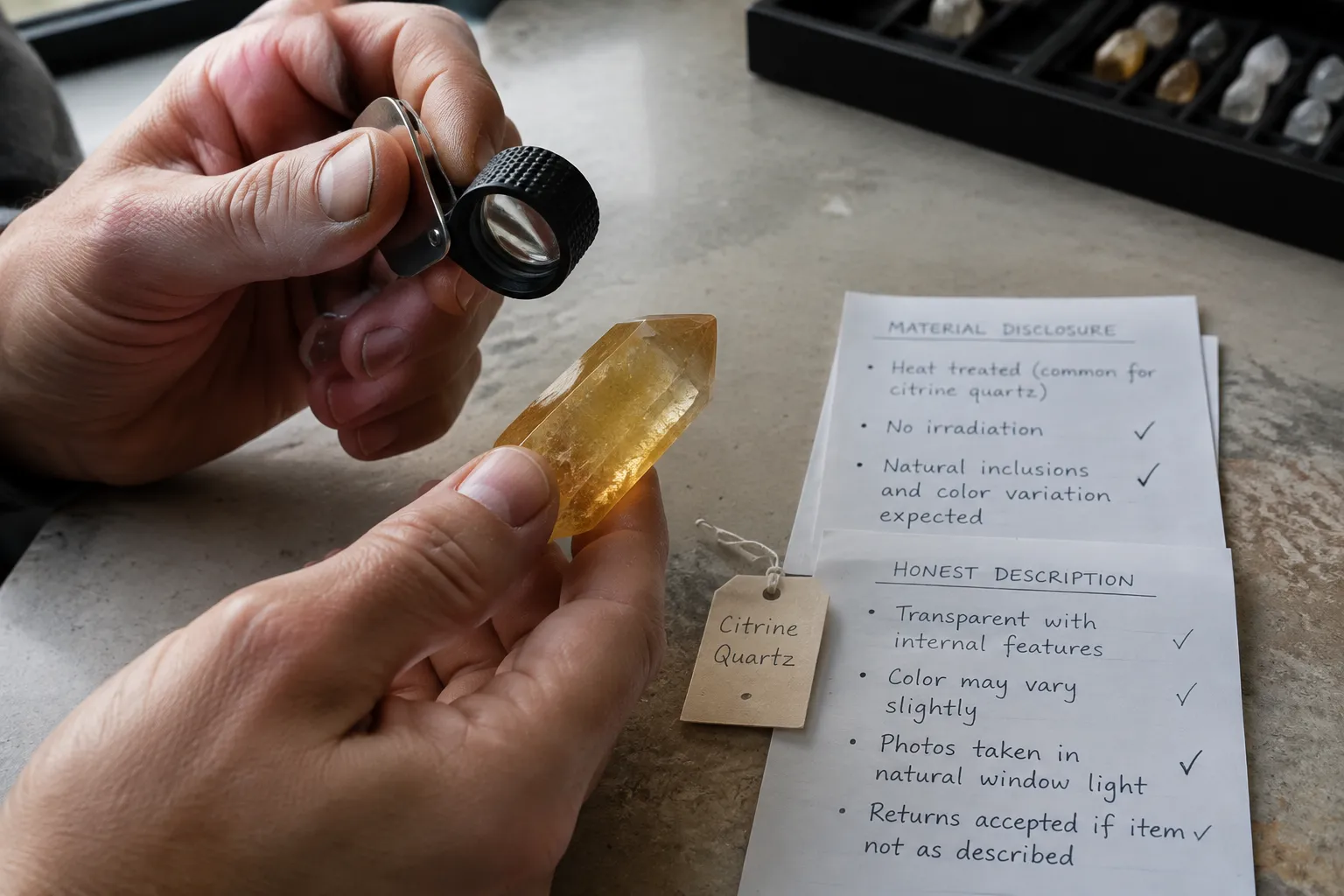
Gemological sources support citrine as a quartz gemstone category, but they also make the natural-versus-treated question less simple than casual retail language suggests. A seller label may say “citrine” while giving little detail about origin, treatment, or testing. Some material sold with citrine language may owe its color to treatment of other quartz varieties. Synthetic material can also appear in the broader quartz market.
For this placement practice, you do not need a rare natural specimen. You do need honest wording. If the stone is sold as “natural citrine,” look for seller disclosure, treatment notes, and identification language that does not overreach. If the seller cannot explain whether the material is natural, treated, or synthetic, it is cleaner to call it “citrine-colored quartz” or “citrine sold without treatment documentation” rather than building a stronger claim around it.
This is not a demand that every decorative piece carry lab documentation. It is a market literacy point. Symbolic meaning can sit beside uncertainty, but the object should not be made more certain than the evidence allows.
Color also needs restraint. A warm golden or yellow-orange stone may visually support the Fire Horse theme because it reads as bright, active, and solar. Color alone does not verify natural origin. The eye can help with room design; it cannot replace gemological testing.
Common confusion around Fire Horse citrine placement
Confusion 1: treating “Fire Horse” as literal fire
The Fire Horse year is a cultural and astrological framing, not an instruction to add flames, heat, incense, or burning rituals to a room. If candles, fireplaces, sunlight, or heat sources are involved for separate reasons, use ordinary fire-safety judgment and keep stones, fabrics, papers, and decor away from hazardous placement. Citrine does not make a flame practice safer.
Confusion 2: making citrine the heavy grounding opposite
Citrine is usually associated in market and symbolic language with brightness, confidence, prosperity, warmth, and forward motion. That makes it a better cue for focused expansion than for low-energy quiet. If your main need is slowing down or reducing stimulation, citrine may not be the most natural visual anchor. You can still use it, but place it beside a written limit, a closed task list, or a quiet planning surface.
Confusion 3: making the year universal
A third confusion is assuming the 2026 Fire Horse year applies the same way to every reader. Zodiac and feng shui interpretations are tradition-bound frameworks. They can offer reflective language for timing, motion, and self-direction, but they should not be written as universal facts about what will happen to a person, household, or business.
Confusion 4: letting prosperity language take over
A fourth confusion is letting prosperity language take over the room. Citrine is often marketed with money and abundance language. A more grounded version is to use the stone near a budget notebook, invoice tray, or project plan as a reminder to match ambition with records. The practical anchor is the behavior around the object, not a promised result from the object.
A compact placement map
Use this map if the question is simply where the citrine should go.
The object does not need to dominate the room. In many spaces, a small visible golden object works better than a crowded crystal arrangement because it gives attention one place to land.
What the evidence can support
The available material supports three restrained claims. First, 2026 can be described as the Year of the Fire Horse within accessible Chinese zodiac and lunar-calendar context. Second, citrine can be discussed as a quartz material with natural, treated, and synthetic-market distinctions. Third, crystal placement can be framed as a complementary or reflective practice with limits.
The material does not show that citrine changes spatial stability, finances, emotional state, safety, or year-specific outcomes. It also does not include credible firsthand room-placement testing. Seller pages and social posts help explain why readers connect citrine with prosperity, action, and quick expansion, but they cannot carry the factual weight of the article.
So the cleanest use is modest: choose one real room, one honestly described piece of citrine or citrine-colored quartz, and one repeated attention cue. Let Fire Horse language describe the pressure toward movement. Let citrine mark the pause before movement becomes excess. That is a stable enough role for the stone; anything stronger needs evidence this page does not have.