What Industrial Silica Regulations Teach Us About Jewelry Care
Industrial Silica Dust Compliance does not mean OSHA rules apply to cleaning citrine, quartz, or everyday jewelry at home. The useful lesson is much narrower: small particles are easier to control before they spread, settle, or get rubbed into a surface.
In an industrial setting, OSHA silica regulations focus on respirable crystalline silica exposure from dust-generating work. In jewelry care, the issue is different. The concern is not workplace airborne exposure; it is surface abrasion from grit, dust, polishing residue, and hard particles dragged across gemstones, metal, or prongs.
The practical translation is prevention-first jewelry care: keep grit away, loosen particles before wiping, store pieces separately, and clean gently instead of trying to polish away avoidable wear later.
broader context
Citrine verification note
This narrower page works best after the broader citrine reference page.
The real lesson is source awareness, not legal compliance
The strongest idea jewelry owners can borrow from industrial silica thinking is simple: ask where particles come from before they become a bigger problem.
In occupational silica guidance, crystalline silica-containing materials become a concern when they are cut, ground, drilled, crushed, or otherwise disturbed in ways that generate respirable dust. OSHA and NIOSH treat that as a workplace exposure-control issue because fine airborne particles can enter the breathing zone during specific tasks.
That is not the same as wearing a finished citrine ring or rinsing a quartz pendant at home.
Still, the prevention logic is useful. For jewelry, the “source” of abrasive particles is usually ordinary and visible:
- Grit from a countertop, drawer, beach bag, garden soil, or gym locker
- Dried lotion, soap film, or cosmetic residue that traps particles
- Polishing compound left around chains, prongs, or stone seats
- Dust in a shared jewelry box
- Hard contact between stones, metal edges, and loose debris
Citrine is a variety of quartz, and quartz is durable enough for many jewelry uses. That does not make it immune to careless handling. GIA’s public citrine-care guidance places it in ordinary jewelry-care territory: warm, soapy water is generally suitable for citrine, while ultrasonic and steam cleaning require caution depending on the stone and setting.
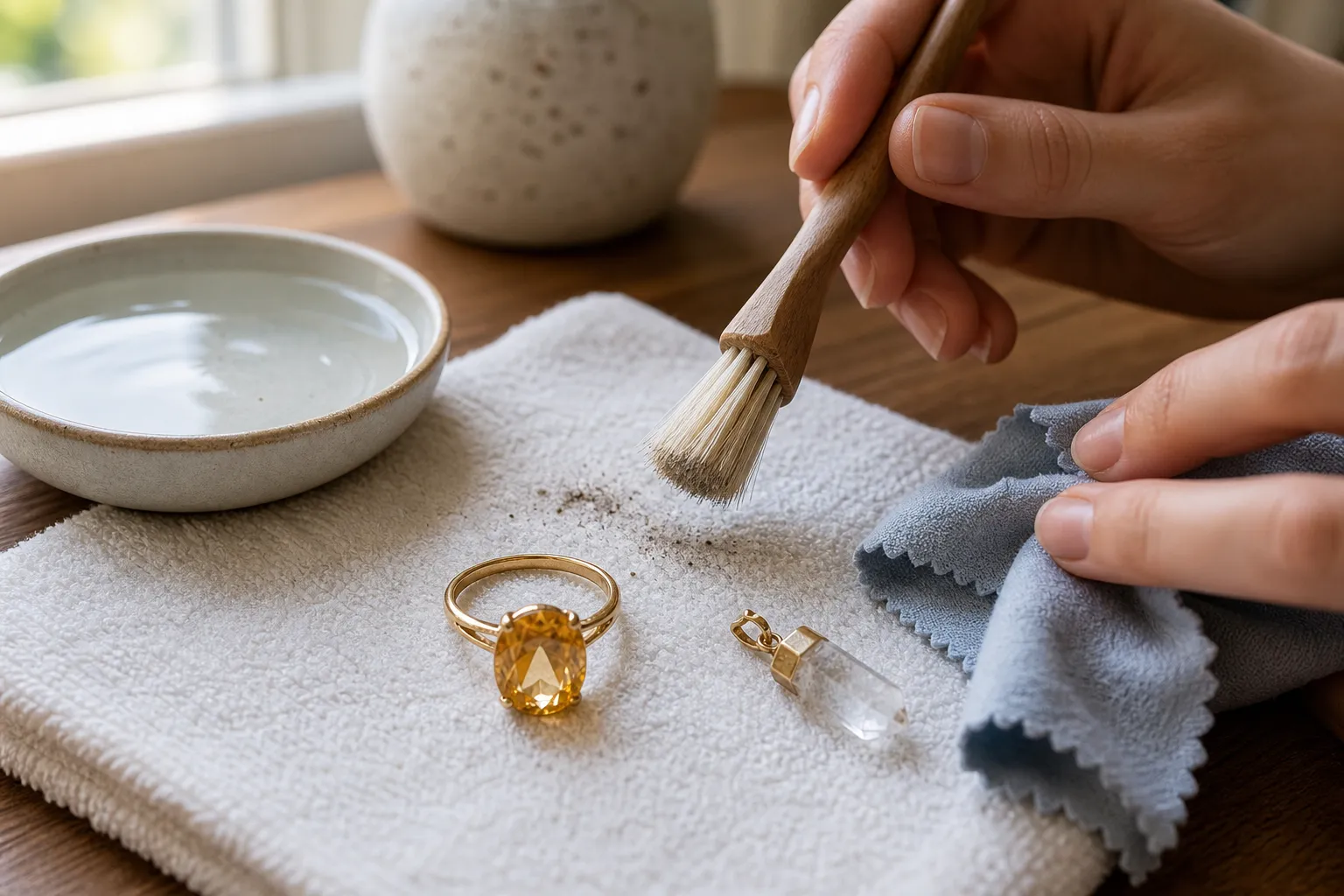
So if a ring looks dusty, the first move should not be hard dry rubbing. Rubbing can turn settled particles into a fine abrasive layer between the cloth and the jewelry. A better sequence is to loosen debris first, rinse when appropriate, then wipe with a soft cloth.
What OSHA silica regulations do—and do not—say about jewelry
OSHA silica regulations are written for occupational airborne dust exposure, not home jewelry cleaning. They address respirable crystalline silica exposure in workplaces where certain tasks can generate fine airborne dust from materials such as stone, concrete, brick, mortar, and sand-containing products.
That boundary matters because citrine and quartz can make the word “silica” sound more alarming than the situation warrants. Chemically, quartz is silicon dioxide. But an intact quartz gemstone in jewelry is not the same thing as respirable crystalline silica generated by industrial or construction processes.
A finished citrine pendant sitting in a tray is not behaving like stone under a grinder. A ring being washed gently in warm, soapy water is not an OSHA workplace task. Ordinary ownership does not become silica compliance simply because the stone belongs to the quartz family.
The jewelry-care lesson is about surface protection, not workplace law.
Industrial silica context
Jewelry-care translation
This comparison should stay modest. It is an analogy, not a compliance framework.
Everyday citrine habits that follow the same prevention logic
The useful habits are low-tech. They are not about buying industrial filtration systems or specialized dust equipment. They are about avoiding unnecessary abrasion.
Loosen particles before wiping
If a citrine ring has visible dust, lotion buildup, or dried soap around the setting, do not press a dry polishing cloth into it right away. First remove loose material.
For many citrine pieces, warm water with mild soap and a soft cloth or soft brush is a reasonable starting point, assuming the setting and any other gems in the piece can tolerate that method.
The goal is to float or loosen particles so they are not dragged across the stone or metal. That is the jewelry-scale version of not letting dust become a moving abrasive.
Use storage as physical defense
In industrial language, physical barriers and source controls help keep dust from spreading. In a jewelry box, the same idea becomes much simpler.
Use separate compartments, soft pouches, or lined trays so stones and metal edges do not rub against one another. Keep citrine away from loose chains, harder stones, dusty drawers, powdered cosmetics, craft materials, and gritty tools.
Separate storage is not dramatic, but it prevents many small contact events that later show up as dullness, haze, or unexplained surface wear.
Keep polishing residue from becoming trapped grit
Polishing can refresh metal, but polishing residue is still residue. If compound or darkened cloth debris remains around prongs, engraving, bezels, or chain links, it can hold fine particles against the piece.
Wipe carefully, rinse when appropriate for the whole item, and avoid pushing residue deeper into tight areas. The prevention-first approach is not “polish harder.” It is “avoid creating a dirty abrasive film in the first place.”
Pay attention to where dust settles
Airborne particles in a home are not an industrial silica issue, but dust still settles. Open trays near windows, vanities, laundry areas, workshops, or craft tables collect more debris than closed storage.
If jewelry sits exposed, clean the storage surface too—not just the gem. A clean pouch or lined compartment often does more for long-term care than repeated last-minute rubbing before wear.

Where the analogy can mislead
The connection between industrial silica rules and jewelry care becomes unhelpful when it turns into fear-based or equipment-heavy advice.
One common misunderstanding is assuming that because citrine is quartz, routine jewelry care involves respirable crystalline silica exposure. OSHA and NIOSH materials focus on workplace conditions where dust is generated and inhaled during specific tasks. Finished jewelry cleaning is a different activity with a different risk profile.
Another mistake is importing industrial filtration language into the home. Terms such as micron-level filtration, MERV ratings, ePM1, local exhaust ventilation, and source capture may help explain why industries care about particle size. They are not normal requirements for caring for a citrine bracelet or quartz pendant.
A third confusion is treating protective gear as the main lesson. In occupational control frameworks, personal protective equipment is usually discussed after other controls. For jewelry care, the parallel is not “gear up to clean a ring.” It is “do not rely on a last-stage fix.” Prevent grit contact, avoid dry abrasive scrubbing, and use gentle cleaning before surface wear accumulates.
Finally, do not let compliance language crowd out gem care. GIA-style guidance is more relevant for jewelry owners than industrial dust-control manuals. The gem, setting, treatments, fractures, metal type, adhesives, and any other stones all affect what cleaning method fits the piece.
A particle-aware cleaning sequence for citrine or quartz jewelry
For a simple citrine or quartz piece that is suitable for water-based cleaning, use this prevention-first sequence:
- Inspect before rubbing. Look for grit, dried lotion, soap film, or debris around prongs and under the stone.
- Loosen loose particles. Use water when suitable for the entire piece, or choose a softer dry approach if the setting or other materials require it.
- Clean mildly, not forcefully. Warm, soapy water and a soft cloth or soft brush generally align with public citrine-care guidance, but the whole piece matters.
- Avoid abrasive cloth pressure. A polishing cloth can be useful on metal, but it should not become a sanding pad full of trapped grit.
- Dry and store separately. Put the piece away only after it is clean and dry, in a pouch, compartment, or lined space where it will not rub against harder objects.
The main exception is mixed-material jewelry. A citrine set with pearls, opals, glued components, delicate enamel, antique foil backing, or fragile mounting details may need a more conservative method. The right care choice is based on the most sensitive part of the piece, not only on the citrine.
The bounded takeaway
Industrial silica rules teach jewelry owners a useful mindset, not a household regulation. OSHA regulations and NIOSH materials belong to occupational airborne dust exposure. They help explain why respirable crystalline silica is treated seriously in workplaces where dust is generated. They do not turn ordinary citrine care into silica compliance.
The practical jewelry lesson is calmer: particles matter before they become visible damage. Prevent grit from reaching the piece, avoid rubbing debris into surfaces, clean with gentle methods appropriate to the stone and setting, and store jewelry so it does not grind against itself.
That is the best version of prevention-first jewelry care: not fear, not filtration, not legal language—just better control of small abrasive particles before they become a surface problem.