Refractive Index Mastery: Essential Testing Methods for Yellow Gemstones
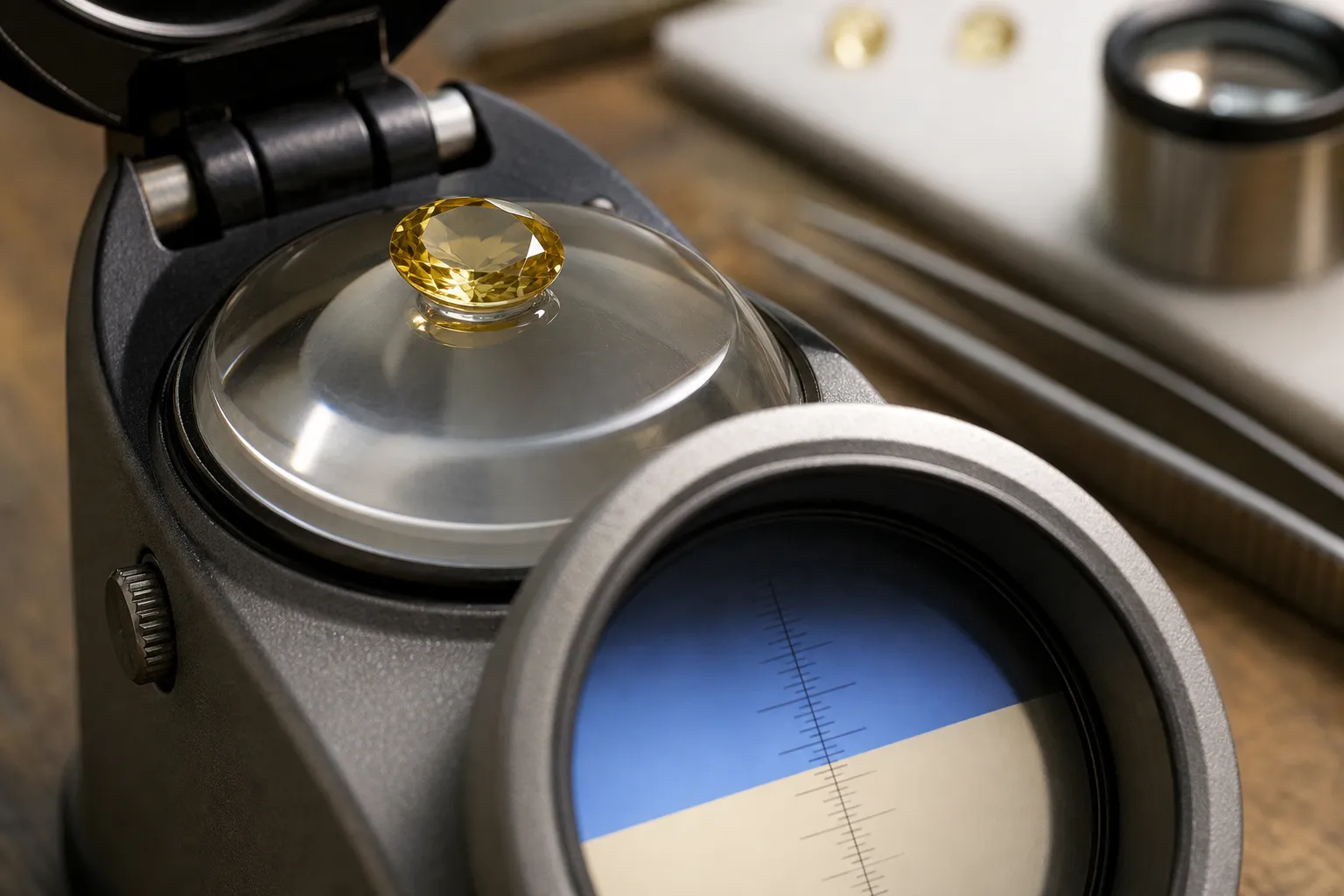
Refractive index gemstone testing helps identify yellow gemstones by turning optical behavior into a number you can compare. With a gem refractometer, a clean flat facet is placed on the instrument’s high-RI glass with a tiny amount of contact liquid, then the light/dark boundary is read on the scale.
For citrine and other yellow quartz, a quartz-like reading, paired with low birefringence, can support quartz as a possible identity. It does not prove natural citrine, confirm treatment history, settle value, or replace a broader gemological check. Its best use is narrower and more useful: record the refractive index, look for birefringence and optic behavior, then compare those observations with likely yellow gemstone candidates.
broader context
Start with the main citrine page
This narrower page works best after the broader citrine reference page.
What the refractometer is actually showing
A gemstone refractometer does not look inside a stone and announce a name. It uses total internal reflection at the contact point between the instrument glass, contact liquid, and gemstone. The visible result is a light/dark boundary on a calibrated scale. That boundary corresponds to a critical angle, which the instrument converts into a refractive index reading.
In plain terms, the tool turns an optical angle into a line you can read.
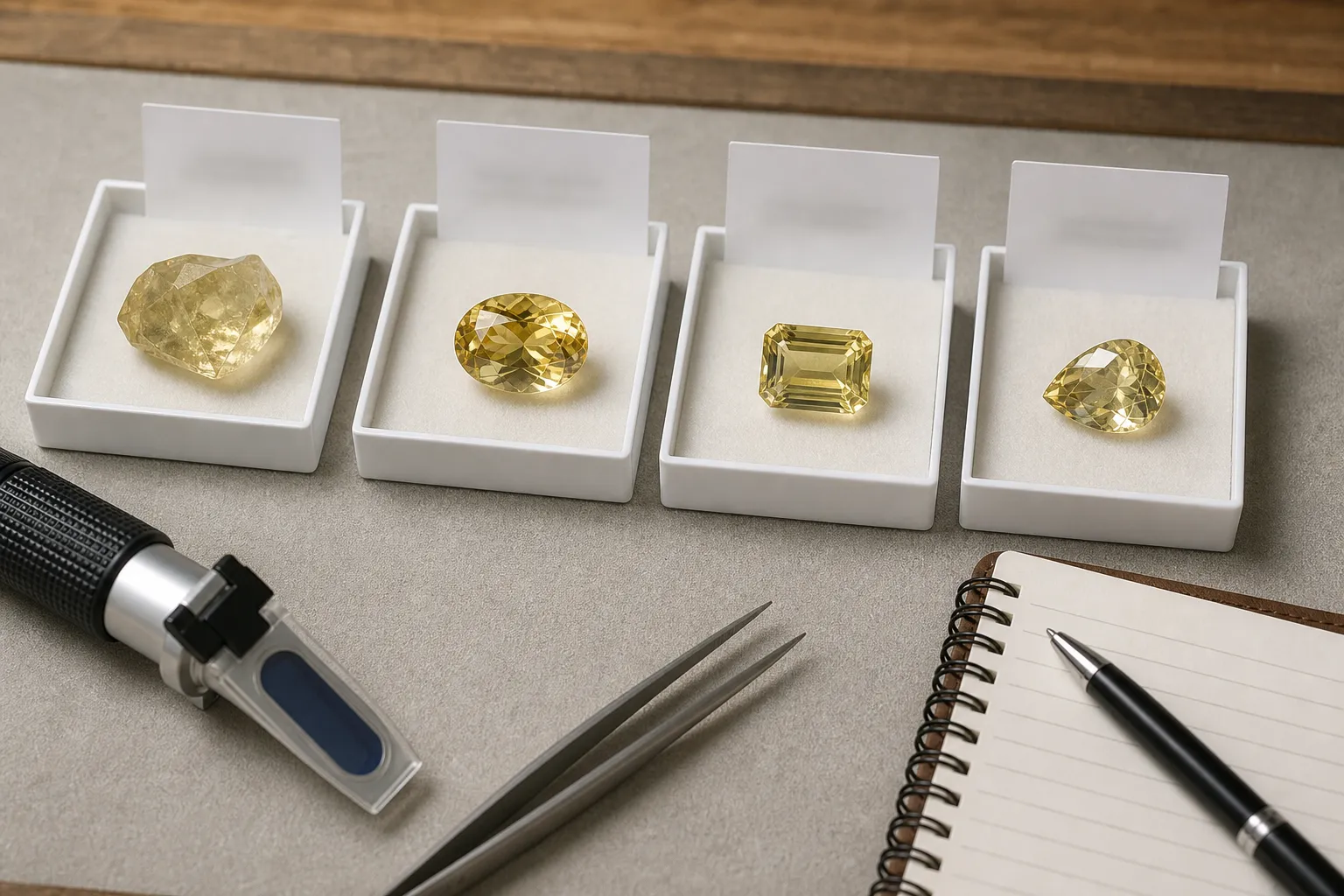
That matters because many yellow stones can look alike in a tray, ring, or listing photo. Yellow quartz sold as citrine, yellow topaz, scapolite, glass, and manufactured simulants can all appear “golden” to the eye. Color may start the question, but it should not answer it.
For a citrine-focused reader, the useful comparison is quartz-like behavior. Recognized gemological references commonly place quartz/citrine around RI 1.544–1.553, with birefringence around 0.009 and uniaxial positive optic character. Treat those values as a comparison zone, not a verdict. A yellow stone that reads like quartz may be consistent with citrine or yellow quartz; it still needs context.
How to take a useful RI reading on a yellow stone
The reading is only as good as the surface, contact, light, and interpretation. A casual touch on the refractometer can create a number-like impression, but a useful result records what was actually seen.
A practical sequence
Choose a suitable surface. Use a clean, flat, polished facet if possible. Curved cabochons, rough material, abraded facets, very small stones, and many mounted gems make good optical contact harder.
Clean the contact area. Oil, dust, polishing residue, or fingerprints can blur the boundary. The goal is not cosmetic shine; it is a clean optical interface.
Use only a tiny amount of contact liquid. The liquid creates optical contact between the stone and the refractometer hemicylinder. Too much can smear, spread, or complicate cleanup.
Place the stone gently. Set the facet down without dragging or pressing. Some gemstones can scratch the instrument glass, and a damaged hemicylinder can make later readings less reliable.
Find the light/dark boundary. Look through the eyepiece and identify where the bright field changes to dark. That line is the reading point.
Record the observation, not the hoped-for answer. Note the reading, whether the boundary was sharp or fuzzy, whether a second boundary appeared, and whether the stone was loose or mounted.
Look for two readings when appropriate. Many gemstones are doubly refractive. If two boundaries are visible, record both. The difference between them is birefringence.
When testing yellow quartz, two readings can be more useful than one. Quartz is doubly refractive, so a quartz-like RI result plus quartz-like birefringence supports the identification more strongly than a single number near a familiar value.
A single visible line still needs caution. It may indicate singly refractive material, but it may also mean one ray is weak, hidden, poorly contacted, or outside the practical reading range. One clean observation is useful evidence; it is not the whole identification.
How to interpret citrine-like readings
For yellow quartz and citrine, RI testing is strongest when the question is: Does this stone behave like quartz? It is weaker when the question is: Is this definitely natural citrine? Those are not the same question.
A reading in the quartz-like range can support quartz as a candidate. If birefringence and optic character also match expected quartz behavior, the case becomes stronger. But a refractometer does not determine whether yellow color is natural, whether another quartz variety was heated, or whether a sales description is complete.
RI and birefringence are consistent with quartz
Quartz/citrine remains a plausible identification.
Yellow color plus quartz-like RI
Color does not identify the stone, but RI supports quartz-like behavior.
One vague boundary near a familiar value
Retest under better conditions before relying on it.
No useful boundary
Contact, surface, mounting, lighting, or range limits may be the issue.
RI clearly higher than quartz-like values
Consider non-quartz yellow stones and recheck reading quality.
This is where citrine versus yellow topaz becomes clearer without turning the test into a buying comparison. Yellow topaz can share similar color language, but published gemological data for yellow topaz commonly shows RI around 1.609–1.617, with birefringence around 0.008. That is noticeably higher than quartz-like RI behavior. If your reading is clean and repeatable, RI can help separate those possibilities.
Scapolite needs a different caution. Yellow scapolite may sit closer to the mid-1.5 RI neighborhood, with reported values roughly around 1.535–1.564 and birefringence that can be higher than quartz. So a transparent yellow stone with a mid-1.5 reading should not be rushed into a citrine label. Birefringence, optic character, specific gravity, inclusions, luminescence, and other tests may matter.
Glass and simulants add another practical wrinkle. Some materials can be yellow and attractive without being quartz. A refractometer reading may help show that the material does not match quartz, but the exact conclusion depends on the reading, the instrument, and supporting observations. Avoid the shortcut “yellow and transparent equals citrine.”
What can make the reading less reliable
A refractometer is a strong identification tool, but several conditions affect how much confidence the reading deserves.
Surface contact comes first
A flat polished facet gives better data than a curved, rough, tiny, or obstructed surface. Mounted jewelry can be difficult because the setting may stop the facet from sitting properly on the hemicylinder. If the stone rocks, tilts, or touches only at an edge, the boundary may mislead you.
The contact liquid sets a practical range
Common high-RI liquids used with gem refractometers are often around RI 1.79, sometimes about 1.81. If a stone’s RI is above the instrument and liquid range, a normal reading may not appear. This is sometimes called a “negative reading,” but it does not mean the gemstone has a negative refractive index. It means the method has reached its reading limit.
Lighting and scale reading matter
Gemological RI values are often discussed using the sodium D-line convention. Illumination affects how easily the boundary can be read. A fuzzy boundary, doubled edge, or drifting line should be recorded as part of the result, not silently rounded into a confident number.
Birefringence matters
For doubly refractive stones, the difference between high and low readings can be as important as the values themselves. Quartz-like RI plus quartz-like birefringence is more meaningful than one approximate number.
Instrument condition matters
A scratched hemicylinder, residue, contaminated contact surface, or careless liquid handling can reduce trust in the reading. Clean the stone and instrument after use. For RI liquid, follow the product safety data sheet, avoid skin and eye contact, ventilate as appropriate, and do not improvise with unknown substitute liquids.
Common misreadings in yellow gemstone identification
The most common mistake is treating the refractometer as a gemstone name generator. It is better understood as one of several gemological identification tools. It gives evidence about refractive behavior; you still have to interpret that evidence.
Another mistake is treating a chart value as an identity certificate. A refractive index chart may be useful for study, but your stone’s reading has to be clean, repeatable, and paired with the right context. Numeric overlap exists. Measurement problems exist. Some materials require more than RI to separate responsibly.
A third mistake is assuming RI can settle treatment history. This is especially important for citrine. Citrine belongs to the quartz family, and yellow-to-brown quartz in the market may have different color histories. A refractometer can help ask whether the material behaves like quartz. It cannot, by itself, reconstruct how the color developed.
Seller language can also blur the issue. Terms such as “golden,” “natural,” “citrine topaz,” or “yellow crystal” may reflect market habit more than mineral identity. RI testing helps move the conversation away from color naming, but it should not be stretched into appraisal, legal authentication, or value certainty.
When professional testing is the better next step
At-home refractive index gemstone testing is useful when the stone is accessible, the surface is suitable, and the question is modest: Does this yellow gemstone’s optical behavior fit quartz, topaz, scapolite, glass, or another candidate?
Professional testing is the better next step when the stone is expensive, fragile, antique, heavily mounted, disputed, or being sold with high-stakes identity claims. A qualified gemologist or gem lab can combine RI with microscopy, polariscope observations, specific gravity, spectroscopy, and other tests where appropriate.
For most citrine-focused readers, the practical conclusion is simple: a refractometer makes yellow gemstone identification much more disciplined than color guessing. It can support or weaken a citrine hypothesis and point toward look-alikes. Its strongest answer is not “this is definitely natural citrine.” Its strongest answer is: this is the optical evidence, and here is what it does—and does not—support.