Sunrise vs. Sunset Charging: Maximizing Citrine's Solar Engine
If you are choosing between sunrise and sunset for a citrine care ritual, sunrise is the cleaner default. It is brief, easy to keep gentle, and naturally fits a “beginning of the day” rhythm. For readers searching for sunrise charging citrine, the practical answer is: use a short, mild morning window if the ritual matters to you, and avoid treating the timing as a proven way to change the stone.
Sunset is still a good fit when you want a quieter closing ritual or when mornings are rushed. Neither window is established here as scientifically better for citrine. In this article, “solar engine” is crystal-care language: bright, symbolic, and sun-associated, not a measured property.

broader context
Citrine verification note
This narrower page works best after the broader citrine reference page.
The Short Answer: Sunrise Is the Gentler Default
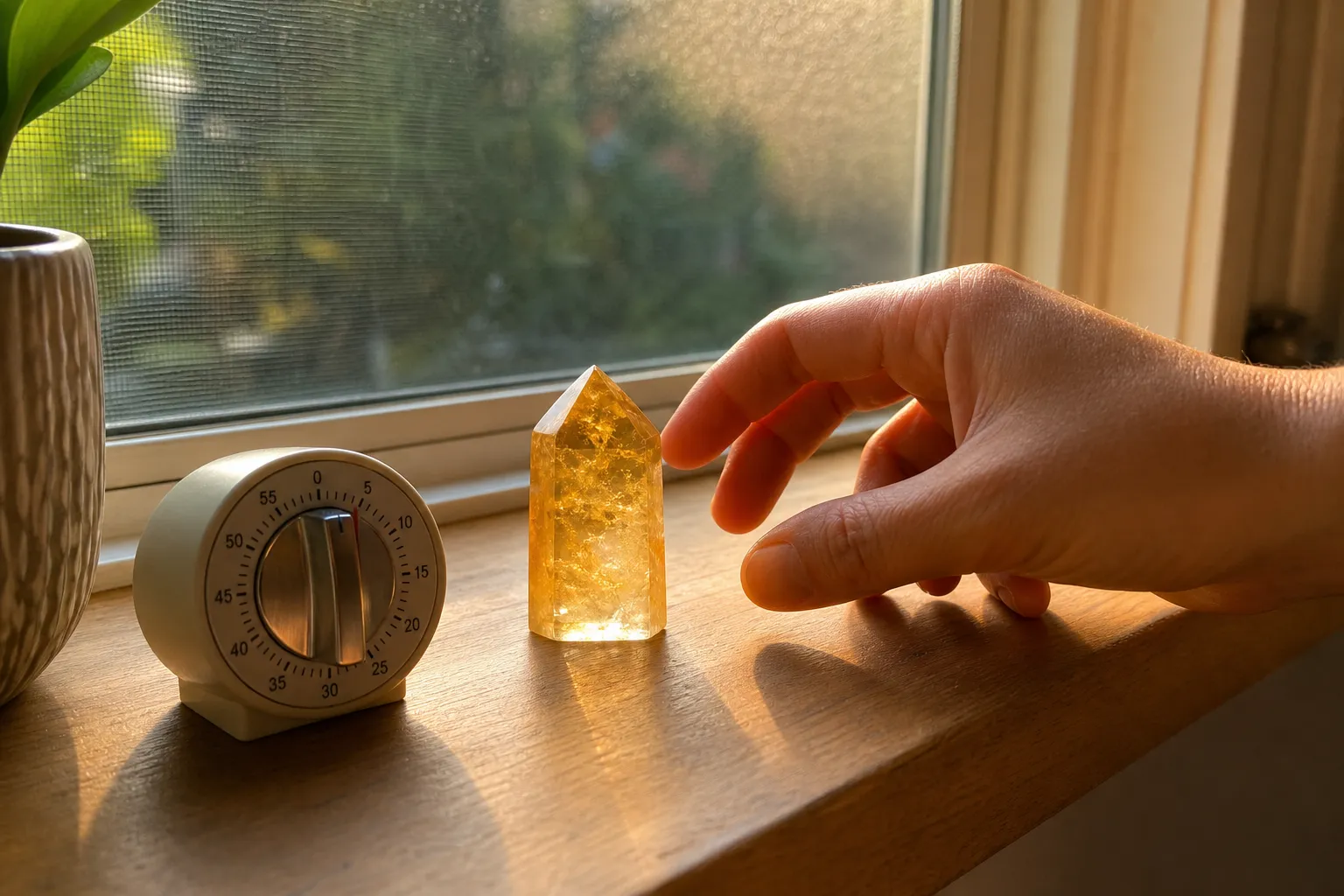
Sunrise works best when the goal is a light-touch routine. Place the citrine where it receives early, mild light for a short time, then move it back to its usual storage or display spot. That keeps the practice simple and prevents “charging” from turning into an all-day sunbath.
In crystal-care culture, sunrise is often linked with starting fresh, setting intention, and beginning the day. Those are symbolic associations, not evidence that citrine absorbs a measurable force. Still, symbolism can be enough for a ritual. If the point is to create a repeatable moment with the stone, morning light is tidy: it arrives before the day gets crowded, feels like a reset, and is easier to keep brief.
Sunset is not wrong. It answers a different need. Evening light can feel slower, more reflective, and better suited to closing a cycle. If your citrine sits where the evening sun arrives softly and briefly, sunset can be a reasonable preference-based care ritual. The better choice is the one you can keep short, calm, and honest about what the practice can and cannot claim.
Morning Sun vs. Evening Sun for Crystals
The real difference between morning and evening is mostly ritual tone, schedule, and exposure habit. The available material for this page does not show that citrine responds differently to sunrise versus sunset, so the comparison should stay modest.
Sunrise supports a beginning-oriented routine. If you use citrine as a reminder of clarity, warmth, focus, or value discernment, morning placement can pair naturally with planning the day. This is not “solar energy optimization” in a technical sense. It is a way to match the stone with a moment when you are already orienting yourself.
Sunset supports an ending-oriented routine. It may suit readers who use crystal charging language to mark a transition: work to rest, activity to reflection, outward attention to inward attention. In that setting, sunset is not weaker than sunrise. It is differently toned.
Convenience matters more than many ritual guides admit. A sunrise practice you miss most days is not automatically better than a sunset practice you can do gently and consistently. Likewise, a sunset window that leaves the stone forgotten in direct light for hours is not better because it feels poetic.
Sunrise
Best fit: starting the day, setting intention, brief gentle light.
Main caution: do not present it as a proven energetic improvement.
Sunset
Best fit: closing the day, reflection, softer personal rhythm.
Main caution: do not leave the stone in prolonged sun by habit.
Either Window
Best fit: preference-based ritual with short exposure.
Main caution: do not treat timing as mineral science without sources.
“Morning sun vs evening sun crystals” is best understood as a ritual-design question, not a verified performance comparison.
How to Use a Gentle Sunlight Window
A careful approach to charging citrine in sunlight is simple. You do not need a complicated sequence, a long exposure, or a promise that the stone has been transformed. A short gentle light window is enough if your purpose is symbolic care.
A restrained routine might look like this:
- Choose sunrise or sunset based on the mood of the ritual.
- Place the citrine where the light is mild and temporary.
- Keep the session short rather than leaving it unattended.
- Use the time for a simple intention, observation, or quiet pause.
- Return the stone to a stable storage or display location.
That keeps the practice within a safer editorial boundary: a personal ritual using light, timing, and attention. It does not require claims about measurable solar optimization, internal crystal recharging, or guaranteed effects.
The wording matters. “I use sunrise as a symbolic reset for my citrine” is a bounded statement. “Sunrise is stronger than sunset for charging citrine” is not supported by the available material. “I prefer a short morning light ritual because it feels clearer and easier to control” is also bounded. “Citrine needs morning sun to work properly” goes beyond what this page can support.
This distinction does not strip the ritual of meaning. It keeps the meaning from being dressed up as false certainty. Citrine already carries a complicated market context: natural, heated, treated, synthetic, misdescribed, pale, saturated, smoky, golden, and commercialized. Clean language helps readers value the object and the ritual without turning every crystal-care phrase into a factual claim.
When Sunset May Be Better
Choose sunset if your mornings are rushed. A ritual done in stress or forgetfulness may defeat its own purpose. If evening gives you a calmer moment to handle the stone and keep the exposure brief, sunset may be the more realistic choice.
Choose sunset if your intention is reflective rather than activating. Some readers use citrine as a marker for gratitude, review, release, or closing a workday. In that context, evening light fits the emotional shape of the ritual better than morning light.
Choose sunset if your available morning light is harsh, awkward, or inaccessible. “Gentle sun exposure” should mean exactly that: mild, brief, and easy to monitor. If a particular window encourages you to leave the stone there unattended, it is not the best ritual location, regardless of the hour.
The exception cuts both ways. If sunset light in your space is intense, prolonged, or easy to forget, use sunrise instead, or skip sunlight and choose a non-solar ritual. The goal is not to force citrine into the sun. The goal is to choose a care practice that stays gentle, intentional, and clear about its limits.
Common Confusion Around “Solar Engine”
“Solar engine” is evocative, but it can mislead if read literally. Here, it refers to the way citrine is often framed in metaphysical charging ritual: bright, golden, sun-associated, and linked in reader language with renewal or momentum. It does not mean citrine has a documented internal engine that stores sunlight in a measurable way.
Three misunderstandings are worth avoiding:
- More sun does not automatically mean a better ritual. A short window fits the cautious care approach better than extended exposure.
- Golden hour crystal charging is aesthetically appealing, but this page cannot present it as a proven technical advantage for citrine.
- Sunrise is not universally superior because it sounds purer or more active. It is the default here because it is simple, brief, and beginning-oriented.
The cleanest version is this: sunrise is the preferred default for a short citrine sunlight ritual; sunset is a valid alternative when it better matches your schedule or symbolic intention; neither should be presented as verified energetic engineering.
What This Page Cannot Claim
The evidence boundary matters because this topic sits close to spiritual, material, and market claims. The supplied research packet does not include public reference links for citrine mineral properties, sunlight effects, fading risk, heat sensitivity, or measurable benefits of one charging window over another. Those points should not be stated firmly here.
This page cannot claim that sunrise improves citrine, that sunset weakens it, that a certain number of minutes produces a reliable energetic result, or that sunlight creates a verified internal change. It also should not give mineral-care rules as if they came from gemological or museum guidance when no such sources were supplied.
A cautious reader can still make a decision. If you like crystal charging language, use it as personal or cultural framing. If you prefer material-care language, think in terms of conservative handling: short exposure, mild light, stable placement, and no need for elaborate claims. If a stone is valuable, fragile, sentimental, or uncertain, avoiding unnecessary exposure and seeking mineral-specific guidance is the more careful path.
Ritual Meaning
Personal timing, intention, symbolism, routine.
Care Habit
Short, gentle, non-dramatic handling choices.
Evidence Claim
Requires reliable external sources before being stated firmly.
For this leaf question, the answer stays narrow: sunrise is the better default if you want a gentle, beginning-oriented citrine ritual; sunset is better if reflection, convenience, or softer personal timing matters more.
A Simple Decision Rule
Use sunrise if you want your citrine ritual to feel like a reset. Use sunset if you want it to feel like closure. Use either only briefly, and keep the language honest: this is a metaphysical charging ritual or preference-based care practice, not a verified performance upgrade.
If you are trying to “maximize” citrine’s solar engine, the most grounded interpretation is not maximum sunlight. It is maximum clarity. Choose the window that keeps the ritual short, repeatable, and symbolically coherent. For most readers, that points to sunrise. For some, sunset will be the better fit. Both are acceptable when handled as gentle sunlight windows rather than proven mechanisms.