Tenebrescence Explained: Can UV Light Restore Faded Yellow Quartz?
If you mean ordinary yellow quartz or citrine, UV light should not be treated as a reliable way to bring back faded color. The question makes sense because reversible photochromism is real: some minerals can darken, fade, or shift color when exposed to certain kinds of light. In minerals, that reversible behavior is often called tenebrescence.
The catch is that tenebrescence is material-specific. The evidence supports it clearly in minerals such as hackmanite, not as a general UV method for faded yellow quartz. Quartz and citrine can owe their color to defects, impurities, irradiation history, heat history, or market treatment, and the available sources do not show dependable UV restoration of faded yellow quartz.
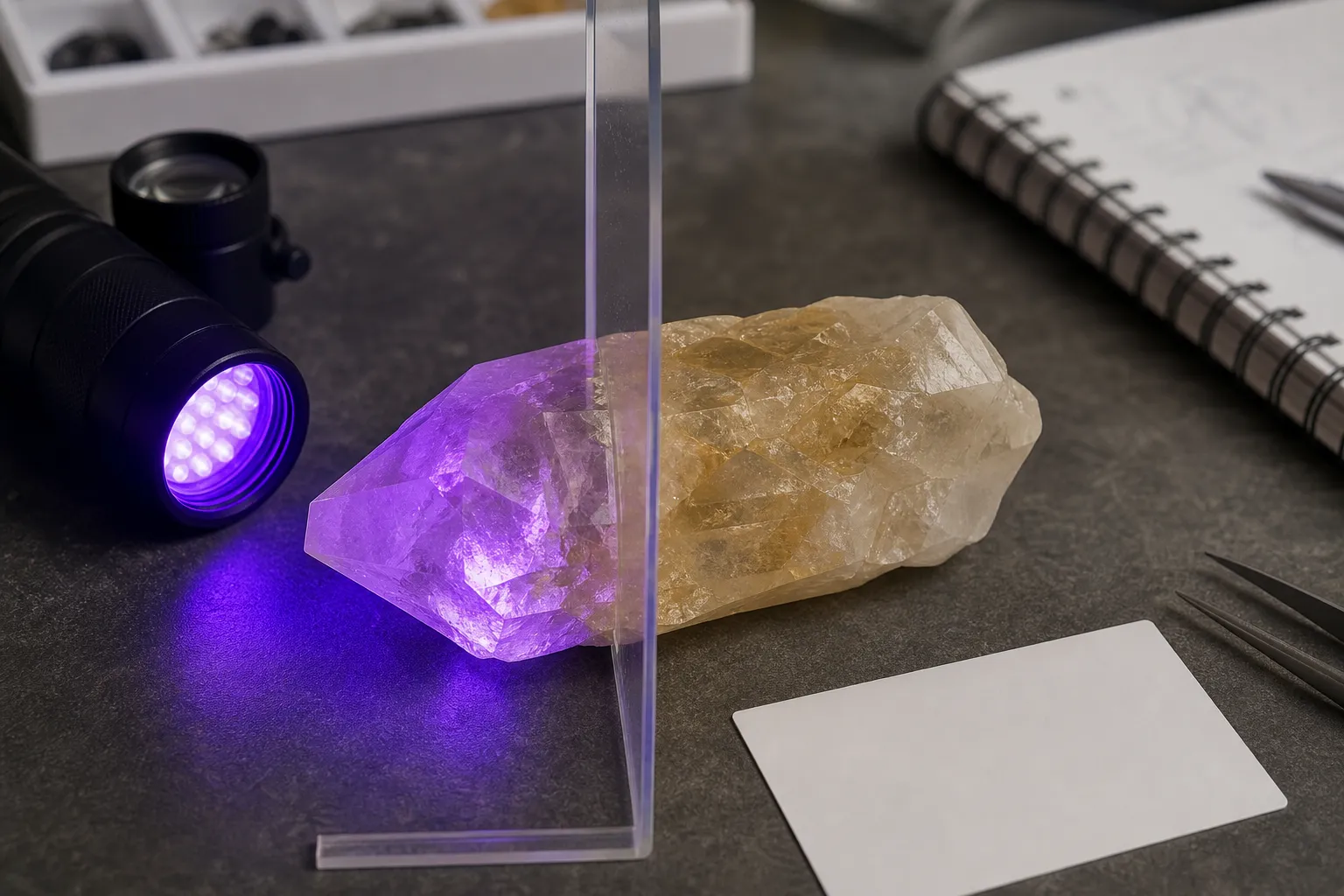
broader context
Broader citrine reference
This narrower page works best after the broader citrine reference page.
The short answer
Tenebrescence is a real light-driven color change, but yellow quartz is not the classic example.
A faded citrine crystal, pale yellow quartz bead, or yellow quartz specimen that has lost color in sunlight may not be “waiting to recharge.” Some light-related color changes are reversible; others are not. Some quartz colors are natural, some are treatment-related, and some stones sold as “yellow quartz” may not be natural citrine at all.
A useful boundary is:
- UV can intensify or create color in some true tenebrescent minerals.
- The selected evidence does not support UV light as a reliable fix for faded yellow quartz or citrine.
- A particular specimen might show some optical response, but that is not the same as proven color recovery.
The issue is not whether UV can affect minerals. It is whether the specific specimen has the right defect system for a reversible color cycle.
Why hackmanite behaves differently
Hackmanite is the mineral people often have in mind when they hear that UV can “bring color back.” It is a sodalite-group mineral known for tenebrescence. In simplified terms, UV exposure can move electrons into defect sites in the crystal structure, forming color centers that change how the mineral absorbs visible light. In hackmanite, that can deepen pink, purple, or violet tones; visible light or time may then reduce the color again.
Researchers describe hackmanite’s behavior through trapped electrons, chloride vacancies, sulfur-related species, and F-centers. For a quartz owner, the main point is simpler: the effect depends on the mineral’s structure and defect chemistry.
Quartz is a different mineral species. Citrine is the yellow to orange variety of quartz, but its color history is not the same as hackmanite’s reversible cycle. Quartz can contain color centers, and quartz color can be changed under controlled irradiation or heating conditions. That does not mean a faded yellow quartz specimen has a UV-triggered color center that will return on demand.
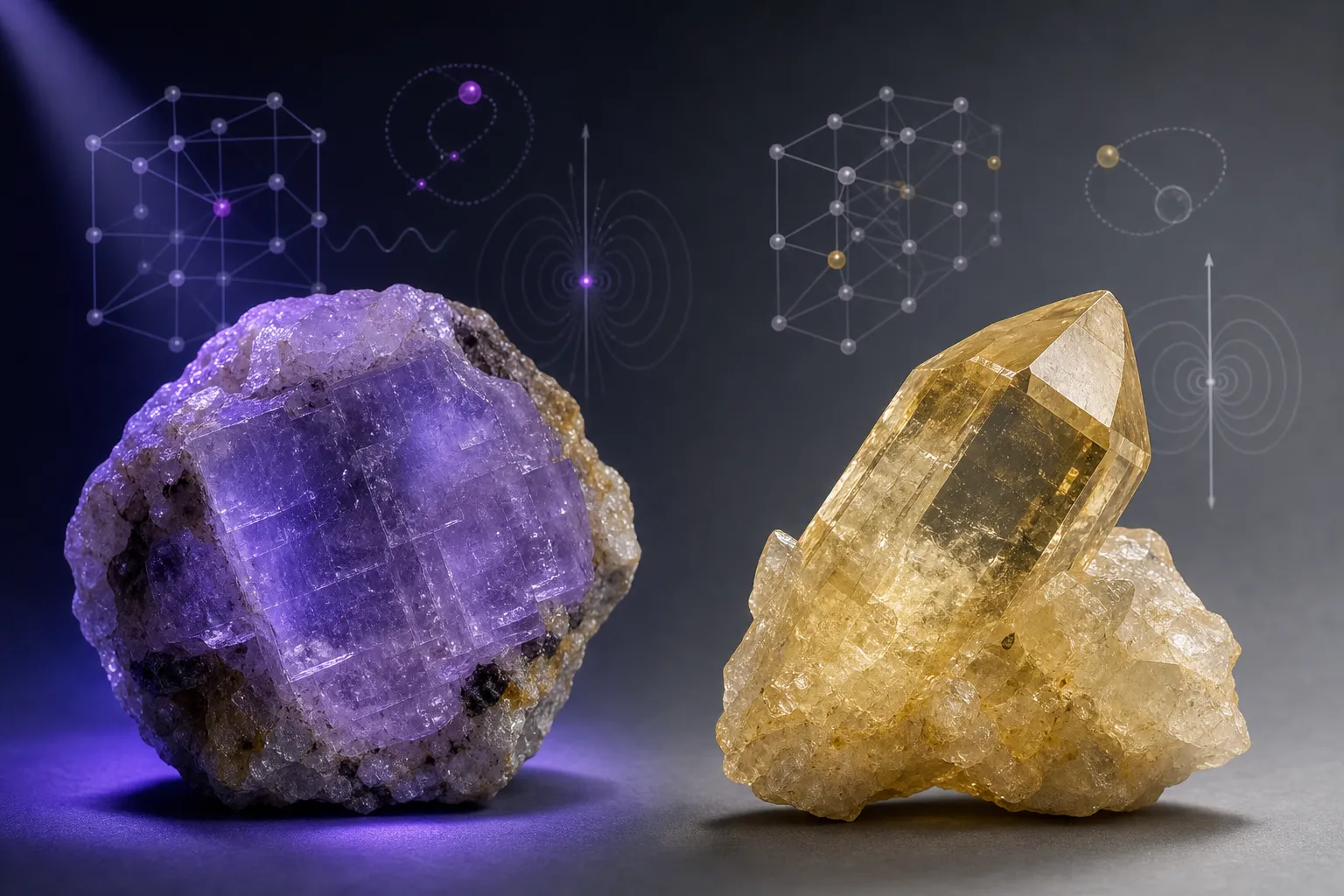
Hackmanite
- Reversible photochromism is well described, especially as a classic mineral example.
- UV can intensify color in some specimens, with specimen variation.
- Reversibility is central to true tenebrescence.
- Its UV response should not be generalized to another mineral.
Yellow quartz or citrine
- Reliable faded-color recovery is not established.
- UV is not supported as a dependable quartz or citrine method.
- Color loss may be irreversible or treatment-related.
- One mineral’s UV response should not be applied casually to quartz.
This is where “UV restore yellow quartz” becomes misleading. It borrows a real behavior from one mineral and applies it to another without enough support.
What “faded yellow quartz” may actually be
The phrase can describe several different materials or histories:
- natural citrine that has become paler after display
- heated amethyst or smoky quartz sold in the citrine market
- irradiated and heated quartz
- dyed, coated, glass, or assembled decorative material
- engineered quartz surface material, which is not a single mineral crystal
Those categories should not be mixed.
For a mineral specimen, the better question is not “How much UV does it need?” but “What caused the yellow color, and what caused the fading?” If the color center was altered by sunlight, heat, or prior treatment, the change may not be reversible under ordinary conditions. If the item is not actually citrine or natural quartz, the restoration question belongs to a different material entirely.
Commercial search results can also blur the topic. Many pages about “quartz fading” discuss countertops, resins, pigments, cleaners, or surface repair. That is not evidence that a natural quartz crystal can be recolored with a UV lamp.
Tenebrescence is not the same as ordinary fading
Not every light-related color change is tenebrescence.
In a true reversible photochromic cycle, light changes the electronic arrangement of defects or color centers. That changes absorption, so the visible color changes. In hackmanite, UV energy can help create a colored state, while visible light or other conditions can move the material back toward a paler state.
Ordinary fading may follow a different path. A color center may be altered in a way that does not easily reverse, or a treatment-related color may become unstable. More light is not automatically restorative; in some materials, additional light exposure may simply add more change.
A simple distinction helps:
- Tenebrescence: a reversible color shift in a material with the right defect structure.
- Luminescence: a glow or emission under UV or other excitation, usually visible during or shortly after exposure.
- Fading: weakening or loss of color, which may or may not be reversible.
- Treatment color change: color produced or modified by processes such as irradiation or heating, with stability depending on the material and treatment.
A quartz piece that fluoresces under UV is not automatically tenebrescent. Fluorescence under a lamp does not prove the yellow body color can be restored. Likewise, hackmanite’s color cycling does not prove citrine will behave the same way.
What matters for a real specimen
If you have a yellow quartz or citrine piece that appears faded, these variables shape the answer.
Correct identification
The material must actually be quartz. Citrine, heated amethyst, smoky quartz-derived material, glass, coated beads, and other yellow stones can be confused in the market. UV response alone is not a complete identification.
Color origin
Quartz color can involve defect centers, impurities, irradiation history, and heat history. Without knowing the color origin, “UV restoration” is only a guess.
Type of color change
A temporary light response is different from long-term fading after display. Tenebrescence implies reversibility; faded color after sunlight exposure does not automatically mean the specimen can cycle back.
Wavelength dependence
Photochromic minerals can respond differently to shortwave UV, longwave UV, visible light, heat, and darkness. That wavelength specificity is one reason hackmanite behavior should not be casually transferred to quartz.
Specimen variation
Even known tenebrescent minerals vary from piece to piece. For yellow quartz, where reliable UV recovery evidence is already lacking, specimen variation makes broad claims even weaker.
Should you try a UV lamp on faded citrine?
For color recovery, do not rely on a UV lamp as a treatment for faded citrine or yellow quartz. The supported boundary is that UV-driven reversible color change is known in certain tenebrescent minerals, not as an established method for ordinary yellow quartz.
There is also a practical safety boundary. UV lamps, especially shortwave UV sources, can be hazardous to eyes and skin. This article is not an exposure recipe, and it is not responsible to give lamp distances, exposure times, or home-treatment steps for a result that is not established.
If the piece matters to you, the better next step is documentation and identification:
- Photograph it in consistent lighting.
- Note where it was displayed and for how long.
- Keep it out of prolonged direct sunlight while the color history is uncertain.
- Seek gemological identification if value depends on whether it is natural citrine, treated quartz, or another material.
- Treat fluorescence or temporary color behavior as a clue, not proof of restored body color.
The useful takeaway
Tenebrescence explains why the UV-restoration idea exists. In true tenebrescent minerals such as hackmanite, light can move electrons among defect-related states, changing absorption and producing a reversible color shift.
Yellow quartz and citrine should not be folded into that story without stronger evidence. Quartz can have color centers, and its color can be affected by treatment history, but the available sources do not show that faded yellow quartz can be reliably restored with UV light.
The narrow answer is the most honest one: UV-driven color recovery is a material-specific photochromic behavior, not a general answer for faded yellow stones. For faded citrine or yellow quartz, identify the material and its likely color history before assuming it can be recharged by light.