Quartz Refractive Index 101: How to Use a Gemological Refractometer
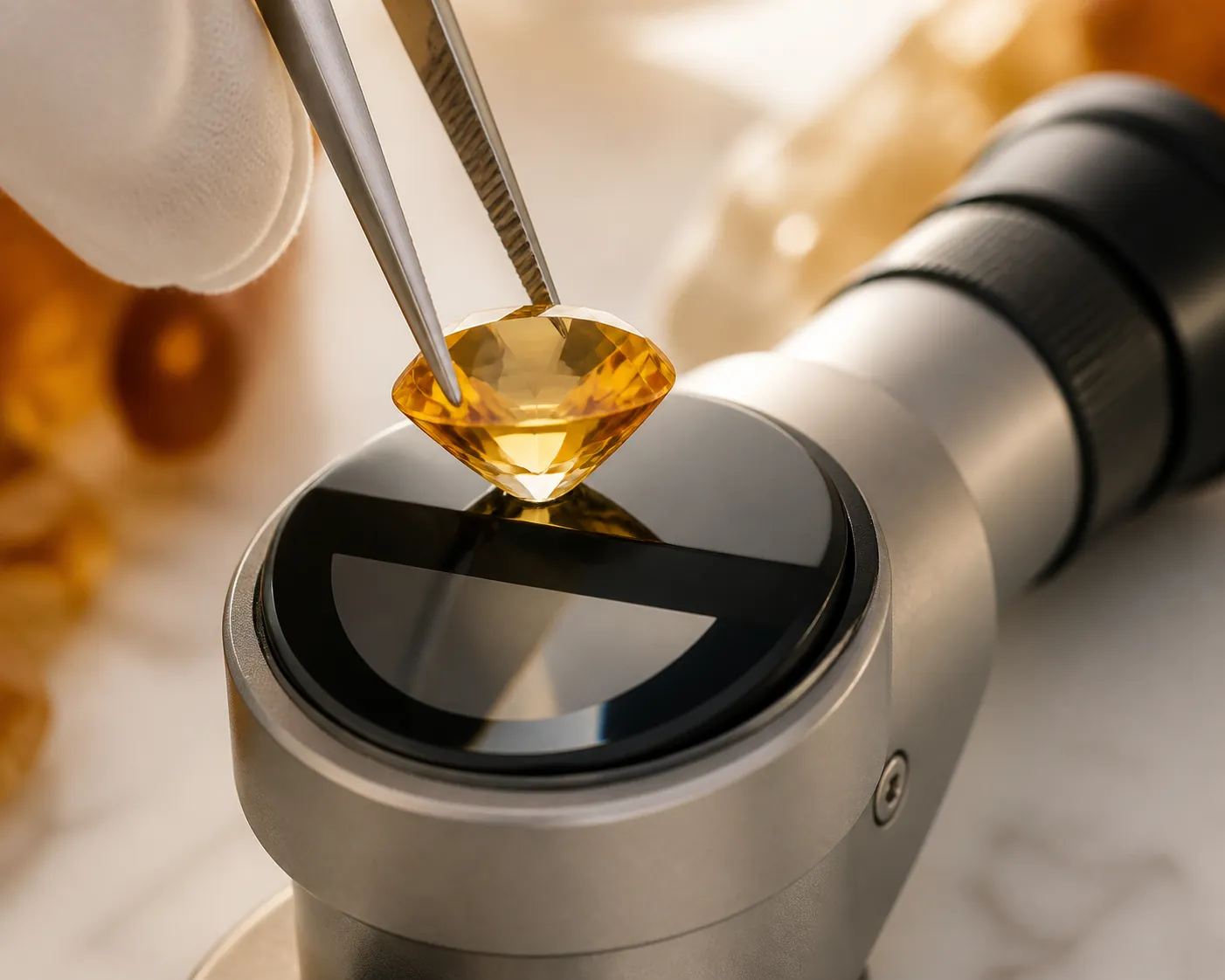
For citrine and other quartz-family stones, a Gemological Refractometer is used by placing a clean, flat polished facet on a tiny drop of refractive-index liquid, looking through the eyepiece, and reading the light/dark boundary or flash line on the scale.
For quartz, the expected refractive-index area is around the mid-1.55 range, with two close readings possible because quartz is birefringent. That result can support identification as quartz-family material. It does not, by itself, prove that a yellow quartz stone is natural citrine, untreated, valuable, or accurately described by a seller.
The useful answer is simple: a quartz refractive index test should give a low, narrow RI reading rather than an “over the limit” result. The careful answer is that surface quality, contact liquid, lighting, viewing angle, birefringence, and instrument limits all affect what you can actually read.
broader context
Start with the main citrine page
This narrower page works best after the broader citrine reference page.
How to set up the refractometer for citrine or quartz
A gem refractometer works because light bends and reflects differently as it passes between materials. The physics behind it involves the speed of light in materials, Snell’s law, the critical angle, and total internal reflection. During a normal gem test, you do not need to calculate those values. You need clean contact and a readable boundary.
A standard gemological refractometer has a high-index glass surface, often called a hemicylinder. The refractive-index liquid is used to remove the air gap between the stone and that glass surface. It is not meant to flood the gem or strengthen the result. Too much liquid can make the reading harder to see.
For faceted citrine, the table facet is often the easiest surface to test because it is broad and polished. If the table is scratched, dirty, curved, or not sitting flat, try another flat polished facet. Rough crystal points, tumbled stones, and cabochons without a suitable flat surface may not give a normal direct reading on a standard refractometer.
A practical reading sequence looks like this:
- Clean the stone so dust, oil, and fingerprints do not interfere.
- Set the refractometer on a stable surface with suitable light entering the light window.
- Place a very small drop of RI liquid on the hemicylinder.
- Gently set the flat polished facet onto the liquid.
- Look through the eyepiece and adjust your viewing angle until the scale is clear.
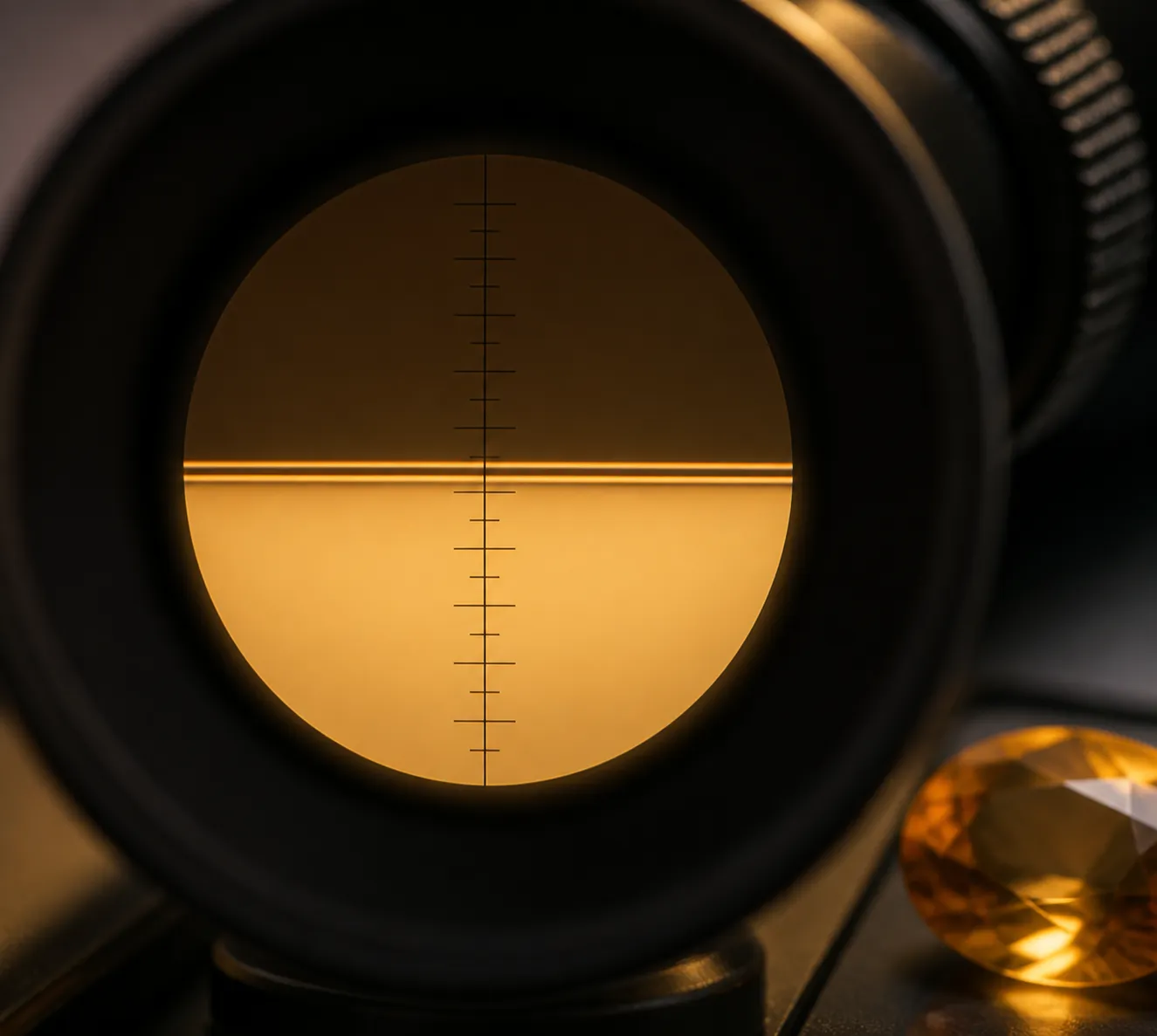
- Read where the shadow edge, flash line, or light/dark boundary crosses the scale.
- Clean the stone and hemicylinder after the test.
That number is the reading for that contact position. With quartz, it should be treated as one optical clue, not a complete conclusion about the stone.
Reading the flash line without forcing the result
Many beginners expect a sharp black line to appear immediately. Sometimes it does. Other times the boundary looks like a faint gray line, a moving flash, or a soft transition between lighter and darker areas. That does not automatically mean the stone is wrong. It may simply mean the contact, light, or viewing angle needs adjustment.
Move your eye slightly while looking through the eyepiece. A line that is invisible from one angle may appear from another. If your refractometer has a polarizing filter, rotating it can help show the behavior of a doubly refractive material.
For routine hobby use, many readings are interpreted to the nearest hundredth. Finer readings depend on the instrument scale, lighting, user skill, and how sharp the boundary is. A “1.55-ish” reading can be useful for separating quartz from many other gem materials, but it should not be treated as a lab-level finding on its own.
If the scale is dark, washed out, or unreadable, check technique before drawing an identification conclusion. Common causes include:
- too much RI liquid on the hemicylinder;
- too little liquid or poor optical contact;
- a dirty or greasy facet;
- a stone that is not sitting flat;
- a scratched, rounded, or poorly polished surface;
- weak or poorly aimed light;
- viewing from the wrong angle;
- trying to read a curved or rough surface;
- testing a material outside the instrument’s readable range.
The last issue is often described as OTL, or “over the limit.” Many gem refractometers have an upper limit around the low 1.8 range, depending on the instrument and liquid. Stones above that range may not produce a normal scale reading. Quartz sits much lower, so OTL is usually not the main issue in a citrine refractive index test.
What quartz birefringence means on the scale
Quartz is not singly refractive. It is a uniaxial, birefringent mineral, which means it can show two close refractive-index readings. In simple gem-testing language, birefringence is the difference between those readings.
On a refractometer, birefringence is checked by rotating the stone and/or the polarizing filter and watching how the boundary changes. Depending on how the facet is oriented, one reading may remain steadier while another shifts slightly. Sometimes both are visible; sometimes a beginner may only see part of the behavior.
For citrine testing, the key point is that quartz should not be reduced to one magic number. A quartz RI result belongs in a narrow expected area, and birefringence explains why two close readings may appear.
Avoid trying to “make” the line show up by pressing harder or adding more liquid. Better steps are simpler: clean the facet, use less liquid, choose a flatter surface, improve the light, adjust your eye position, and repeat the reading.
What can change the reading in real use
The refractive index of quartz is only part of what you see. The visible result also depends on the stone, instrument, liquid, light, and user technique.
Facet condition matters.
A refractometer needs a flat polished contact surface. Scratched, rounded, rough, or greasy surfaces can scatter light or prevent proper contact.
The RI liquid matters.
Use a tiny drop. The stone should sit in the liquid, not float on a puddle. High-index contact liquids should be handled cautiously: avoid skin contact and breathing vapors, cap the bottle promptly, clean the hemicylinder after use, and wash your hands after handling.
Lighting matters.
Refractive-index values vary slightly with wavelength. That is why reference values may be written with notation such as nD, referring to the sodium/Fraunhofer D line near 589 nm. In practical use, a suitable yellow or monochromatic-style light often makes the boundary easier to read than uncontrolled white light.
Orientation matters.
Because quartz is birefringent, one quick reading from one position may not show the full behavior. Rotating the stone or polarizing filter can clarify what you are seeing.
Instrument range matters.
A gem refractometer reads within its designed scale and optical limits. Charts are useful comparison tools, but they do not guarantee that every stone will produce a clean, easy boundary.
What a citrine refractive index test can and cannot tell you
A citrine refractive index test can support identification as quartz-family material. If a yellow stone gives a clean RI reading consistent with quartz, that is meaningful evidence.
But it does not answer every question buyers usually attach to the word “authentic.”
A refractometer reading alone does not determine whether citrine is natural or synthetic. It does not determine whether the yellow color is untreated or the result of heating another quartz variety. It does not establish geographic origin, rarity, or appraisal value. It also does not replace a broader gemological examination when the stakes are high.
This matters because citrine market language often blends several different issues: material identity, origin, treatment, color quality, rarity, and price. RI answers one optical question: how the material bends and internally reflects light under the test conditions. It is useful because it narrows possibilities. Its limit is that people often ask it to settle more than it can.
For stronger identification work, RI is usually considered alongside other observations, such as magnification, inclusions, color zoning, growth features, density-related tests, spectroscopy, or lab examination, depending on the question.
Quick troubleshooting checklist
If the refractometer reading looks wrong or disappears, check the basics before deciding what the stone is:
- Is the tested surface truly flat and polished?
- Is the stone clean before contact liquid is added?
- Did you use only a tiny drop of RI liquid?
- Is the gem sitting in the drop rather than floating on excess liquid?
- Is the light entering the refractometer correctly?
- Have you adjusted your viewing angle through the eyepiece?
- Have you rotated the polarizing filter or stone to check for birefringence?
- Is the material possibly outside the instrument’s readable range?
- Did you clean the hemicylinder after testing?
If the answer is still unclear, the cautious conclusion is not “the stone is fake.” It is “this refractometer reading was not conclusive.” That distinction prevents both false confidence and unnecessary alarm.
FAQ
Can a gemological refractometer confirm natural citrine?
No. It can support identification as quartz-family material when the reading is consistent, but it cannot confirm natural origin, treatment status, geographic source, or market value by itself.
Why can’t I see the light/dark boundary?
The usual causes are poor optical contact, too much or too little RI liquid, a dirty or curved surface, weak lighting, a difficult viewing angle, or an unsuitable facet. A missing line is a testing problem before it is an identification conclusion.
What RI should I expect for quartz?
Quartz is generally expected around the mid-1.55 refractive-index area, with two close readings possible because of birefringence. Exact visibility depends on the instrument, light, facet orientation, and reading technique.
Is a digital gem refractometer better for citrine?
Digital instruments may be convenient, but the same limitation remains: the result must be interpreted within the instrument’s method, range, and reliability. For citrine, the larger question is whether the reading is clean, repeatable, and understood as one clue rather than a complete verdict.