Trace Element Chemistry
The Role of Trivalent Iron: How Golden Quartz Gets Its Natural Hue
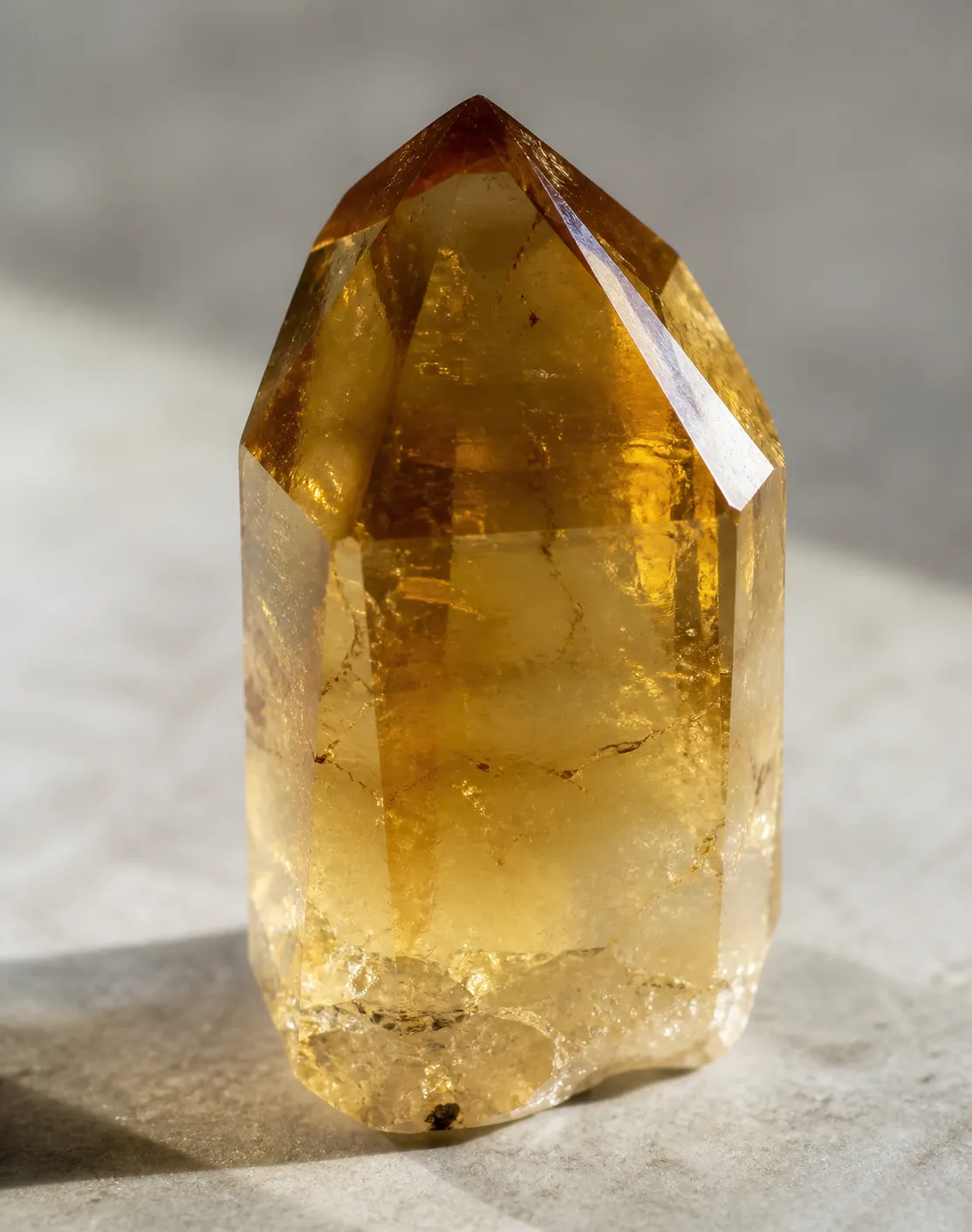
A golden citrine color is best understood as a trace-chemistry effect in quartz, not as yellow pigment mixed through the stone. In natural citrine, tiny amounts of trivalent iron, written as Fe3+, may sit in or near the quartz crystal lattice, interact with defects and charge balance, and change how the crystal absorbs visible light. The eye reads the remaining light as yellow, honey, smoky yellow, or golden.
That is the useful answer from Trace Element Chemistry. Pure quartz is generally colorless; colored quartz usually needs trace elements, lattice defects, color centers, heat history, irradiation history, inclusions, or some combination of those conditions.
The boundary matters from the start. Lattice-related iron chemistry is not the same thing as iron oxide staining on a surface, and color alone does not prove natural citrine.
broader context
Citrine verification note
This narrower page works best after the broader citrine reference page.
Why Pure Quartz Needs a Color Cause
Quartz is silicon dioxide. In an ideal clean structure, it has no strong reason to show a body color. So a golden quartz crystal raises a material question before it raises a market question: what changed the way light moves through the crystal?
For citrine, the answer is usually not visible flakes of iron. It is very small amounts of iron, especially Fe3+, associated with the quartz structure and its defect environment. Those trace conditions can affect which parts of visible light are absorbed.
“Trace Fe3+ in quartz” should be read carefully. Trace means very small amounts compared with the main quartz chemistry. In gemstones, that small amount can still matter because color can be sensitive to oxidation state, local bonding, charge compensation, and defects.
This also explains why two quartz specimens with broadly similar chemistry may not look the same. Color depends not only on whether iron is present, but on where it is held, what defects sit nearby, and what heat or irradiation history the crystal has experienced.
Where Fe3+ Fits in the Quartz Crystal Lattice
The quartz crystal lattice is built mainly from silicon and oxygen. A simplified explanation often says iron “replaces silicon,” but that can sound cleaner than the evidence allows. Isomorphic substitution in quartz is relevant, yet a neat one-for-one replacement is not the safest wording for every citrine color situation.
A more careful version is this: trivalent iron in citrine can be present in structural or near-structural environments where it interacts with the quartz lattice, charge-compensating defects, and oxygen. Because Fe3+ differs from the normal silicon-centered setting, local charge balance can become part of the color story.
That is where color centers and charge-transfer behavior enter the explanation. A color center is a local feature in a crystal that absorbs certain wavelengths of light. A charge-transfer transition involves electron movement between neighboring chemical components when light interacts with the material. Some quartz spectroscopy discussions connect iron and oxygen-related charge transfer with visible absorption. Without turning that into a single diagnostic wavelength here, the practical point is enough: internal trace chemistry can shift light absorption so the stone looks golden.
Iron is not simply “yellow.” Its color role depends on oxidation state, position, bonding environment, and defect history. Fe2+ and Fe3+ do not behave identically, and even Fe3+ does not create the same visible result in every mineral setting.
Internal Iron Color Versus Iron Oxide Staining
Many citrine questions begin with a visual worry: is the yellow color inside the crystal, or is it just iron staining?
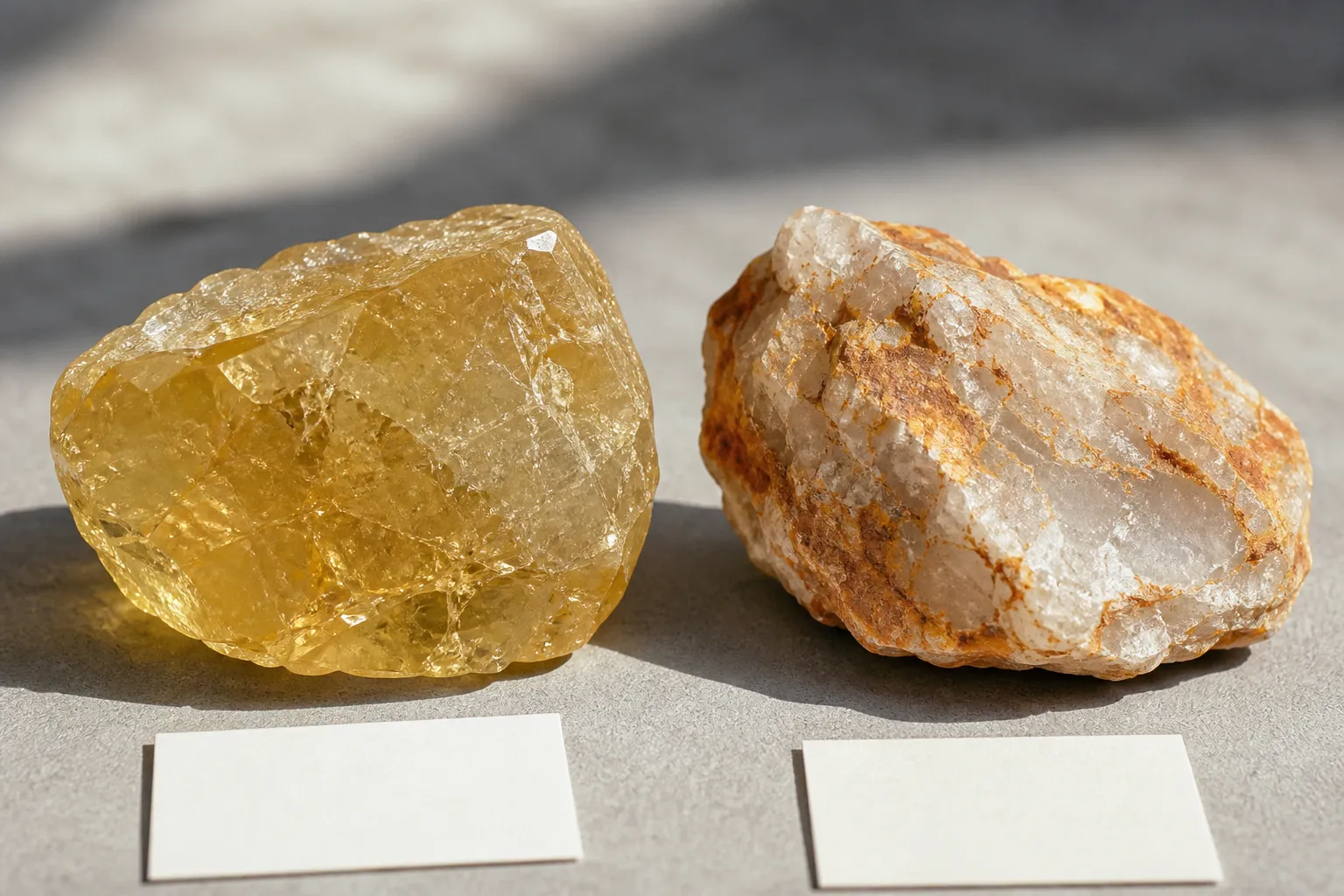
That distinction is essential. Lattice-related or defect-associated Fe3+ is an internal color mechanism. Iron oxide staining is an external or near-surface issue. It may appear as rusty, orange-brown, earthy, patchy, or coating-like color on quartz surfaces or along fractures. It can make quartz look yellowish or brownish, but it is not the same explanation as trivalent iron participating in quartz color centers.
Lattice-related citrine color
- The iron effect is in or associated with the quartz structure and defects.
- The color comes from electronic absorption linked to trace chemistry and defects.
- It can support a possible internal color mechanism, but not proof by sight alone.
- Casual viewing cannot settle it with high confidence.
Iron oxide staining
- The iron effect is on surfaces, along fractures, or as coating-like material.
- The color comes from visible iron-bearing residue, coating, or staining.
- It supports surface coloration, not necessarily citrine body color.
- Sometimes staining is visible, but unclear cases remain.
The market confusion is understandable because both situations use “iron” language. A seller may say iron gives citrine its color; a collector may see rusty quartz and call it iron-stained. Those statements are not interchangeable. One points toward trace element chemistry and light absorption. The other points toward visible iron-bearing material outside or near the surface.
That is why “yellow quartz” is not always a clean synonym for citrine. Citrine is a yellow to golden variety of quartz, but not every yellow-looking quartz specimen has the same color cause, treatment history, or gemological meaning.
Heat History and the Amethyst Confusion
The citrine conversation often gets pulled into a second claim: citrine is simply heated amethyst. That is too broad.
Amethyst and citrine are both quartz varieties, and quartz color can change under heat and irradiation in some conditions. Research on quartz-family color centers supports the broader point that iron-activated defects, heat history, and irradiation can influence visible color. In the marketplace, some amethyst is heated to produce yellow, orange, or brownish-orange material sold as citrine or citrine-like quartz.
But that does not mean all citrine is heated amethyst. Natural citrine can form with its own geological history and trace element conditions. The better distinction is not “citrine versus iron.” It is natural color origin versus treatment-modified color origin, and that distinction usually requires more than a color impression.
Color descriptions can help explain why shoppers ask questions. Pale honey, smoky yellow, champagne, and softer golden tones are often discussed as natural-looking citrine colors. Stronger orange or burnt-orange material is often associated with heated amethyst in consumer and gemological discussions. Those observations can guide questions, but they should not become diagnostic rules.
A bright orange stone is not automatically artificial. A pale stone is not automatically natural. A seller’s word “natural” is not a lab result. Color is evidence to notice, not a conclusion to stop at.
What This Means for Natural Citrine Testing
The role of trivalent iron explains why citrine can be golden, but it does not authenticate a stone by itself. That is the practical limit of the chemistry.
A stronger assessment may need gemological context: observation under suitable conditions, spectroscopy, microscopy, treatment history when available, and careful review of seller disclosure. Gem treatment sources treat disclosure as a real issue because treatment can affect appearance and may not be reliably separated by casual viewing.
For this page’s narrow question, the verification point is simple: the Fe3+ explanation is a color mechanism, not a standalone test for natural origin. If a report, seller, or description says “iron,” ask which iron-related claim is being made:
- Is it trace Fe3+ associated with the quartz lattice or defects?
- Is it an iron-activated color center shaped by heat or irradiation history?
- Is it iron oxide staining on the outside or along fractures?
- Is it loose market language with no testing behind it?
Those are different claims. They should not be collapsed into one label.
This also keeps Trace Element Chemistry in its proper lane. Trace chemistry can explain why a stone has color. It does not automatically establish natural origin, treatment status, geographic provenance, rarity, price, or value. Those require separate evidence.
A Careful Way to Say It
If you want a precise one-sentence explanation, use this:
Citrine’s natural golden hue can be associated with trace Fe3+ in or near the quartz crystal lattice, where iron-related defects and electronic absorption influence the light the stone transmits.
That wording is intentionally restrained. It avoids treating iron as a visible dye. It leaves room for charge balance, defect environments, and color centers. It also avoids turning every yellow quartz specimen into natural citrine.
A less careful version would say, “Citrine is yellow because it has iron.” That is partly useful, but it hides the important parts: oxidation state, lattice setting, surface staining, and heat history. It also makes it too easy for commercial language to blur natural citrine, heated amethyst, and iron-stained quartz into one simplified story.
The cleaner reading is narrower and stronger. Trivalent iron helps explain golden color when it is part of the crystal’s internal color mechanism. Surface iron staining is a different issue. Heat-treated amethyst is a treatment and disclosure question. Visual color can start the conversation, but it cannot finish it.
Short Questions About Trivalent Iron and Citrine
Is all yellow quartz citrine?
Not necessarily in a gemological sense. Citrine is the yellow to golden variety of quartz, but yellow appearance can come from different causes, including internal color centers, treatment history, inclusions, or iron oxide staining. The label needs context.
Does Fe3+ prove a citrine is natural?
No. Trace Fe3+ helps explain a possible color mechanism, but it does not prove natural origin by itself. Treatment history and citrine authenticity need separate gemological evaluation.
Is iron staining the same as citrine color?
No. Iron oxide staining is surface or fracture-related coloration. Citrine’s natural golden hue is better discussed as internal trace element chemistry involving the quartz lattice, defects, and electronic absorption.
Can color alone separate natural citrine from heat-treated amethyst?
No. Color may suggest questions to ask, especially when material is very orange or uneven, but it is not a reliable standalone test. Natural citrine testing requires more than a visual impression.
Trivalent iron gives citrine its most useful chemical explanation only inside a bounded frame. It can explain golden color through trace chemistry and absorption. It cannot, by itself, settle origin, treatment, or market claims.