Earthy Luxe Decor: Integrating Raw Geode Cathedrals Into Modern Homes
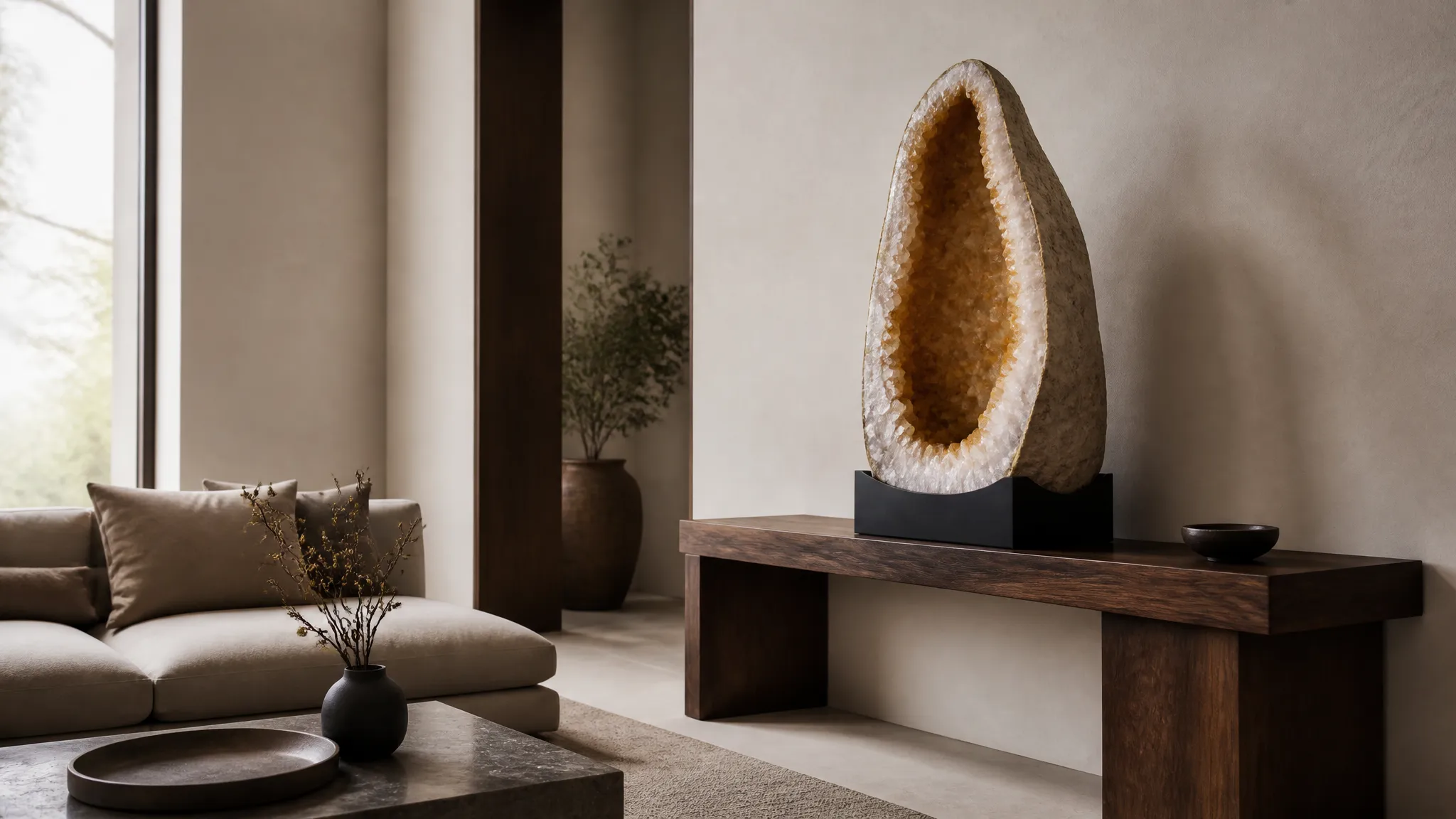
A raw citrine geode cathedral works best in Earthy Luxe design when it is treated as one sculptural focal point, not as a cluster of crystal decor. Place it on a stable, weight-appropriate surface; choose a spot where the room already has a natural pause; surround it with quiet materials such as plaster, stone, walnut, linen, cream walls, or blackened metal; and use soft directional light to reveal the crystal interior without making the display feel like a showroom counter.
Direct answer
The look succeeds when the geode’s warm golden color, rugged exterior, and crystalline depth are balanced by restraint, negative space, and practical placement.
One boundary matters from the start: “citrine geode cathedral” is often retail or reader-facing language. It can describe the golden mineral look you want in a room, but the name alone does not prove that a specific piece is natural, untreated, rare, gem-quality, or valuable.
broader context
Broader citrine reference
This narrower page works best after the broader citrine reference page.
What Makes a Citrine Geode Cathedral Feel Earthy Luxe Instead of Cluttered
Earthy Luxe interiors depend on contrast: raw texture against clean architecture, mineral warmth against quiet walls, and organic irregularity against tailored furniture. A citrine geode cathedral fits that mood because it brings several visual forces at once: vertical height, a rough outer shell, a cut or polished face, yellow-to-orange warmth, and a crystal field that catches light.
That same intensity can become clutter if the room around it is already busy.
A raw geode has strong surface activity. If it sits beside patterned pillows, several small crystals, shiny metallic objects, framed art, and a decorative lamp, the eye has nowhere to rest. In a modern home, the geode needs air around it. Negative space is not emptiness here; it is what lets the piece read as intentional.
A useful styling rule: let one cathedral be the mineral statement, then quiet the nearby objects. A low ceramic bowl, a linen-bound book, a matte stone tray, or a single branch in a simple vessel can support the mood without competing with it. If every object nearby is also trying to be dramatic, the room starts to feel like a retail display rather than a restrained luxury interior.
That is where Earthy Luxe differs from generic luxury crystal decor. The goal is not to make the crystal look expensive by adding more shine. The goal is to make the whole space feel composed. The geode brings the drama; the room brings the discipline.
Scale, Sightline, and Spatial Integration
Spatial integration is the difference between placing a geode somewhere and making it belong there. For a raw geode cathedral, the main variables are scale, sightline, circulation, and the surface supporting it.
In a living room, a tall cathedral often works best where the eye naturally lands: beside a fireplace, on a substantial console, in a recessed niche, near a reading chair, or against a calm wall plane. It should not interrupt a walking path or sit where a door, vacuum, pet, or child can easily bump it. A large crystal object may be decorative, but it is still a heavy, hard object with a center of gravity.
In an entry, the geode can create a strong first impression, but only if the console is deep and stable enough. A narrow hallway table with a heavy vertical object near the edge is rarely a good match. If the entry is busy with bags, keys, shoes, and daily movement, the piece may be safer and more visually convincing in a more protected location.
In a bedroom, keep the tone calmer. A smaller cathedral or lower, wider piece may sit better than a tall statement object. Place it where it can be seen from the doorway or a reading corner, not where it crowds the bedside or risks being knocked during routine use.
In an office or study, a citrine-colored geode can warm up a modern desk wall, built-in shelf, or credenza. Proportion matters. If the geode is too small for a large wall, it can look like an accessory. If it is too large for a delicate desk, it can look unstable. The base, furniture, and wall space should feel strong enough to carry it visually and physically.
A simple test
Step back to the main viewing point of the room. If the geode is the first thing you see and the second thing you notice is the calmness around it, the integration is working. If your eye jumps from crystal to lamp to art to tray to plant with no pause, edit the surrounding objects before moving the geode.
Materials That Calm the Golden Crystal
Citrine-like color brings warmth, but it can become loud when paired with too many saturated or reflective finishes. Earthy Luxe design usually benefits from materials that quiet the piece rather than amplify every sparkle.
- Cream or limewash-style walls: A soft backdrop keeps the golden crystal from feeling harsh.
- Travertine, limestone, marble, or honed stone: Stone creates a mineral conversation without turning the room glossy.
- Walnut, oak, or dark-stained wood: Wood grounds the warmth and keeps the display from feeling cold.
- Linen, boucle, wool, or raw cotton: Matte textiles absorb visual noise and soften the hard mineral surface.
- Blackened metal or bronze: Dark metal can frame the object, especially on a console or custom stand, without competing with it.
- Clay, ceramic, or plaster objects: These echo natural materiality while staying quieter than glass or mirror.
What tends to weaken the look is too much shine near the geode. Mirrored trays, high-polish gold accessories, glass clusters, and multiple reflective objects can make the display feel commercial. The crystal interior already reflects light. Surround it with matte, tactile materials and the geode feels more architectural.
Color matters too. A golden geode usually looks more refined against warm neutrals, mineral grays, muted taupe, chalky white, olive, tobacco leather, or deep charcoal. Pairing it with bright yellow, orange, or highly polished gold can flatten the nuance of the crystal and make the scene feel themed.
If the home already uses natural materials—stone coffee tables, plaster walls, wood beams, linen upholstery, handmade ceramics—the geode should not feel like an imported novelty. It should feel like one concentrated expression of the same material language.
Lighting a Geode Cathedral Without Turning It Into a Display Case
Lighting changes how crystal surfaces read. Transparent, translucent, and reflective mineral faces can look flat in dull light and overly flashy under harsh light. The best approach is usually soft, directional, and slightly off-axis.
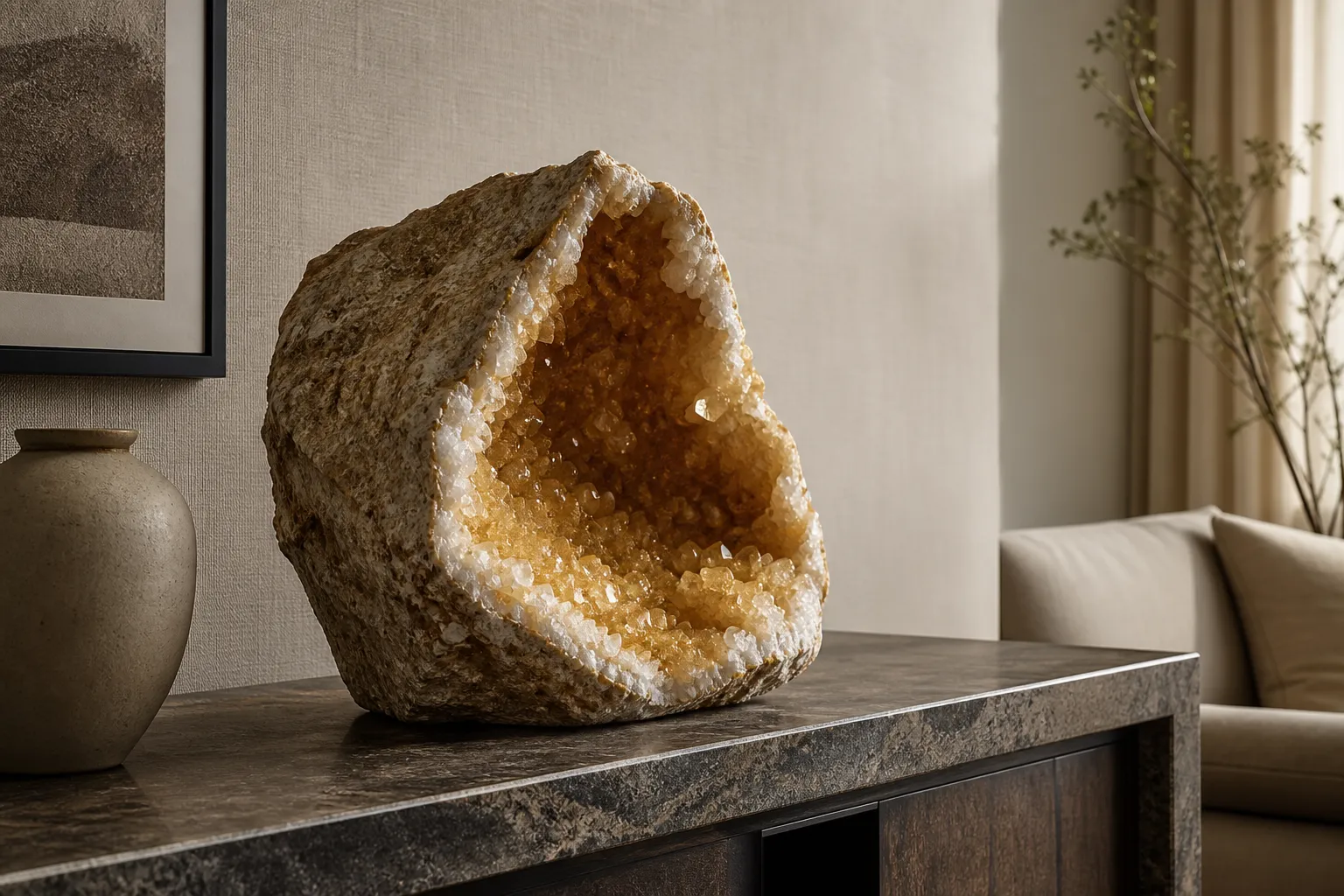
A small spotlight, picture light, or adjustable lamp can help the crystalline interior show depth. Side lighting often reveals texture better than straight-on lighting. Warm white light usually supports the golden tone better than cool, bluish light, which can make warm minerals look brittle or artificial.
Avoid placing the geode where direct sun hits it for long periods unless you have considered heat, glare, and fading risks for nearby materials. The available sources do not establish a geode-specific rule for residential sunlight exposure, so this is best treated as a cautious design choice rather than a hard rule. In practice, strong direct light can also make a reflective crystal face uncomfortable to look at.
Backlighting can be tempting, especially for mineral decor, but it is not always the most elegant choice for a cathedral form. Some translucent mineral slices respond beautifully to backlight; a large raw geode may look more natural with grazing side light or a soft pool of light from above. If the piece starts to resemble a shop window, reduce the intensity or move the light source farther away.
The goal is not maximum sparkle. The goal is controlled depth: enough light to reveal the crystal interior, enough shadow to preserve the raw exterior, and enough restraint for the room to still feel residential.
Safety and Stability Are Part of the Design
A heavy object that is beautiful but poorly placed is not well integrated. General household safety guidance from the U.S. Consumer Product Safety Commission focuses on tip-over awareness for heavy items in homes, especially where children are present. A geode cathedral is not the same category as a television or large furniture piece, and geode-specific safety evidence is limited. Still, the practical design principle applies: weight, stability, height, and household movement matter.
- First, the surface should be level and weight-appropriate. A delicate floating shelf, narrow pedestal, or lightweight console may not be suitable for a dense mineral object. If the furniture wobbles before the geode is placed, it is not the right surface.
- Second, the base or stand should match the object’s shape and center of gravity. Many cathedral pieces are uneven at the bottom or heavier toward one side. A stand that looks attractive but does not hold the piece securely is not a design solution.
- Third, the location should be outside tight circulation paths. Avoid spots where people turn corners, carry laundry, open doors, reach for curtains, or clean frequently. Pets and children change the risk profile, so a low pedestal in an active family room may be less sensible than a protected console or niche.
- Fourth, the height should feel secure. Higher is not automatically more luxurious. A heavy crystal object placed above shoulder height can be difficult to inspect, clean, or adjust. If it falls, the consequences may be more serious than if it is placed low and stable.
This does not need to make the room feel anxious. In Earthy Luxe design, a solid surface, clean sightline, and properly scaled base are both aesthetic and practical choices.
The Mineral-Language Boundary: Beautiful Does Not Mean Verified
Citrine is a quartz variety in gemological language, and GIA describes citrine with attention to color, quality factors, and treatment issues. That matters because the decor market often uses attractive names loosely. A large object sold as a “citrine geode cathedral” may fit the desired interior look, but the name alone does not verify natural origin, treatment status, gem quality, rarity, or value.
For an interiors page, this does not mean you need to become a gemologist before styling a room. It means the design claim should stay in its lane.
It is fair to say
- “The piece brings warm golden mineral color into the room.”
- “The cathedral shape creates a vertical sculptural focal point.”
- “The raw edge contrasts well with modern furniture.”
- “The crystal surface catches directional light.”
It is not well supported to say, without specimen-specific documentation
- “This is untreated natural citrine.”
- “This is investment-grade.”
- “This color proves high quality.”
- “This piece guarantees a personal or environmental effect.”
- “This geode is rare because of its retail name.”
The same caution applies to interior design trends 2026 language. Natural materials, restrained luxury, and warm tactile interiors are commonly discussed in professional design contexts, and a raw geode cathedral can visually participate in that direction. But the available material does not support a strong claim that citrine geode cathedrals themselves are a confirmed mainstream 2026 trend. It is more accurate to frame them as a niche statement object that aligns with broader interest in natural materiality and sculptural decor.
Quick Placement Checklist
Use this before committing to a final spot:
- Does the geode have at least one calm wall, surface, or furniture plane behind it?
- Is the supporting furniture deep, level, and visually substantial?
- Can people move through the room without brushing past it?
- Does the lighting reveal the crystal interior without harsh glare?
- Are nearby objects quieter in texture, color, and shine?
- Is the piece positioned as one focal point rather than one item in a crowded crystal grouping?
- Have children, pets, doors, cleaning routes, and daily use been considered?
- Are any claims about naturalness, treatment, value, or rarity supported by documentation rather than retail language?
If most answers are yes, the geode is more likely to feel like a considered part of the room. If several answers are no, the issue is usually not the object itself. It is scale, support, lighting, or visual competition.
The Short Answer
To integrate raw citrine geode cathedrals into a modern Earthy Luxe home, place one substantial piece where the room can visually pause, support it on a stable surface, surround it with matte natural materials, light it gently from the side or above, and leave enough negative space for the crystal to read as sculpture.
Keep the language honest: enjoy the golden color and raw mineral drama as decor, but do not treat the retail name as proof of authenticity, value, rarity, or any guaranteed effect. The most luxurious version is not the brightest or largest display. It is the one that feels grounded, stable, and edited.