How GIA’s 2026 Origin Reports Are Rewriting Citrine Valuations
The answer is more limited than the headline sounds: 2026 GIA origin reports could change citrine valuation conversations only when the report itself clearly supports geographic-origin language and the market separately rewards that origin.
The available public sources support GIA’s role in colored stone reporting, citrine identification, and quartz-family terminology. They do not establish that GIA has launched a new citrine-specific origin service in 2026, and they do not show that Brazilian citrine prices have already shifted because of new report wording.
So the practical change is not an automatic price jump. It is a wording change: a lab-supported origin statement, if present, can make provenance claims more precise. It still does not set market value by itself.
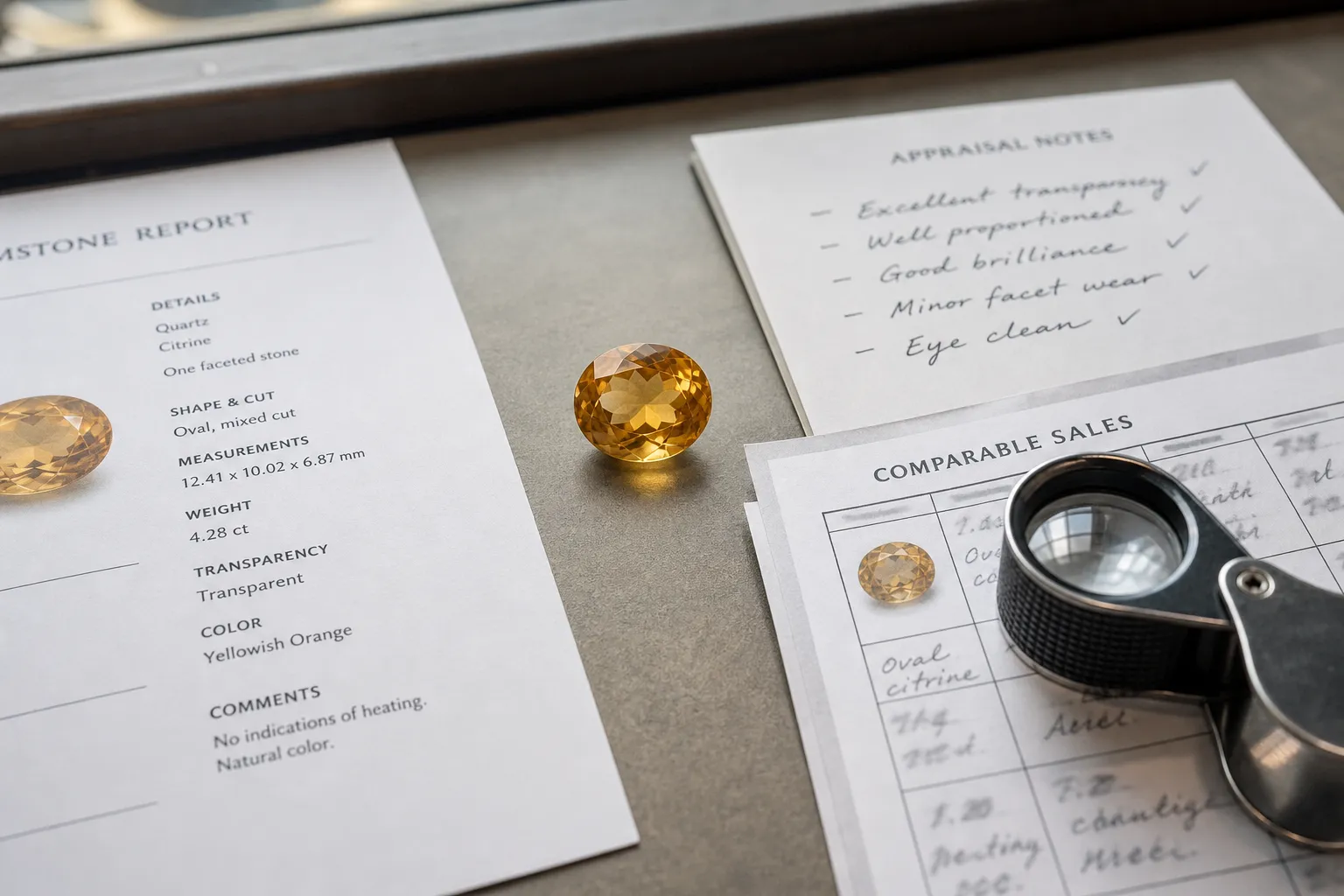
The real shift is cleaner provenance language
Citrine is a gem where sales language can blur several different claims. A listing may call a stone “Brazilian citrine,” “natural citrine,” “Madeira color,” “untreated,” “heat-treated amethyst,” or simply “quartz.” Those phrases are not interchangeable.
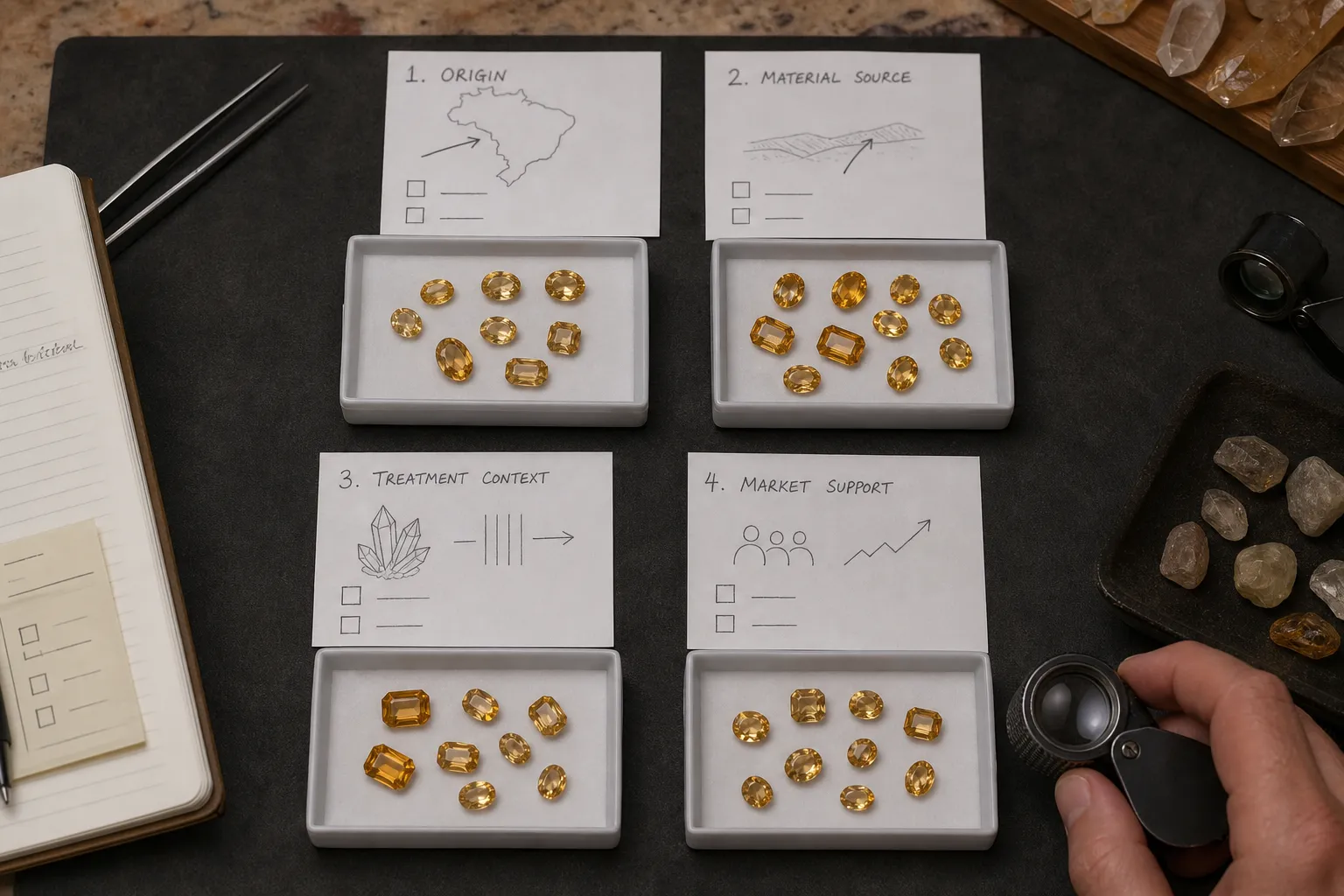
For value discussions, the questions need to stay separate:
Identification
What is the material?
Treatment context
Has color or appearance been modified or induced?
Geographic origin
Where is the material attributed to, if that can be determined within the report scope?
Market value
What are buyers actually paying for comparable stones?
A GIA colored stone report can help anchor some of that language because it uses lab terminology rather than seller wording. But a citrine identification is not the same as a geographic-origin determination, and neither one is the same as an appraisal.
If a report for a specific citrine states origin language, that can affect how the stone is described: a buyer can ask whether the document actually says “Brazil,” a seller can avoid relying on loose trade language, and an appraiser can cite the report as one part of the description. That is the useful “rewrite”: more disciplined provenance wording, not a guaranteed premium.
What GIA can support, and where value begins outside the lab
GIA is an appropriate source for its own colored stone report categories, laboratory terminology, and basic gemological education. For this topic, that includes citrine as a quartz variety and the distinction between gem identification and broader claims about origin or value.
The boundary is market pricing.
A lab report may support identity, treatment observations, or origin language if those are included in the report’s scope for that stone. It is not a retail price guide, auction record, appraisal rulebook, or dealer index. It does not prove that one citrine is worth a fixed percentage more than another.
A Brazilian citrine valuation claim needs evidence beyond the report, such as:
- Comparable sales.
- Appraisal reasoning.
- Dealer or auction behavior.
- Clear quality comparisons.
- Separation of origin from color, size, clarity, cut, treatment, and demand.
Without that market evidence, “geographic premium” is a claim to examine, not a conclusion to accept.
Why Brazilian citrine claims need extra care
Brazil is important in citrine discussions because Brazilian quartz and amethyst materials are widely associated with the gem trade. Technical literature also discusses enhancement of lower-value gemstones from southern Brazil, including heat treatment contexts. That background is useful, but it does not prove the origin or value of an individual citrine.
In sale language, “Brazilian” can mean different things:
“Brazilian citrine”
May suggest: mined origin or trade association.
Still needs support: report wording, chain of custody, or other provenance evidence.
“Brazilian material”
May suggest: rough, cutting source, supply source, or inventory language.
Still needs support: whether it refers to actual geologic origin.
“Natural citrine from Brazil”
May suggest: natural color plus Brazilian origin.
Still needs support: separate support for both color context and provenance.
“Heat-treated Brazilian amethyst”
May suggest: treated amethyst or quartz-related material.
Still needs support: treatment disclosure and market relevance.
“Brazilian premium”
May suggest: higher value due to origin.
Still needs support: independent pricing or appraisal evidence.
This is where verified report wording would matter. It could make a seller more exact. A stone is not Brazilian just because citrine is often discussed alongside Brazilian quartz. A stone is not more valuable just because a listing uses a country name. And a stone identified as citrine does not automatically inherit the reputation of a mining region.
Identification is not provenance
The most common mistake is treating a colored stone identification report as if it answers every question about the gem.
A citrine identification can be useful. It helps confirm the submitted material within the lab’s testing scope, and it can reduce confusion around quartz varieties, treated material, synthetic possibilities, assembled stones, or look-alikes. Instrumental testing matters because visual appearance alone is often not enough.
But identifying citrine is not the same as determining where it came from.
Geographic origin work depends on reference samples, comparison data, inclusions, chemistry, spectroscopy, and the limits of the question being asked. Research on analytical proof of origin emphasizes that provenance claims depend on reliable known-origin reference material and representative datasets. In plain terms: “it looks Brazilian” is not enough.
That matters even more with quartz, because quartz is widespread and citrine color can have natural and treatment-related contexts. Any origin wording should be read exactly as written, not stretched into a stronger claim.
Treatment context can affect value without proving origin
Citrine value discussions often get tangled because treatment, color, and origin are discussed together. They should not be treated as one claim.
Gemological and technical sources commonly describe citrine as a quartz variety, and market supply can include material whose color is related to heating of amethyst or other quartz material. That does not mean every citrine is treated. It does not mean Brazilian citrine is automatically treated. It also does not mean treated citrine has no value.
It means the valuation conversation needs separate variables:
- Is the stone identified as citrine?
- Does the document mention treatment or color context?
- Does the document state geographic origin?
- Are color, cutting, clarity, size, and condition strong?
- Is there evidence that buyers pay more for that documented origin?
A report can strengthen one part of the chain. It cannot complete the whole value argument.
How to read a GIA origin phrase in a sale
If a citrine is accompanied by GIA documentation, read the report wording literally.
Careful valuation language would sound like this:
Careful language
- “The stone is identified as citrine in the accompanying report.”
- “The report states the origin as written on the document.”
- “Origin is considered alongside quality, treatment context, and market comparables.”
- “Any geographic premium would need comparable market support.”
Overstated language
- “GIA says it is citrine, so it must be Brazilian.”
- “Brazilian origin automatically increases value.”
- “A report guarantees resale demand.”
- “Quartz identity proves provenance.”
- “A 2026 report makes older citrine valuations obsolete.”
The difference is not just wording. It affects what a buyer is being asked to pay for.
What would show that valuations have actually changed?
To say that 2026 GIA origin reports have truly rewritten citrine valuations, three kinds of evidence would need to line up:
- Primary GIA evidence showing current report scope or examples where citrine receives geographic-origin language.
- Stone-level documentation showing actual citrine reports with origin wording that can be cited.
- Market evidence showing that comparable citrines with documented origin sell differently from comparable stones without that documentation.
Without all three, the strongest supported conclusion is conditional: GIA-origin language could reshape citrine valuation discussions by making provenance claims more disciplined, especially around Brazilian claims. The broader claim that citrine prices have already been rewritten is not established by the available sources alone.
Quick checklist before paying for a geographic premium
Before accepting a Brazilian citrine premium, ask:
- Does the document identify the stone as citrine?
- Does the report category include the statement being claimed?
- Is geographic origin written on the report, or only in the seller’s description?
- Is treatment context addressed separately from origin?
- Do the stone’s color, cut, clarity, size, and condition support the asking price?
- Are there comparable sales or appraisal reasoning behind the premium?
- Is the seller repeating the report’s wording, or expanding it into a stronger claim?
If the premium depends on language the report does not contain, treat it as sales language rather than verified provenance.
Bottom line
The best way to read the 2026 GIA origin reports question is as an evidence test, not a promise of higher citrine prices.
A lab report can make citrine descriptions cleaner. It can separate identification from provenance. It can make Brazilian-origin claims easier to support or challenge. It can give buyers, sellers, and appraisers better wording to work with.
What it cannot do alone is create market value.
For now, the responsible answer is conditional: if GIA report language verifies citrine origin in a specific case, it may change how that stone is described and compared. If independent market evidence shows buyers reward that documented origin, valuation may shift. Until both are present, the report is best treated as documentation, not a standalone price engine.