The Truth About Heat Treatment: Will Your Citrine Fade Over Time?
If your citrine was heat-treated, that does not mean it is likely to fade quickly in normal ownership. Citrine heat treatment usually means controlled heating that changes the color behavior inside quartz, often moving amethyst-colored quartz toward yellow, orange, or brownish citrine-like tones. That is different from a surface dye or temporary coating.
The honest answer is narrower: laboratory work supports that heat-induced citrine color can remain stable under dark conditions after treatment. What is less well documented is years of real-world exposure to sunlight, display lighting, repeated heat, cleaning, and daily wear. So the practical answer is: heat-treated citrine is not automatically unstable, but no one should promise that it will “never fade” under every condition.
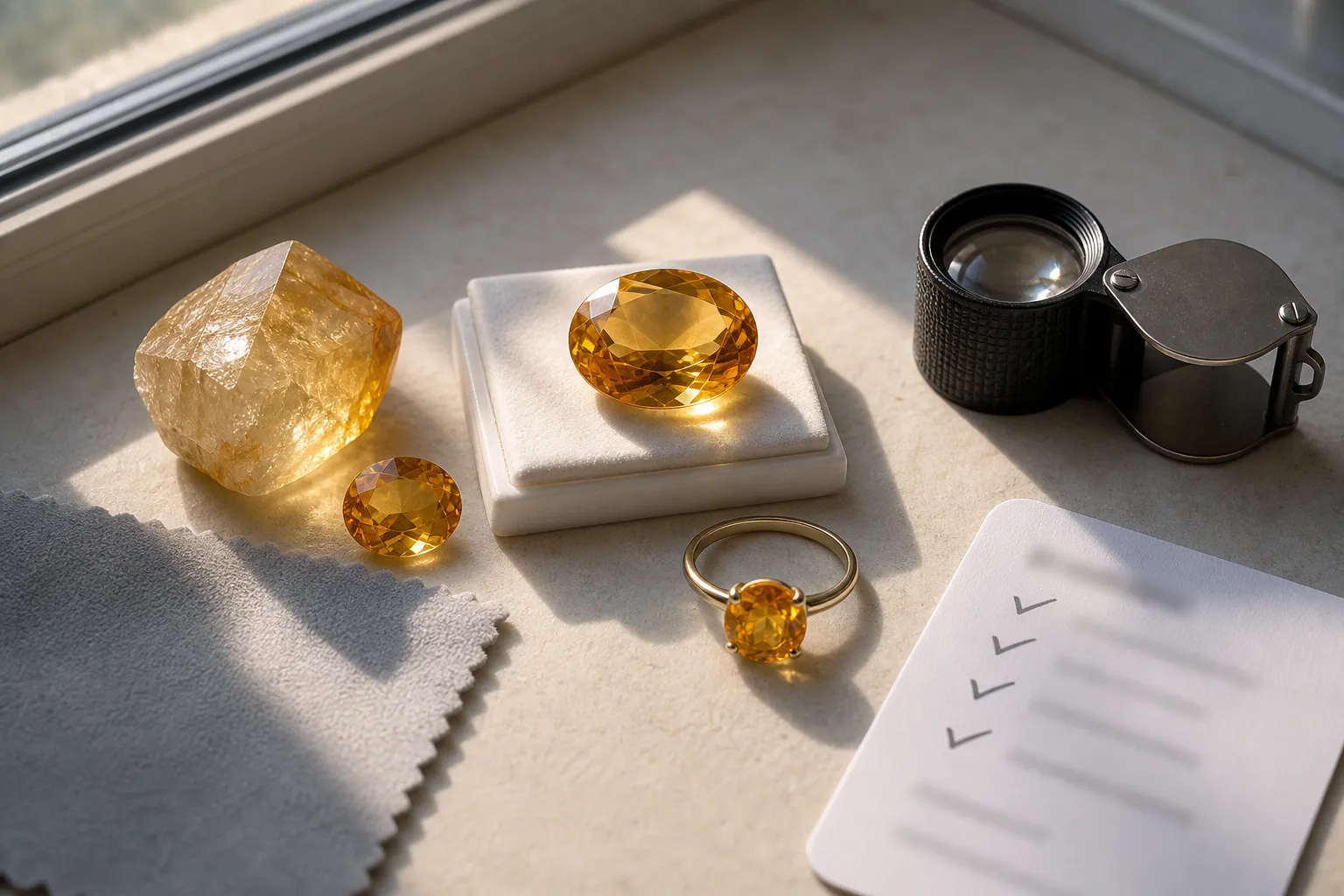
What heat treatment actually changes
Citrine is a yellow to brownish variety of quartz. Its color is not simply sitting on the surface like paint. In quartz, color can be tied to internal defects, impurities, and color-center behavior. Heat can alter those internal color conditions, which is why some quartz changes color when heated.
Much of the citrine-like material in the jewelry and crystal market is commonly discussed as heated amethyst or heated quartz. In simple terms, purple quartz can lose violet color under controlled heating and shift through different color stages before reaching yellow, orange, or brownish tones associated with citrine.
That does not mean every yellow quartz has the same origin, treatment history, or fading risk. Natural citrine exists. Heat-treated citrine also can still be real quartz. The treatment history matters for disclosure and value language, but it does not automatically make the stone fragile, fake, or temporary.
A useful way to separate the issues:
Is it quartz or citrine?
Material identity
Was it heated?
Treatment history
Will it fade?
Color stability under exposure
Is it priced like untreated material?
Market and disclosure context
Those questions often get mixed together in shopping language, but they are not the same evidence problem.
Does heat-treated citrine fade over time?
The best cautious answer is: ordinary heat treatment does not make citrine color automatically short-lived, but long-term fading risk depends on exposure conditions and the individual stone.
The strongest relevant laboratory evidence concerns amethyst heated into citrine-stage colors. In that work, the resulting color did not show obvious change under dark conditions after treatment. That supports an important consumer point: a heat-treated citrine is not necessarily a stone whose color is still actively changing the moment you buy it.
But dark laboratory storage is not the same as a ring worn outdoors for years, a crystal kept on a sunny windowsill, or a shop display under strong lighting. Public evidence does not give a clean, multi-year comparison for heat-treated citrine across sunlight, ultraviolet-rich environments, household cleaning, daily wear, and storage.
For an owner or buyer, that leaves a measured conclusion:
- Heat-treated citrine can be reasonably color-stable after treatment, especially when kept away from unnecessary strong light and heat.
- Fading is not guaranteed simply because the stone was heated.
- Harsh long-term exposure is a sensible concern, but there is not enough direct evidence to give a universal timeline such as “after five years” or “after one summer.”
- Absolute color promises should be treated carefully, especially if they are not paired with clear treatment disclosure and realistic care language.
This is also why “color stabilization” can be slippery in retail wording. Heat may create or improve a desirable color, and that color may remain stable under certain conditions. But “stable” should not be read as “unchangeable in every environment.”
What can change the answer
A citrine’s fading risk is not controlled by the label “heat-treated” alone. Several practical factors affect how confidently anyone can talk about color stability.
Light exposure
The relevant heat-treatment evidence supports stability in dark conditions, not every lighting environment. A stone kept in a jewelry box is not experiencing the same conditions as a crystal left on a bright windowsill.
For citrine, this does not mean panic about normal wear. It means avoiding unnecessary extremes: permanent sun display, heat lamps, car dashboards, or storage spots that repeatedly heat up in direct sun.
Repeated heat
Citrine heat treatment is a controlled process, not a home test. High-temperature baking or reheating quartz in a domestic oven is not a reliable way to identify treatment history or improve color. Laboratory heating uses controlled temperatures, measured samples, and proper methods. Home heating can damage appearance, affect settings, or stress the stone.
For owners, the rule is simple: do not try to prove anything by heating the stone.
The original quartz material
Heat-treated citrine is not one uniform product. Starting material can vary in color zoning, impurity distribution, and internal structure. Studies on heated amethyst note that different areas of a sample may respond differently during heating, especially where color bands are present.
That helps explain why two stones with similar retail names may not behave identically. It also explains why appearance alone is a weak basis for treatment history. A deep orange stone, pale yellow stone, or brownish “Madeira” color may raise questions, but color by itself does not give a complete answer.
Cleaning and wear
The evidence does not support a specific claim that ordinary cleaning makes heat-treated citrine fade. Still, cautious care is reasonable: use gentle cleaning, avoid harsh chemicals, and do not expose mounted jewelry to unnecessary heat.
This is not because every heat-treated citrine is unusually delicate. It is simply a better habit than trying dramatic tests on a stone whose full treatment history may not be known.
Heat-treated does not mean fake
One of the most common misunderstandings is the jump from “heated” to “fake.” That jump is not accurate.
Heat treatment is a gemstone treatment. It changes or improves color; it does not automatically mean the material is glass, plastic, or not quartz. If amethyst-colored quartz is heated into a yellow citrine-like color, the material is still quartz.
The more precise issue is disclosure: was the stone sold with clear treatment language, or was it described in a way that made treated material sound untreated?
Better wording looks like this:
- “This is quartz with citrine color.”
- “This material may be heat-treated.”
- “Treatment history has not been confirmed.”
- “The seller should disclose known treatment.”
- “Appearance alone is not enough to confirm untreated origin.”
Less useful wording looks like this:
- “Baked means fake.”
- “Natural color never changes.”
- “Dark orange proves heat treatment.”
- “If it is genuine, it cannot be treated.”
Gemological reality is usually less tidy than retail shorthand.
Can you tell from appearance whether it will fade?
Not reliably. Visual clues may suggest questions, but they should not be treated as a fading test.
A very uniform orange color, strong reddish-brown tone, white base on crystal clusters, or dramatic “burnt” appearance may make buyers wonder whether a specimen was heated. These features often appear in discussions of citrine heat treated vs natural material. But visual impression does not tell you how the stone was heated, what the starting material was, how long it has already been exposed to light, or whether the color will remain unchanged in your conditions.
Instrumental methods such as UV-visible spectroscopy can help gemologists study absorption behavior in gemstones, and research literature discusses how heating and irradiation can affect optical absorption. Even then, a proper comparison database matters, and spectra do not always answer every natural-versus-treated question on their own.
For a typical owner, a home flashlight, window test, phone photo, oven experiment, or UV experiment is not enough to confirm treatment history or predict future color stability. If treatment disclosure matters because of price, resale, or collecting value, ask for seller documentation or consider a gemological laboratory report for higher-value material.
How to care for heat-treated citrine without overreacting
You do not need to treat heat-treated citrine as if daylight will ruin it. You also do not need to stress-test it.
A sensible care routine is modest:
- Store citrine away from constant direct sun when you are not wearing it.
- Avoid leaving rings, pendants, or loose stones on windowsills, car dashboards, or under strong display lights for long periods.
- Keep the stone away from repeated high heat.
- Clean gently using methods appropriate for quartz jewelry and the setting.
- Do not use home baking, chemical exposure, or UV experiments as identification tests.
- Ask for treatment disclosure before purchase if untreated origin affects the price you are willing to pay.
This advice is conservative, not alarmist. It is not a claim that every heat-treated citrine will fade in sunlight, nor a claim that untreated citrine is immune to color concerns. It simply matches the evidence boundary: avoid unnecessary extremes, especially when treatment history is unclear.
The practical buying answer
If your main fear is fading, do not reject a stone only because the word “heated” appears. Heat treatment is common in the broader citrine market conversation, and it does not automatically make the stone unstable.
The better question is whether the seller’s language is clear:
- Is the material identified as quartz or citrine?
- Is heat treatment disclosed if known?
- Is the stone being presented as untreated without support?
- Is the price consistent with the disclosure?
- Are color-stability claims phrased realistically?
Be cautious with absolute promises. “Will not fade under any condition” is stronger than the available evidence supports. “Heat-treated color can be stable with normal care, but avoid prolonged harsh light and heat” is more responsible.
For an owner, the answer is reassuring but not absolute: your heat-treated citrine is not doomed to fade just because it was heated. For a buyer, the answer is practical: ask for disclosure, do not rely on appearance alone, and care for citrine like a colored quartz gemstone.
Bottom line
Citrine heat treatment is a treatment history, not a fading sentence. Controlled heating can produce yellow to orange citrine colors in quartz, and laboratory evidence supports stability under dark conditions after treatment. What remains less well documented is multi-year real-world exposure across sunlight, display lighting, heat, cleaning, and daily wear.
So the truth is measured: heat-treated citrine is not automatically fake, not automatically unstable, and not something you can identify or predict by appearance alone. Keep it out of prolonged harsh light and heat, avoid home testing, and treat disclosure as a buying issue rather than a reason to assume the stone will fade.