How to Identify Authentic Congo Citrine for Deep Shadow Work
You cannot reliably identify an Authentic Congo Cathedral Quartz or Congo/Lwena citrine claim from color, shape, seller language, or “energy feel” alone. The responsible answer is narrower: treat the piece as possibly consistent with the claim until the seller can show credible provenance, clear treatment disclosure, and, when the claim affects price or trust, editorial review or laboratory confirmation.
For deep shadow work, separate two questions:
- Spiritual use: Does this stone support your symbolic, reflective practice?
- Mineral claim: Is the origin, treatment status, and quartz identity documented well enough to trust?
A crystal can be meaningful in personal ritual without proving a Congo or Lwena origin. But a seller should not use spiritual language to replace evidence.
broader context
Start with the main citrine page
This narrower page works best after the broader citrine reference page.
What to check before trusting the listing
Start with the exact claim. “Congo citrine,” “Congo Lwena citrine,” “Lwena citrine,” “Authentic Congo Cathedral Quartz,” “natural citrine,” and “non-heat-treated citrine” are not automatically the same thing.
A stronger listing should explain:
What the claim is about
Whether the claim is about Congo origin, Lwena locality, citrine identity, cathedral quartz form, non-heat-treated status, or several of these at once.
What supports it
A collector label, dealer chain, acquisition record, treatment disclosure, expert opinion, or lab report.
What remains uncertain
Exact locality, color origin, treatment history, or ownership chain.
How “cathedral” is being used
Whether it is being used as a mineral description, trade description, or spiritual description.
If the listing mostly relies on phrases like “rare energy,” “deep shadow work,” “high vibration,” or “guaranteed authentic” without explaining the mineral claim, that is not strong authentication. It may still be spiritually appealing, but it is weak evidence.
What your eyes can help with — and what they cannot prove
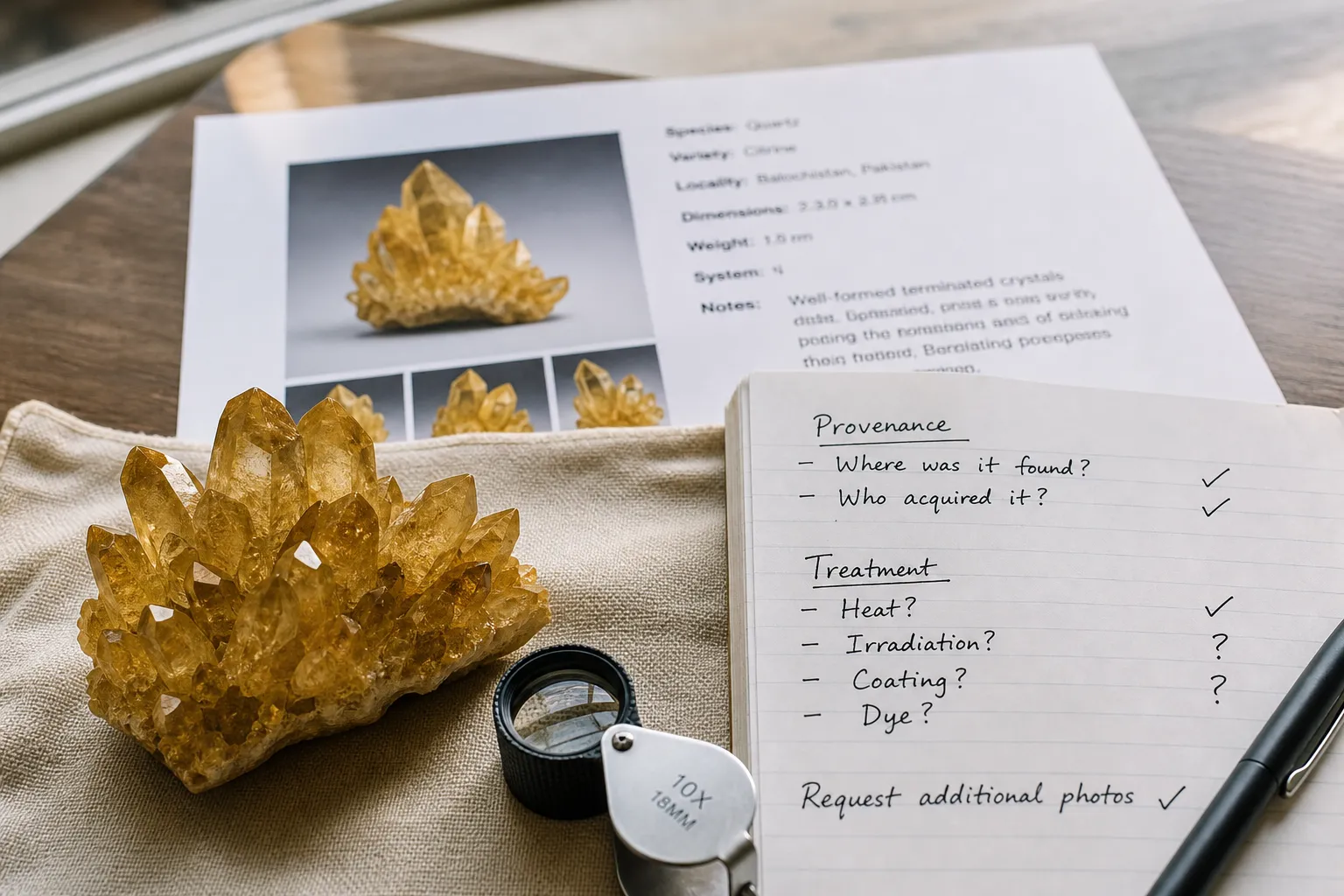
Visual inspection is useful as a first filter. Ask for natural-light photos, several angles, close-ups of terminations and surface condition, size, weight, and any visible matrix or repairs. These details can help you decide whether the seller is transparent enough to keep asking questions.
Photos may also reveal warning signs:
- vague or shifting labels;
- unusually saturated color with no explanation;
- one specimen described with several stacked names without clarification;
- a premium price but no treatment disclosure;
- a locality claim with no provenance trail.
Still, visual checks only raise or lower confidence. They do not prove that a quartz specimen came from Congo, that it came from Lwena, or that it is non-heat-treated.
This matters especially with “cathedral” language. In the crystal trade, cathedral quartz usually refers to a clustered, layered, or temple-like growth impression. It is often descriptive rather than diagnostic. A cathedral-like form does not prove Congo origin. A Congo claim does not prove citrine identity. Citrine color does not prove untreated color origin.
“This specimen visually fits parts of the seller’s description, but the origin and treatment claims still need support.”
Documentation that actually helps
Paperwork may feel less important than how a crystal feels in your hand, but if you are paying for an authentic Congo citrine claim, documentation matters.
Useful seller documentation for citrine may include:
- a prior collector or dealer label with locality information;
- a purchase record from a reputable source;
- a consistent chain of description from acquisition to resale;
- clear treatment disclosure, including whether non-heat-treated status is known, unknown, or assumed;
- a lab report when the claim is high-value, disputed, or difficult to verify visually.
For Lwena origin verification, the standard should be higher than a loose listing title. Locality is about where the material came from, not just how it looks. Provenance work in minerals and gemstones often depends on traceable records, reliable reference material, and sometimes analytical comparison. That does not mean every small crystal needs lab testing. It does mean a seller should not present Lwena origin as visually obvious without support.
A seller who says, “This came from an old Congo parcel, but I do not have documents,” is being more transparent than one who claims certainty without explanation. But it is still weaker than documented provenance.
When editorial review or lab confirmation makes sense
Not every purchase needs laboratory analysis. For a modestly priced stone used as a personal reflection object, honest uncertainty may be enough. Lab confirmation becomes more relevant when several premium claims are stacked together: Congo origin, Lwena locality, citrine identity, non-heat-treated status, and cathedral form.
editorial review may help with quartz identification, terminology, and treatment discussion. Laboratory methods used in mineral and gemstone characterization can include Raman spectroscopy, FTIR, XRF, SEM-EDS, or ICP-MS, depending on the question being asked. These tools are not automatic proof of origin; they work best when there is a clear question and a reliable comparison framework.
The key boundary for this topic is simple: there is no responsible visual checklist that can prove Congo/Lwena citrine or Authentic Congo Cathedral Quartz from appearance alone. No single color tone, growth habit, inclusion pattern, or intuitive response should be treated as proof.
A practical rule
- If the stone is low-cost and for personal symbolism, ask for transparency and accept uncertainty.
- If you are paying a premium for “Authentic Congo Cathedral Quartz,” ask for provenance before buying.
- If resale value, collection value, or serious trust is involved, consider editorial review or lab confirmation.
- If the seller avoids basic questions while using high-certainty language, treat that as a confidence problem.
Keeping shadow work meaningful without using it as proof
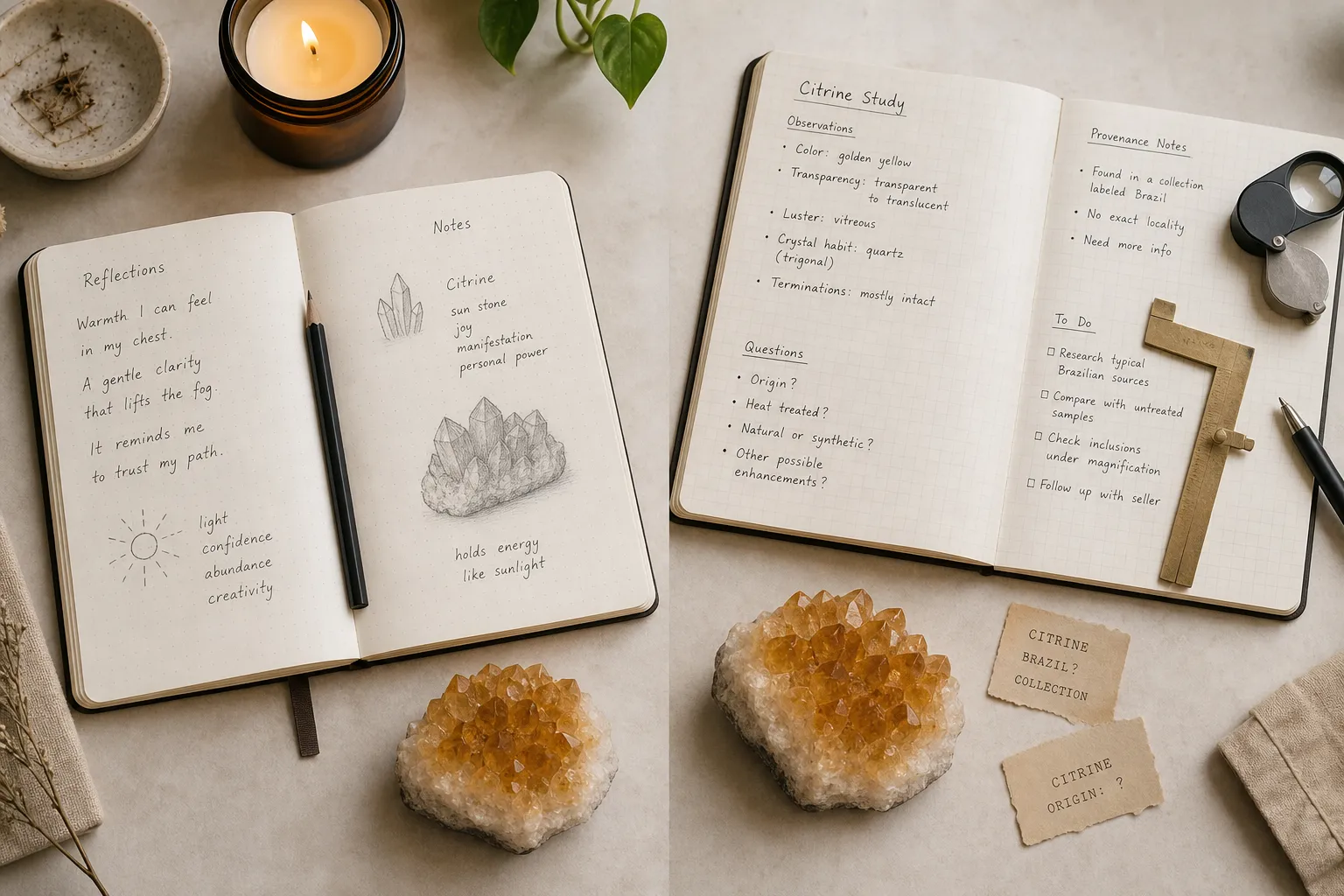
Deep shadow work belongs to reflection, ritual, journaling, meditation, and personal meaning. Some practitioners use citrine or cathedral quartz as symbolic anchors for honesty, self-inquiry, confidence, grief, fear, ambition, or self-worth. That kind of use is personal and reflective; it is not mineral authentication and not a substitute for professional care.
A helpful way to stay grounded is to keep two ledgers.
The symbolic ledger
What does the stone invite you to sit with? Its color, form, weight, clarity, or story may help you focus your attention during journaling or ritual.
The evidence ledger
What is the specimen? What is claimed? What is documented? What is unknown? Has treatment status been disclosed? Is the locality supported by more than a title?
This separation protects your practice from market mythology. A crystal does not need an inflated origin story to be meaningful. At the same time, a seller should not use shadow-work language to bypass provenance questions.
A quick trust test before you buy
Before purchasing Congo Lwena citrine or Congo Cathedral Quartz for shadow work, ask:
-
Is the claim specific?
The seller should separate citrine identity, Congo/Lwena origin, cathedral form, and non-heat-treated status.
-
Is the evidence named?
Look for provenance records, prior labels, supplier-chain details, editorial review, or lab documentation.
-
Is uncertainty admitted?
Honest uncertainty is better than unsupported certainty.
-
Are photos treated as preliminary?
Visual inspection can screen a listing, but it cannot prove origin or treatment history alone.
-
Does the spiritual language stay in its lane?
Shadow-work language can describe personal use, but it should not be presented as proof of authenticity.
If a specimen passes these checks, you may have a reasonable basis for cautious trust. If it fails several of them, the best conclusion is not automatically “fake.” It is more precise to say: the claim is not well supported.
Bottom line
To identify authentic Congo citrine for deep shadow work, do not try to prove everything with your eyes. Use visual inspection for early screening, seller documentation for provenance confidence, editorial review for mineral consistency, and lab analysis when the claim is valuable or contested.
For the spiritual side, let the stone support reflection without turning symbolism into evidence. The most trustworthy Congo/Lwena citrine claim is not the loudest one. It is the one that clearly separates what is observed, what is documented, what is tested, and what remains unknown.