The New Year Abundance Ritual: Using Stones as a Physical Focus Anchor
A New Year Financial Ritual is most useful when the stone is treated as a physical focus anchor—not as something that changes your finances by itself.
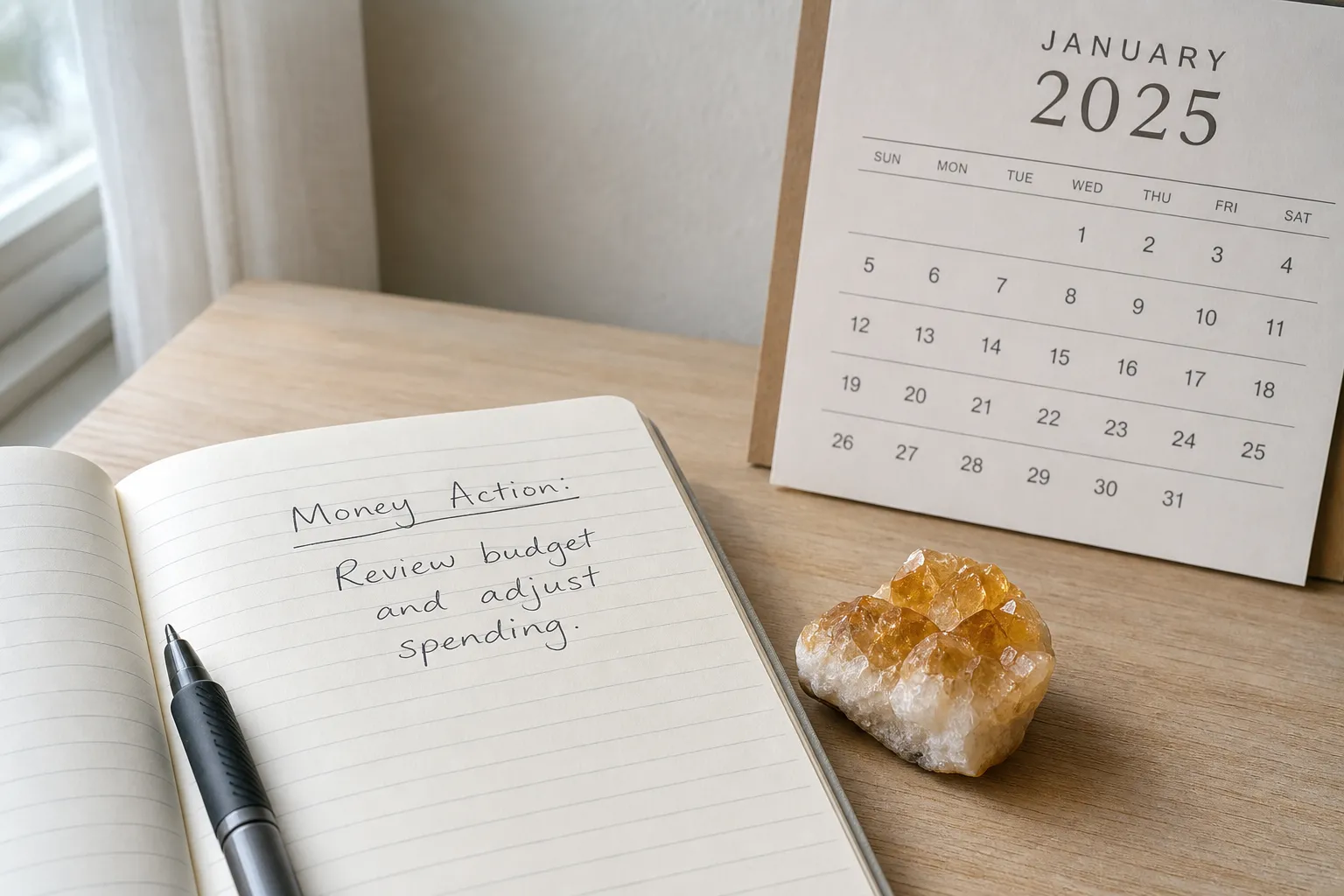
In this grounded version, citrine or another stone gives your attention somewhere to land. You hold it, name one money intention, place it where you will see it, and connect that sight or touch to one practical follow-through action. New Year matters because it can feel like a clean starting point. The stone matters because it becomes a visible prompt. The useful outcome is not “wealth attraction”; it is remembering the behavior you chose.
The simplest version is this: choose a stone, choose one intention, choose one money action, and make the stone the reminder.
broader context
Citrine verification note
This narrower page works best after the broader citrine reference page.
Why New Year Works as a Reset Point
New Year has symbolic weight because it marks a boundary. Many people use it to separate “what I have been doing” from “what I want to practice next.” Research on temporal landmarks and the fresh-start effect supports this general idea: certain dates can make goal initiation feel more salient.
That does not mean January has special financial power. It means the calendar can help the mind organize change.
For a New Year abundance ritual, that distinction matters. If you treat the date as a promise, the ritual becomes fragile. If a bill arrives, income stays the same, or a plan needs revision, the ritual may feel like it “failed.” If you treat New Year as a time node—a meaningful starting marker—the ritual has a more realistic job: helping you begin a behavioral sequence.
That sequence can be small:
- see the stone on your desk;
- remember the intention you named;
- open a budget note, savings tracker, spending list, or planner;
- take one low-risk step you already chose.
The stone is not the cause of the financial result. It is the cue that helps you return to the action.
Citrine as a Stone Focus Anchor
Citrine is a variety of quartz. Gemological sources such as GIA describe it in mineral terms, not as evidence of financial effects. In cultural and market language, citrine is often linked with brightness, prosperity, confidence, and abundance. Those meanings can be personally resonant, but they should stay symbolic.
A clear separation keeps the ritual honest:
Citrine as quartz
What it can support
A real stone you can see, hold, place, and identify.
What it cannot support
Evidence that money outcomes will change.
Citrine symbolism
What it can support
A personal association with abundance, warmth, or clarity.
What it cannot support
Guaranteed income, debt reduction, or business success.
New Year timing
What it can support
A meaningful reset point for intention and planning.
What it cannot support
A promise that finances will improve.
Ritual sequence
What it can support
A repeatable reminder tied to behavior.
What it cannot support
A substitute for financial decisions or advice.
You can use citrine if its color and symbolism feel right to you. You can also use clear quartz, smoky quartz, jade, pyrite, a river stone, or any object that feels steady and visible. The stone does not need to be expensive, rare, or marketed as powerful. For this purpose, the best stone is the one you will actually notice.
A small tumbled citrine beside a notebook may work better than a costly display piece hidden in a drawer. The function is not glamour. The function is recall.
A Simple New Year Abundance Ritual With One Money Action
Use this as a short ritual sequence, not a full financial plan. Keep it plain enough that you can repeat it.
1. Choose the stone and name its role
Hold the stone and define it in grounded language:
“This stone is my physical focus anchor for the money behavior I am choosing this year.”
If you like abundance language, keep it symbolic:
“I use this citrine as a reminder of clarity, steadiness, and enoughness.”
Avoid wording that makes the stone responsible for your finances. A stronger ritual is one where you remain the actor.
2. Write one money intention
The intention should point toward a behavior. Research on New Year’s resolutions has found that approach-oriented goals can be more successful than avoidance-only goals, though that does not prove any ritual effect. The practical takeaway is simple: phrase the intention around what you will do.
Less useful:
- “I will stop being bad with money.”
- “I will never overspend again.”
- “I need wealth to come to me.”
More grounded:
- “I will review my spending every Friday morning.”
- “I will write down one money decision before I make it.”
- “I will check my savings goal on the first Sunday of each month.”
- “I will list one financial question I need help with and decide who to ask.”
A clean intention can sound like this:
“This year, I am practicing more conscious money decisions by [specific action].”
3. Attach the stone to a cue-action plan
Psychology uses the term implementation intention for a plan that links a cue to a response, often in the form “when X happens, I will do Y.” This is where the stone becomes useful. It turns the ritual from a mood into a cue-action plan.
Examples:
- “When I see the citrine beside my laptop on Friday morning, I will review my recent spending for ten minutes.”
- “When I touch the stone before opening a shopping site, I will pause and ask whether this purchase fits my current priority.”
- “When I move the stone to my planner on the first of the month, I will write one next money step.”
Keep the action small. “Fix my finances” is too large. “Review one account,” “write one question,” or “check one spending category” is easier to remember and repeat.

4. Place the stone where the action happens
Stone placement matters because the stone is a visual prompt. If the action is reviewing spending, place it near the notebook, calendar, or device you use for that review. If the action is pausing before purchases, place the stone near your wallet, desk, or a small tray where you set receipts. If the action is a monthly money check-in, place it with your planner.
Good placements:
- beside a budget notebook;
- near a calendar reminder;
- on a desk where you pay bills or review accounts;
- in a small dish where you keep receipts;
- beside a written intention card.
Weak placements:
- in a drawer;
- in a bag you rarely open;
- on an altar or shelf you never connect to the action;
- beside unrelated objects where the reminder visually disappears.
The practical heart of the ritual is simple: the stone quietly asks, “What did I say I would do?”
5. Close with one review point
A ritual that never returns to real life can become vague. Add one review point before you finish.
You might write:
“On the first Sunday of each month, I will check whether this action is still useful. If it is too large, I will make it smaller.”
This keeps the practice flexible. If your chosen action does not fit your life, adjust it. The point is not to prove devotion to the ritual. The point is to keep one grounded money behavior alive.
What Changes the Answer
This ritual works best as a reminder system. It becomes less useful when it is asked to do a job it cannot do.
The answer changes if you expect the stone to cause financial outcomes. The available sources do not support claims that citrine, crystals, intention, visualization, or New Year timing can increase income, remove debt, improve investments, protect against financial loss, or guarantee business success. Abundance language can be meaningful, but it should not replace practical decisions.
The answer also changes if the chosen action is too broad. “Become abundant” may feel inspiring, but it gives the mind no next step. “Open my spending note every Friday” is less dramatic and more usable.
It changes again if the money issue is complex or high stakes. Budgeting, emergency savings, debt planning, taxes, credit, insurance, retirement, business decisions, legal documents, and investments are practical financial matters. A symbolic ritual may help you remember to take a next step, but it is not a substitute for consumer-protection tools, careful planning, or guidance from a qualified financial professional.
And if money topics trigger avoidance or shame, make the action gentler. Instead of “review everything,” choose “write down one question.” Instead of “fix the budget,” choose “look at one recent transaction.” A good focus anchor should reduce friction, not become another way to blame yourself.
Common Confusion: Abundance Ritual vs. Financial Advice
A New Year abundance ritual and financial advice are not the same thing.
A ritual can help you mark a beginning. It can make an intention feel concrete. It can turn citrine into a visual prompt for budgeting, a money check-in, or another simple behavior. It can give emotional shape to a reset.
Financial advice is different. It deals with specific accounts, risks, debts, laws, taxes, investments, insurance, and personal circumstances.
The safest bridge between the two is one modest action:
- The ritual does not “bring savings.” It reminds you to check the savings step you chose.
- The stone does not change a debt situation. It reminds you to list one question or review one planned step.
- The New Year does not “open wealth.” It gives you a culturally meaningful date to begin again.
- The intention does not replace planning. It clarifies the behavior you want to practice.
This is still allowed to feel warm. It can still be personal. It can still use words like abundance, reset, clarity, steadiness, and enough. The boundary is simply that symbolic language should not be treated as financial causation.
A Clean Intention Formula You Can Use
If you want one sentence for the ritual, use this structure:
“On this New Year reset, I use this stone as a physical focus anchor for [value], and when I see it, I will [specific money action] at [time or place].”
Examples:
“On this New Year reset, I use this citrine as a physical focus anchor for clarity, and when I see it beside my planner, I will review my spending for ten minutes each Friday.”
“On this New Year reset, I use this stone as a reminder of steadiness, and when I touch it before making a nonessential purchase, I will pause and check whether the purchase fits my current priority.”
“On this New Year reset, I use this citrine as a symbol of enoughness, and when I see it on the first Sunday of the month, I will write one practical next step for my finances.”
That is enough. The ritual does not need more objects, more rules, or more dramatic claims. Its strength is its simplicity: a time node, a stone, an intention, a cue, and one behavior.
The Boundary That Keeps the Ritual Honest
The stone does not make money arrive; it gives your attention somewhere to land and reminds you of the behavior you chose.
That sentence is the boundary. Citrine can be beautiful. New Year can be meaningful. Abundance language can be emotionally useful. But the grounded value of the practice comes from the behavioral sequence you attach to it.
If you want a New Year abundance ritual, make it small, visible, and honest. Choose the stone. Name the intention. Place the stone where it can interrupt forgetfulness. Tie it to one low-risk money action. Review it later.
The ritual is not the financial outcome. It is the reminder at the beginning of the path.