Retail spectroscopy boundary
Point-of-Sale DRIFTS: The Future of Retail Crystal Authentication
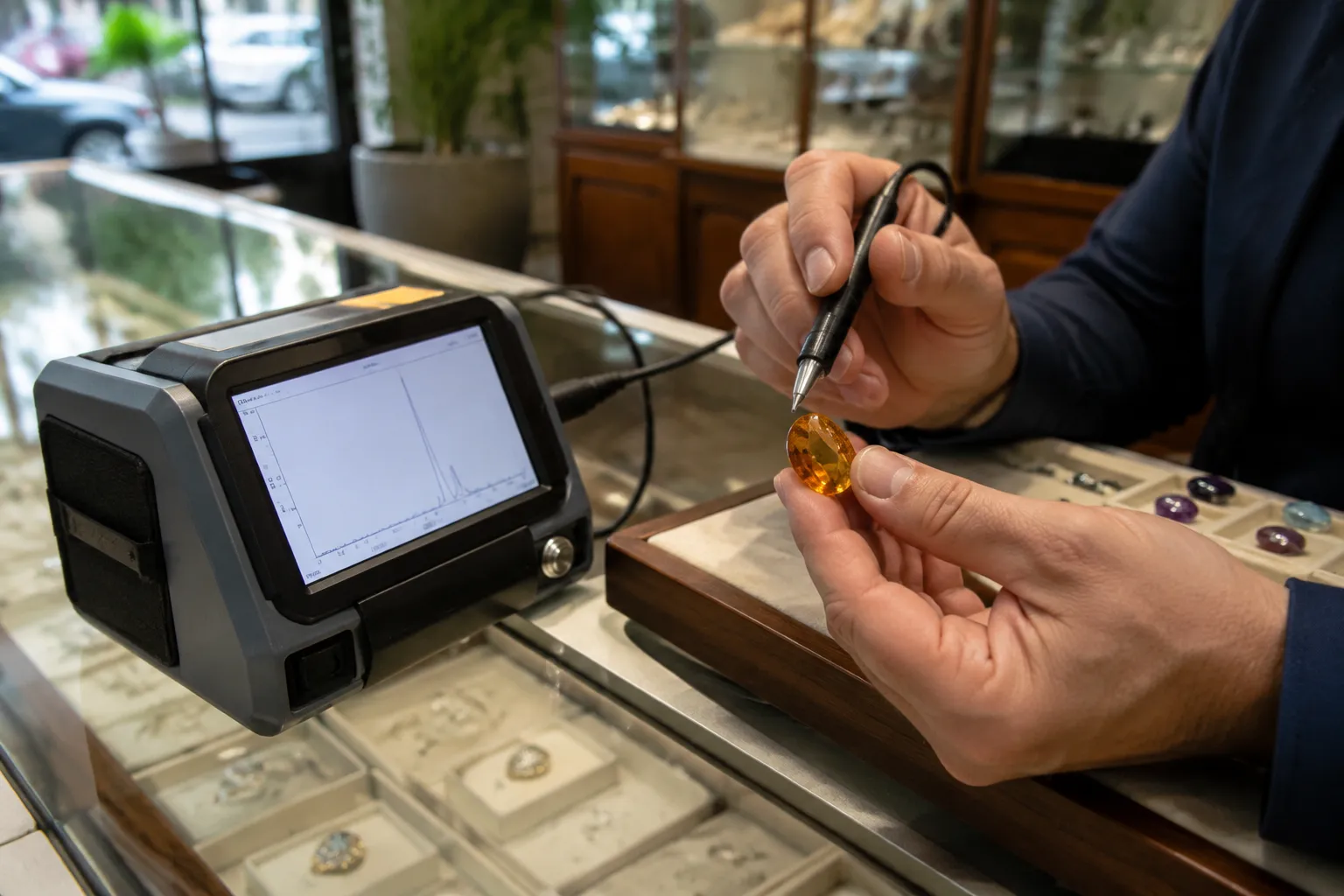
A citrine cabochon can look convincing under counter lighting and still leave the real question open: natural citrine, treated quartz, synthetic material, or a label stretched past the evidence? Portable DRIFTS Integration can realistically support crystal authentication at the point of sale, but only as a controlled screening layer. It is not a retail shortcut to final proof.
The available source base supports portable infrared spectroscopy, gemological use of FTIR, diffuse reflectance method logic, calibration discipline, and spectrum comparison. It does not directly validate portable DRIFTS as a complete point-of-sale authentication system for crystals. That is the working boundary. A jeweler could use it to strengthen a retail conversation when setup, reference comparison, and wording are disciplined; unresolved stones still need fuller gemological evaluation.
broader context
Broader citrine reference
This narrower page works best after the broader citrine reference page.
What Point-of-Sale DRIFTS Would Actually Mean
Point-of-sale integration here does not mean checkout software, payment terminals, inventory records, or security cameras. Those tools may shape the shop workflow, but they do not identify a stone. For crystal authentication, point-of-sale DRIFTS means placing a portable infrared measurement step near the moment of inspection, explanation, or sale.
DRIFTS stands for Diffuse Reflectance Infrared Fourier Transform Spectroscopy. In practical terms, the instrument collects an infrared response from the sample in a reflectance arrangement. FTIR produces an infrared absorption spectrum, and that spectrum can be compared with known material patterns or treatment-related features when the method and references match.
For citrine and related quartz material, a scan does not settle every value question. One layer asks whether the sample behaves like quartz. Another asks whether the color story is consistent with natural citrine or treated material. Another asks whether seller disclosure matches what the evidence can support. DRIFTS may help with parts of that screening, especially where infrared features are relevant. It cannot turn weak disclosure into a provenance record.
The retail appeal is easy to understand. A portable tool sounds faster than sending every uncertain stone away. The useful version, though, is not counter theater. It is a documented screening process that records what was measured, what reference comparison was used, and what remains outside the scan.
Why Portable Infrared Tech Is Plausible, But Not Decisive
The stronger case for portable DRIFTS begins outside the jewelry counter. Portable FTIR has been studied for field characterization of mineral samples, and gemology already uses infrared spectroscopy for certain identification and treatment-detection questions. Gem research also depends on comparison against reference spectra rather than bare interpretation alone.
That makes portable infrared tech plausible for on-site screening. The instrument class is real, and the method is connected to gemology. A compact system can, in principle, produce a spectrum in a shop and show whether the reading resembles expected material behavior. It can also flag samples that deserve more careful analysis.
The limit sits beside the promise. Portable does not mean definitive. Miniaturized tech may bring the measurement closer to the sales counter, but it also raises practical questions about optical geometry, sample presentation, operator discipline, and data interpretation. A spectrum is not a certificate. It is a measured response that must be collected well and read against something reliable.
For citrine authenticity, this protects both buyer and seller. If a stone sold as natural citrine shows evidence more consistent with treated quartz, the retail conversation should change. If the scan is unclear because the surface, geometry, or spectral response is poor, the cleaner answer is that the point-of-sale screen did not resolve the question.
Conditions That Would Make Retail Use More Credible
Calibration comes first
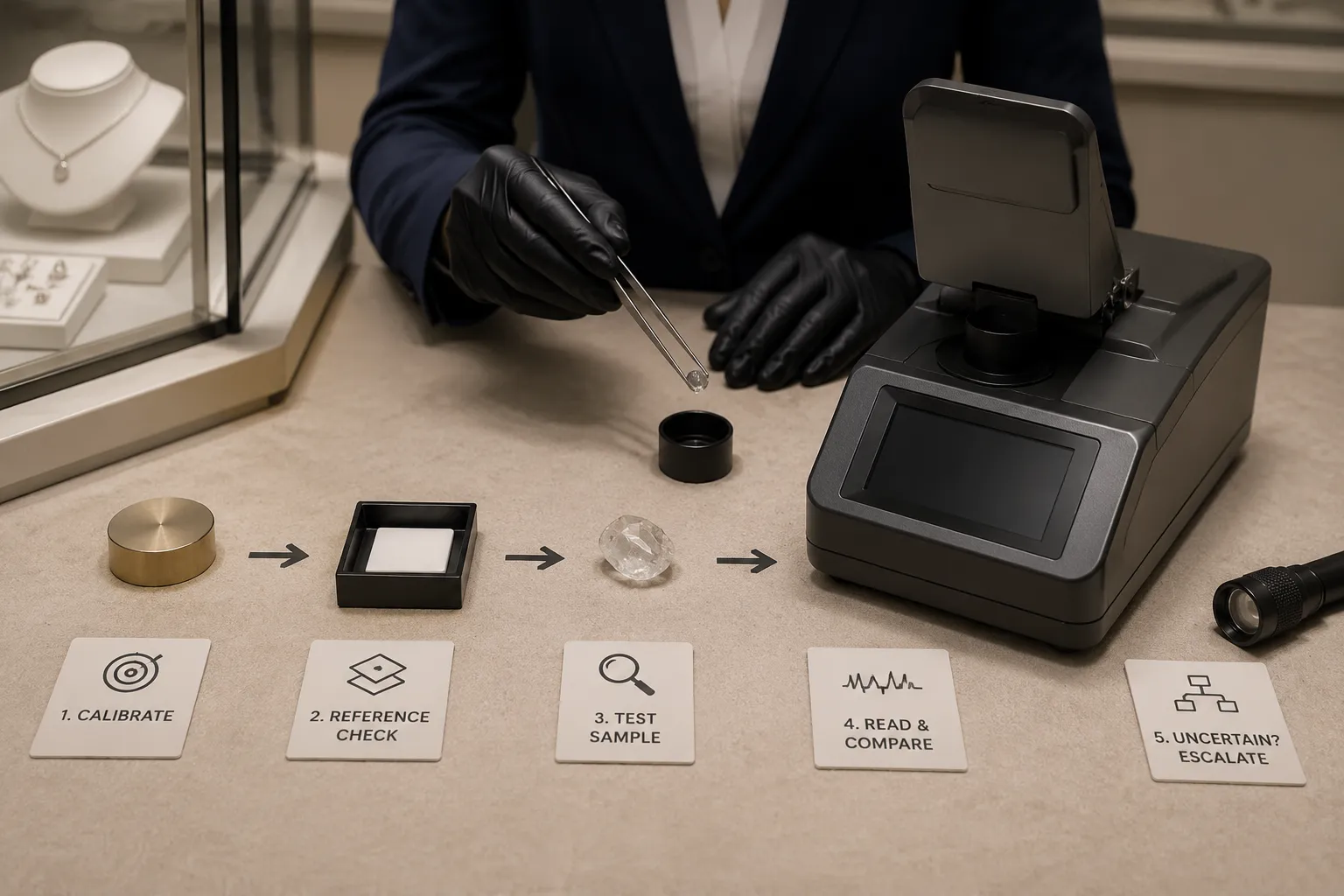
A point-of-sale DRIFTS workflow becomes more credible when it is treated as gemology spectroscopy, not as a sales feature. Diffuse reflectance methods are sensitive to setup quality, background collection, reference standards, and instrument drift. A shop that does not control these factors may be producing impressive-looking graphs without dependable meaning.
Reference comparison comes next
Infrared data becomes useful when it can be compared against suitable spectra for the relevant material, treatment state, and measurement mode. Public spectral datasets and institutional research can support the method context, but a retail system still needs a carefully matched reference library. Comparing a DRIFTS reading with a mismatched ATR spectrum, a poorly documented entry, or an unrelated mineral reference can create false confidence.
Sample handling also matters
Diffuse reflectance depends on how light interacts with the surface and near-surface region of a material. Crystal shape, polish, transparency, inclusions, coatings, mounting, and the measurement spot can affect what the instrument sees. A loose rough point, a polished bead, and a faceted stone may not behave the same way under a portable reflectance setup.
Procedural clarity finishes the workflow
Retail staff do not need to become research spectroscopists, but the process needs rules: when a scan is acceptable, when it should be repeated, when the stone should be referred out, and how the result should be worded for the buyer. A careful phrase would be: “This on-site infrared screen is consistent with the reference material used here.” That is cleaner than turning one scan into an authenticity guarantee.
Where Shoppers and Sellers Often Misread the Technology
Confusing point of sale with payment integration
A jewelry POS system may track inventory, receipts, customer notes, and transaction records. None of that establishes crystal identity. A portable DRIFTS instrument could sit near the same counter, but its value comes from spectroscopy, not from being connected to retail software.
Assuming a field-ready tool has authority in every case
Portable gem-testing tools already appear in market language around fieldwork, retail inspection, and student use. That reflects real demand for smaller instruments, but it does not show that every portable system can authenticate every crystal type under shop conditions. Terms like rugged, modern, integrated, or trusted are commercial vocabulary unless supported by independent method evidence.
Reading a spectrum as a simple pass-or-fail badge
An infrared absorption spectrum can be informative, but it still requires interpretation. Peaks may be affected by sampling mode, surface condition, mixture, treatment, and the reference set used for comparison. Some features may support a material call; others may only show that more work is needed.
Treating ATR and DRIFTS as interchangeable
ATR-FTIR and DRIFTS are both infrared approaches, but their sampling behavior differs. ATR depends on contact with an internal reflection crystal and probes a shallow region of the sample. DRIFTS uses diffuse reflectance behavior and is sensitive to surface texture, scattering, particle behavior, and alignment. A reference built for one method should not be casually used as if it were built for the other.
For a buyer asking about citrine, the practical lesson is simple: the tool matters, but the workflow matters more. A portable instrument without calibration, method-matched references, and cautious wording may add display before it adds useful certainty.
What DRIFTS Can Support at the Counter
Used carefully, point-of-sale DRIFTS could support three retail functions.
- Triage: A jeweler may be able to separate stones that are broadly consistent with expected material behavior from stones that need more careful review. That is especially useful when the alternative is relying only on color, seller story, or vague labels.
- Disclosure conversations: If a citrine-like stone is being sold with claims about natural origin, treatment, or rarity, an on-site spectrum can move the discussion toward evidence. The result should still be expressed within its limits, but even a limited screen can discourage overconfident retail language.
- Documentation: A measured spectrum, the instrument mode, the reference comparison, and the date of screening create a clearer record than a verbal assurance. That record is not the same as an independent laboratory report, but it can show what was checked at the counter and what was not.
The more ambitious claim, that portable DRIFTS is already the complete future of retail crystal authentication, remains ahead of the public evidence. The visible source set supports feasibility and method boundaries more than real-world retail deployment.
The Sensible Future Is Screening Plus Escalation
The most realistic future is not a counter device that replaces gemological judgment. It is a point-of-sale screening workflow that improves the first conversation and sends unresolved stones to a stronger process.
For citrine, that means a seller should not treat appearance as proof. Yellow-orange color alone does not settle natural-vs-treated discernment, and retail labels can be broad. A portable infrared screen may add useful evidence when the shop has method discipline and a relevant reference library. If the result is ambiguous, the retail action should be disclosure or further testing, not a forced conclusion.
For buyers, the better question is not “Does the shop have a scanner?” It is: “What does this scan compare against, and what would make you send the stone for further verification?” That question exposes the difference between a genuine screening process and a sales prop.
Portable DRIFTS Integration is plausible at the point of sale. It may help crystal authentication by making spectroscopy more available where retail trust is formed. The supported role is narrower: on-site screening, reference comparison, and better disclosure language. A careful scan can improve the conversation. It cannot carry every authenticity claim by itself.
Quick Answers
Can portable DRIFTS authenticate citrine at the counter?
It can support a screening opinion when the setup, sample handling, and reference comparison are sound. It should not be treated as final identification for every stone.
Is point-of-sale DRIFTS the same as jewelry POS software?
No. Jewelry POS software manages sales operations. Point-of-sale DRIFTS refers to an on-site spectroscopy step used near the retail decision.
What should a buyer ask before trusting the result?
Ask what reference material was used, whether the method matches the reference library, and what result would trigger further gemological verification.