Quartz specific gravity testing
Specific Gravity Secrets: Using Density to Verify Champagne Quartz
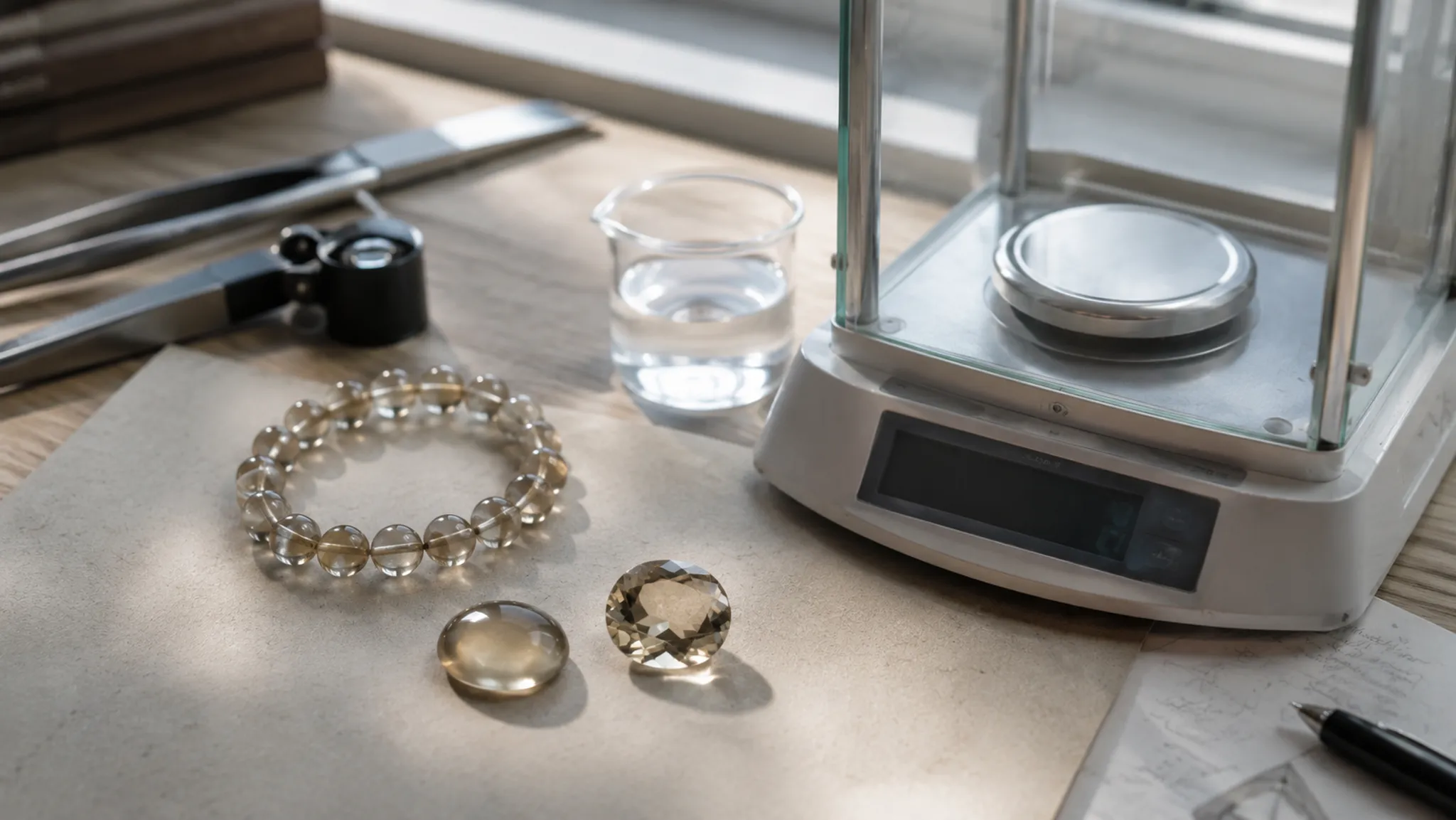
A champagne quartz bead, cabochon, or faceted stone can look convincing because its color stays close to familiar quartz territory: pale brown, golden gray, smoky honey, or soft tea. Quartz specific gravity testing can help screen that stone by asking one narrow question: does its density behavior fit what reliable quartz references would lead you to expect?
If the result sits clearly outside the expected quartz pattern, the piece deserves more scrutiny as a possible imitation, assembled item, or misdescribed material. If the result appears consistent, that is useful but not final. Density can support quartz identification; it cannot prove natural origin, rule out treatment, confirm a trade name, or settle market value.
broader context
Broader citrine reference
This narrower page works best after the broader citrine reference page.
What Specific Gravity Can Actually Tell You
Specific gravity compares the weight of a material with the weight of an equal volume of water. In gemstone work, it is one way to check whether a material behaves like the mineral it is being sold as. For champagne quartz screening, the point is not to prove the full sales description. The point is to see whether the stone stays in the quartz lane.
That distinction matters. “Champagne quartz” is a market-facing color phrase, not a separate mineral species. A stone sold under that name may be natural quartz, treated quartz, smoky quartz with a warmer tone, citrine-colored material, or something described loosely by a seller. Density testing addresses the material question at a broad level. It does not explain why the color is present, whether heat or irradiation influenced it, or whether the seller’s disclosure is complete.
Used well, gemstone density is a filter. A reading that does not align with quartz expectations can push the piece toward further testing. A reading that does align keeps quartz plausible, but it does not close the file.
How Hydrostatic Weighing Fits the Screening Task
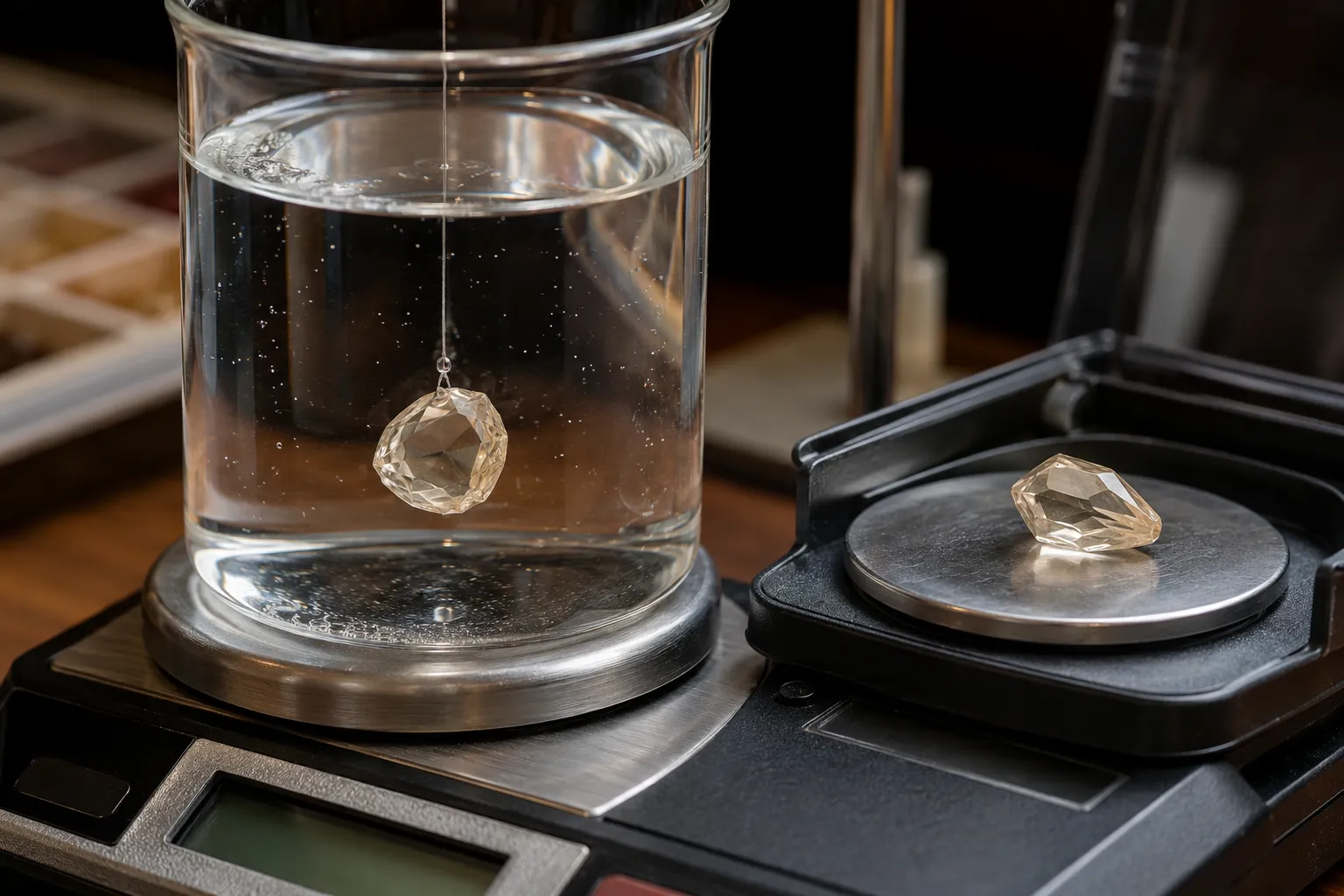
Hydrostatic weighing is the usual method people mean when they talk about measuring a gem’s specific gravity without cutting or damaging it. The stone is weighed in air, then weighed while suspended in water, and the difference is used to calculate density behavior. The method is useful because it relies on weight and displaced water rather than surface appearance.
For champagne quartz, that separate physical clue matters because color is a poor witness. Glass imitation stones, dyed or treated material, and other lookalikes can be sold in warm brown or golden tones. A color name alone does not tell you what the material is.
The procedure still has to be treated as a measurement, not a ritual. A small stone, uneven suspension, trapped air, surface residue, inaccurate scale readings, or contact with the container wall can shift the result enough to make interpretation shaky. Mounted jewelry adds another problem: metal, glue, backing, or a closed setting can make a stone-only density reading impossible. In that situation, the number may describe the setup more than the gem.
Because the available material for this page does not include public testing manuals or quartz density references, this article does not give a numeric range or a full procedure. The safer use is editorial and practical: understand what the test can contribute, then compare any actual result with reliable mineralogy references or a qualified gemological assessment when the purchase matters.
When a Density Result Helps, and When It Misleads
A density result helps most when it is cleanly inconsistent with the expected quartz range from reputable references. If a loose stone gives a stable measurement far away from quartz behavior, that is a useful warning. It does not automatically identify the substitute, but it can justify asking for additional testing, clearer disclosure, or a return before treating the item as champagne quartz.
A density result is less decisive when it appears compatible with quartz. Many questions around citrine authenticity and champagne quartz come from the same market problem: a color label is being asked to carry too much information. A quartz-like density result may support the idea that the material is quartz, but quartz can be natural, treated, synthetic, or described with loose color language. Density does not separate those categories on its own.
Seller language should stay beside gemological evidence, not above it. Phrases such as “genuine quartz,” “champagne citrine,” “natural champagne quartz,” or “smoky citrine” may describe appearance, trade positioning, or seller interpretation. They do not become fully established facts because the stone has a plausible density reading.
The same caution applies to identifying quartz imitations. Density can raise suspicion about some non-quartz materials, including glass imitation stones, but it is not a universal sorting tool. Some materials overlap closely enough, and some home measurements are uncertain enough, that the reading should remain one clue. Better identification combines density with refractive behavior, magnification, inclusions, growth features, color distribution, and credible documentation.
Conditions That Make a Reading Worth Considering
A useful specific gravity reading depends on small conditions that can change the result.
Stone access
The stone should be loose, clean, and fully accessible. A pendant or ring usually cannot be measured as “the stone” unless the stone is removed, because the mounting adds weight and may displace water in a different way.
Scale sensitivity
The scale must be sensitive enough for the gem’s size. Small stones leave little room for error. A tiny shift in the reading may matter more for a small bead than for a larger specimen.
Suspension control
The suspension must not add hidden forces. If thread, wire, tweezers, or a basket touches the side or bottom of the water container, the submerged weight can be wrong. Air bubbles can also cling to facets, pits, drill holes, or rough surfaces.
Reference quality
The comparison source matters. A number without a trustworthy quartz density reference is just a number. Retail charts, seller pages, and equipment listings may help explain the language people use, but they are weak support for disputed authenticity or identification claims.
The water setup must be stable. Movement, temperature differences, incomplete submersion, and surface tension can affect delicate readings. Home testing is not useless, but a single casual number should not be treated as lab-level identification.
Common Confusions Around Champagne Quartz and Density
Density is not a color test
One common confusion is treating density as a color test. It is not. Specific gravity says something about material behavior, not about why a stone looks champagne, smoky, golden, or honey-toned. A quartz-like result cannot tell you whether the color is natural, treatment-related, or loosely described by a seller.
Quartz and citrine are not identical buying claims
Another confusion is treating “quartz” and “citrine” as identical buying claims. Citrine is a yellow to orange variety of quartz in ordinary gem language, while champagne quartz is often used more flexibly for subdued brown-gold material. A density reading may support a quartz-family material, but the trade label still needs separate scrutiny.
Specific gravity does not solve value
A third confusion is expecting density to solve value. Market value depends on more than material identity: color quality, size, cutting, clarity, treatment disclosure, origin claims, rarity language, and seller trust all matter. Specific gravity testing can improve market literacy by challenging a weak material claim, but it does not price the stone.
A strange result also does not automatically mean the stone is misrepresented. It may mean the measurement was poor, the stone was not loose, the setup trapped air, or the object included more than one material. The better response is retesting under cleaner conditions or moving to another form of verification.
A Practical Screening Path for a Buyer
- 1. Separate the claim into parts. For a loose champagne quartz stone, ask whether the seller is claiming quartz material, natural color, treatment status, origin, or simply a color style. Density testing can only address the material part.
- 2. Check whether the stone suits hydrostatic weighing. If it is mounted, glued, drilled with residue, heavily included with cavities, or too small for your equipment, the result may be too weak to carry much meaning.
- 3. Compare the reading with a dependable quartz density reference. A result clearly outside expected quartz behavior is a reason to pause. A result consistent with quartz is a reason to continue verification, not a reason to accept every sales phrase attached to the stone.
- 4. Ask what remains unanswered. Treatment context, synthetic material concerns, and natural citrine claims usually require more than density. Refractive index testing, magnification, inclusion study, color zoning review, and documentation may be more relevant depending on the claim being made.
For a higher-value purchase, professional gemological testing is cleaner than stretching one home measurement into a full conclusion.
The Evidence Boundary
The available source material for this page did not include public mineralogy references, gemological testing manuals, or hydrostatic weighing documentation that could support precise values or a detailed procedure. For that reason, this page avoids giving a numeric quartz specific gravity range, a step-by-step calculation, or a confidence promise for separating quartz from every imitation.
That limit does not make density irrelevant. It keeps the claim properly sized. Quartz specific gravity testing can be a useful screening step for champagne quartz when the stone is suitable, the measurement is careful, and the result is checked against reliable references. It is strongest as a warning signal when the reading is clearly inconsistent. It is weaker as proof when the reading seems plausible.
For a shopper, the cleanest wording is this: density can help test whether the material behaves like quartz, but it cannot verify the whole champagne quartz claim. Use it to challenge weak seller disclosure, then leave treatment, origin, and value questions to broader gemological verification.