Is Citrine Water Safe? The Complete Guide to Washing Your Crystals
Yes, citrine can usually touch water briefly when you are washing a stable piece. Citrine is a yellow-to-orange variety of quartz, and ordinary loose stones are generally suitable for a short rinse or a wipe with a damp soft cloth.
The safer answer is still conditional: water cleansing citrine should not mean long soaking, saltwater baths, strong cleaners, steam, or ultrasonic cleaning by default. Cracks, coatings, glue, filled fractures, jewelry settings, unknown treatments, and sudden temperature changes can all change the care decision.
If you want the simplest rule: brief lukewarm water contact is usually the low-risk part. Soaking, chemistry, hidden damage, and settings are where caution matters.
broader context
Broader citrine reference
This narrower page works best after the broader citrine reference page.
Brief Water Is Usually Fine; Soaking Is Different
For physical cleaning, citrine is more water-tolerant than many softer or more porous crystals. Its quartz identity matters: citrine belongs to a mineral family commonly described as durable, rather than to a soft, flaky, or easily water-damaged group.
That does not make every citrine piece “water safe” in every situation. Gemstone care depends on the object in your hand, not just the mineral name. A smooth, stable, loose citrine can usually handle a short rinse better than a cracked specimen, an old ring, or a stone with unknown enhancement or repair history.
For washing citrine safely
- Use clean, lukewarm water, not hot or icy water.
- Rinse briefly or wipe with a damp soft cloth.
- Avoid abrasive scrubbing.
- Dry the stone completely.
- Do not leave it sitting in water as a cleansing shortcut.
A quick rinse gives the stone limited water contact. Soaking gives water more time to move into small openings, under settings, around glue, into fractures, or along coatings if any are present. The available gemstone-care guidance supports conservative cleaning, not unlimited water exposure.
So if you are asking, “Can citrine go in water?” the answer is usually yes for brief cleaning. If you are asking about an overnight bowl, saltwater, bathwater, or a cleansing jar, the better answer is no—especially when the stone’s condition or treatment history is uncertain.
Why Citrine Handles Water Better Than Some Crystals
Citrine is quartz with a yellow to orange color range. Quartz is commonly listed at 7 on the Mohs scale, which helps explain why citrine is fairly resistant to scratching compared with many softer minerals used in crystal collections.
The citrine Mohs scale detail is useful, but it is often stretched too far. Hardness measures scratch resistance. It does not prove that every specimen is safe in water, salt, heat, jewelry cleaner, steam, or an ultrasonic machine.
A hard stone can still have surface coatings, fractures, filler, glue, metal settings, or old repair work. Any of those can affect how the piece should be cleaned.
Think of Mohs hardness as one clue, not a complete care plan. It explains why stable citrine is not in the same category as very soft or water-sensitive minerals. It does not tell you whether your pendant traps water, whether a crack reaches the surface, or whether a cleaner will affect the mounting.
What Changes the Answer
The main risk is rarely “water touched quartz.” It is usually water plus condition, time, temperature, chemistry, or construction.
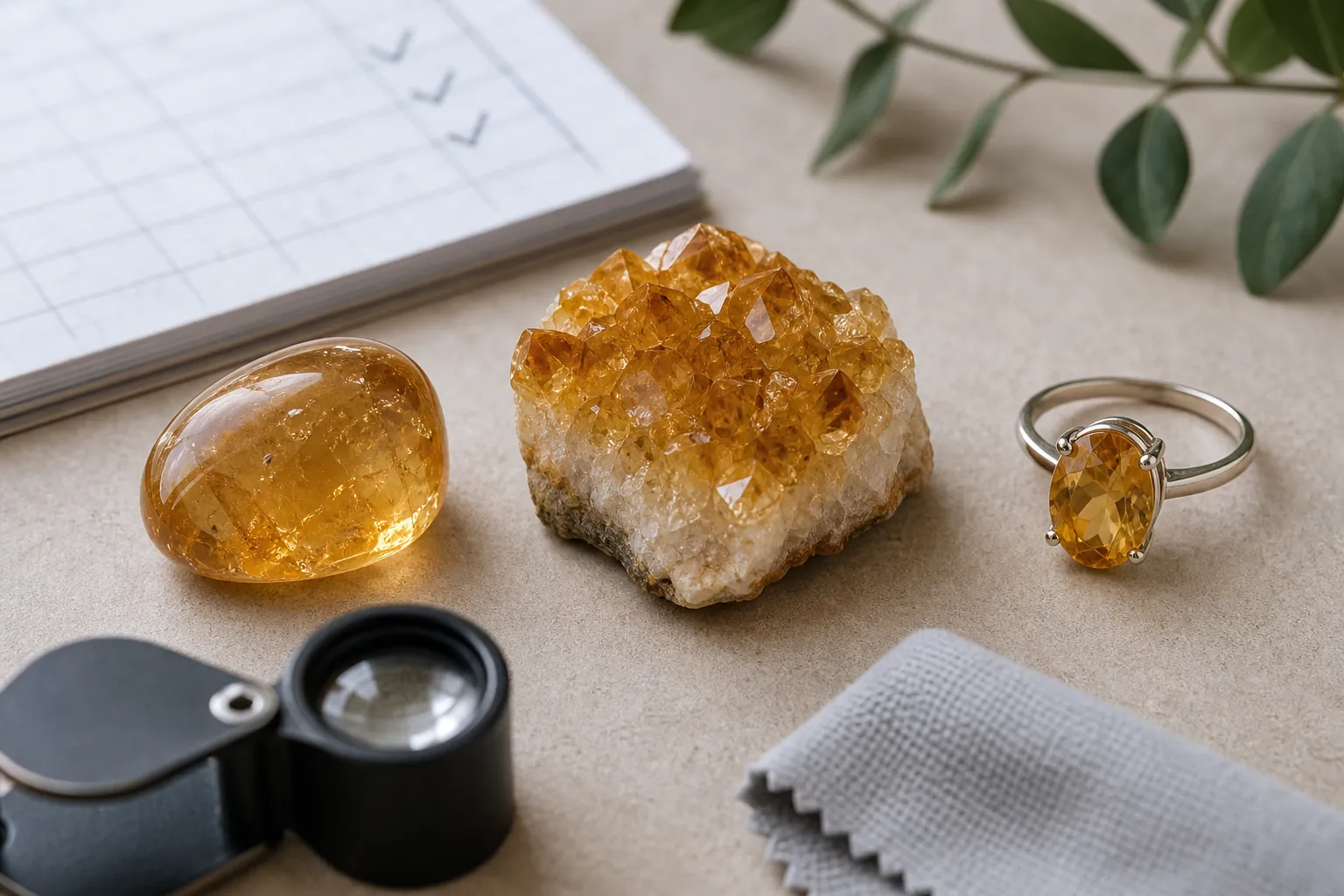
Stable loose citrine
A loose, polished citrine with no visible damage is the easiest case. A short lukewarm rinse, gentle handling, and complete drying are usually sensible.
Rough specimens and clusters
A rough specimen or cluster deserves more caution. Natural cavities, tiny cracks, matrix material, and uneven surfaces can hold water longer than a polished stone. Even if the citrine areas are quartz, the whole specimen may not behave like a simple cut gem.
Cracks, chips, and repairs
A cracked citrine in water is different from an intact stone. Chips, open fractures, and repaired areas can trap moisture or make the piece more vulnerable during cleaning. If you see damage, skip soaking and use a barely damp cloth.
Treatment uncertainty
Treated citrine care also calls for restraint. Some citrine may be natural-color quartz; some may be heat-treated amethyst or smoky quartz; some stones may have surface treatment, dye, coating, filling, or unknown enhancement. Heat treatment alone does not automatically mean the stone cannot touch water, but unknown treatment is a good reason to avoid aggressive cleaning.
Jewelry settings
Jewelry set citrine needs separate judgment because the stone is not the only material involved. Metal, prongs, closed backs, glue, plating, accent stones, antique construction, and previous repairs can all affect cleaning. A citrine ring can be more complicated than a loose citrine of the same size. For jewelry, gentle wiping is often safer than immersion, especially if the piece is old, valuable, delicate, or unfamiliar to you.
Temperature shock
Temperature shock is another avoidable issue. Do not move citrine from a hot windowsill into cold water, or from a cold place into hot water. Lukewarm water is enough for ordinary cleaning.
A Safe Way to Rinse Citrine
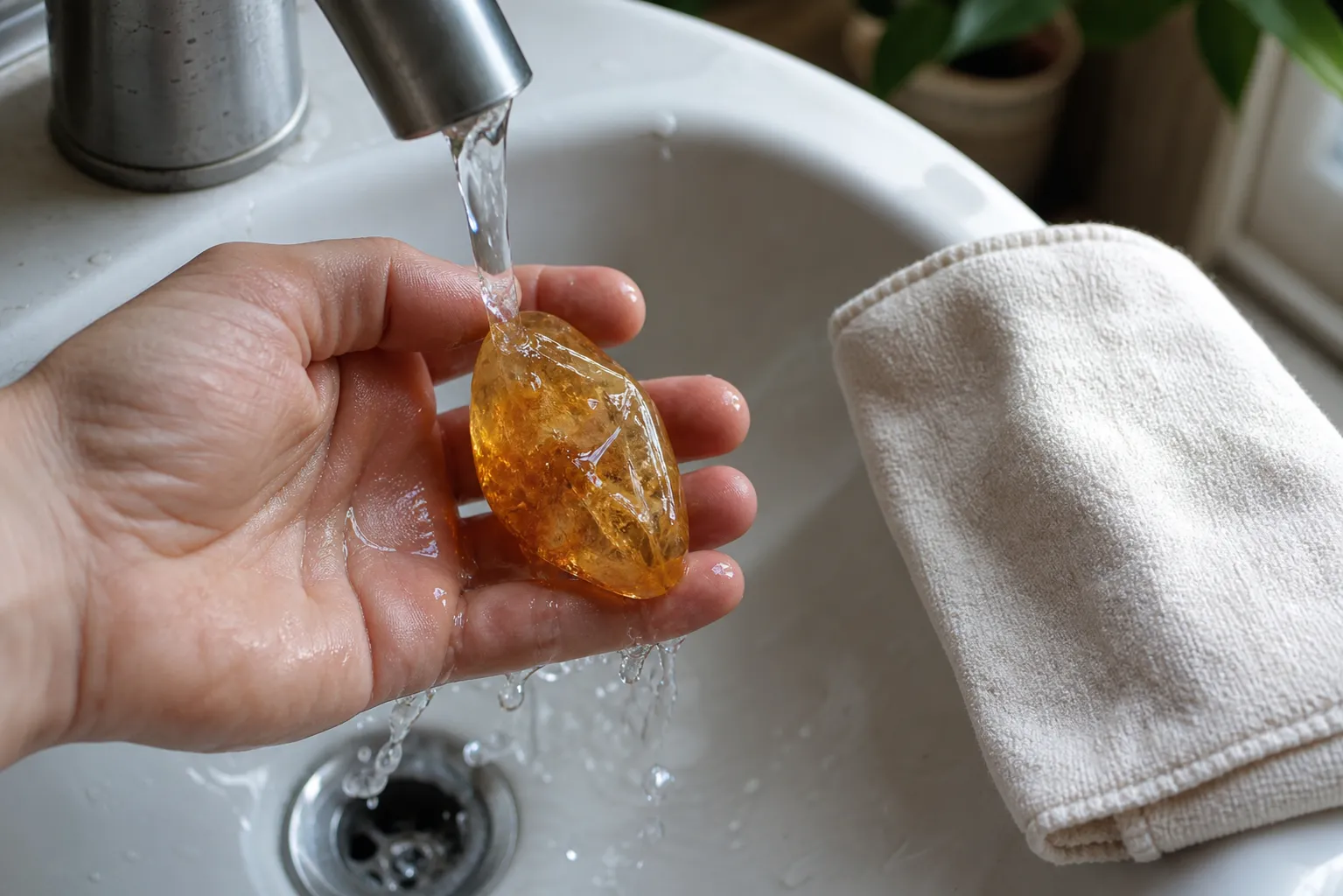
If your citrine appears stable, not visibly coated, and not set in delicate jewelry, a simple rinse is usually enough.
- First, check the surface. Look for chips, open cracks, cloudy coatings, loose settings, glue lines, or dirt trapped under a mounting. If anything looks fragile, do not soak it. Use a soft, slightly damp cloth and stop there.
- For a stable loose stone, hold it under lukewarm running water briefly. Use your fingers or a soft cloth to loosen dust. If needed, add a small amount of mild soap, then rinse it away fully. Avoid bleach, acids, abrasive powders, strong household cleaners, alcohol-heavy products, and jewelry dips unless a qualified jeweler has confirmed they suit that specific piece.
- Dry the citrine completely. Moisture can sit in small openings, around drill holes, or near metal findings. Pat the surface with a soft cloth, then let the piece air-dry in a safe place before storing it.
For a running water crystal cleanse, keep the same physical-care limits. If you choose to pass citrine under running water as part of a personal practice, keep it brief, gentle, and non-extreme. Gem-care references can support material handling; they do not establish symbolic or wellness effects.
What to Avoid With Citrine and Water
Avoid saltwater soaking citrine.
Saltwater adds chemistry that clean water does not, and salt can remain in small openings as the piece dries. For fractured, rough, mounted, or unknown stones, that is unnecessary extra exposure.
Avoid long soaking.
Hours in water are not the same as a quick rinse. Long immersion increases the chance of water reaching gaps, glue, filled fractures, or jewelry construction.
Avoid harsh cleaners citrine does not need.
Ordinary dust and handling residue should not require bleach, strong detergents, acidic products, abrasive powders, or aggressive jewelry solutions. A durable mineral can still be affected by the wrong cleaning environment, especially when mounted or treated.
Avoid ultrasonic and steam cleaning unless the specific stone and setting have been evaluated for that method.
These methods add vibration, heat, and stress; they are especially questionable for fractured, filled, glued, coated, antique, or complex jewelry pieces.
Avoid assuming that all yellow-orange quartz has the same care history.
Public reference material supports citrine’s identity and general gemstone-care boundaries, but it does not cover every treated stone, every mounting, or every long-term water practice.
Common Confusion Around Water Cleansing Citrine
The phrase “water cleansing citrine” mixes two conversations. One is physical care: removing dust, oils, or dirt. The other is personal ritual language, where water may be used symbolically.
This page’s reliable answer is about material care. Citrine can usually tolerate brief, gentle water contact when the stone is stable. That does not mean a long ritual soak is safer than a short rinse, and it does not add a material-care reason to leave the stone in water.
Another common confusion is the idea that crystals are either completely water-safe or completely water-unsafe. Citrine does not fit that kind of label neatly. Compared with many softer minerals, stable citrine is usually a better candidate for brief water contact. Compared with an “anything goes” idea of water safety, real citrine still needs condition-based care.
Hardness charts create one more misunderstanding. Since citrine is quartz and quartz is relatively hard, some readers treat Mohs hardness as the whole cleaning rule. It is not. Water safety also depends on structure, surface condition, treatments, settings, time, drying, and temperature.
The most useful approach is simple: choose the least aggressive method that gets the stone clean.
Quick Decision Guide
Use this check before putting citrine in water:
- Stable loose polished citrine: a brief lukewarm rinse is usually reasonable.
- Dusty but not dirty citrine: a dry or slightly damp soft cloth may be enough.
- Cracked, chipped, rough, coated, glued, filled, or fragile citrine: avoid soaking and minimize water.
- Jewelry set citrine: be cautious with immersion because the setting may be the weak point.
- Valuable, antique, or unknown citrine: use gentle wiping or ask a qualified jeweler before stronger cleaning.
- Saltwater, long soaking, steam, ultrasonic cleaning, or harsh products: do not treat “citrine is quartz” as permission.
Citrine’s quartz identity makes brief water contact less concerning than it would be for many delicate crystals. The final care choice still belongs to the actual piece you are cleaning.
FAQ
Can citrine go in water overnight?
It is better to avoid overnight soaking. A brief rinse is different from long immersion, especially if the citrine has cracks, surface treatments, glue, filler, or a jewelry setting. Overnight water exposure adds risk without being necessary for ordinary cleaning.
Is running water safe for citrine?
Running water is usually acceptable for a stable loose citrine when contact is brief and the water is lukewarm. Dry the stone fully afterward. If the piece is cracked, mounted, coated, or uncertain, use a damp cloth instead of holding it under the tap.
Does citrine’s Mohs hardness make it water safe?
Not by itself. Citrine’s quartz hardness helps explain why it is fairly durable and scratch resistant, but Mohs hardness is not a complete water-safety test. Treatments, fractures, settings, cleaner chemistry, soaking time, and temperature changes still matter.