Acoustic Brainwave Entrainment Soundscapes
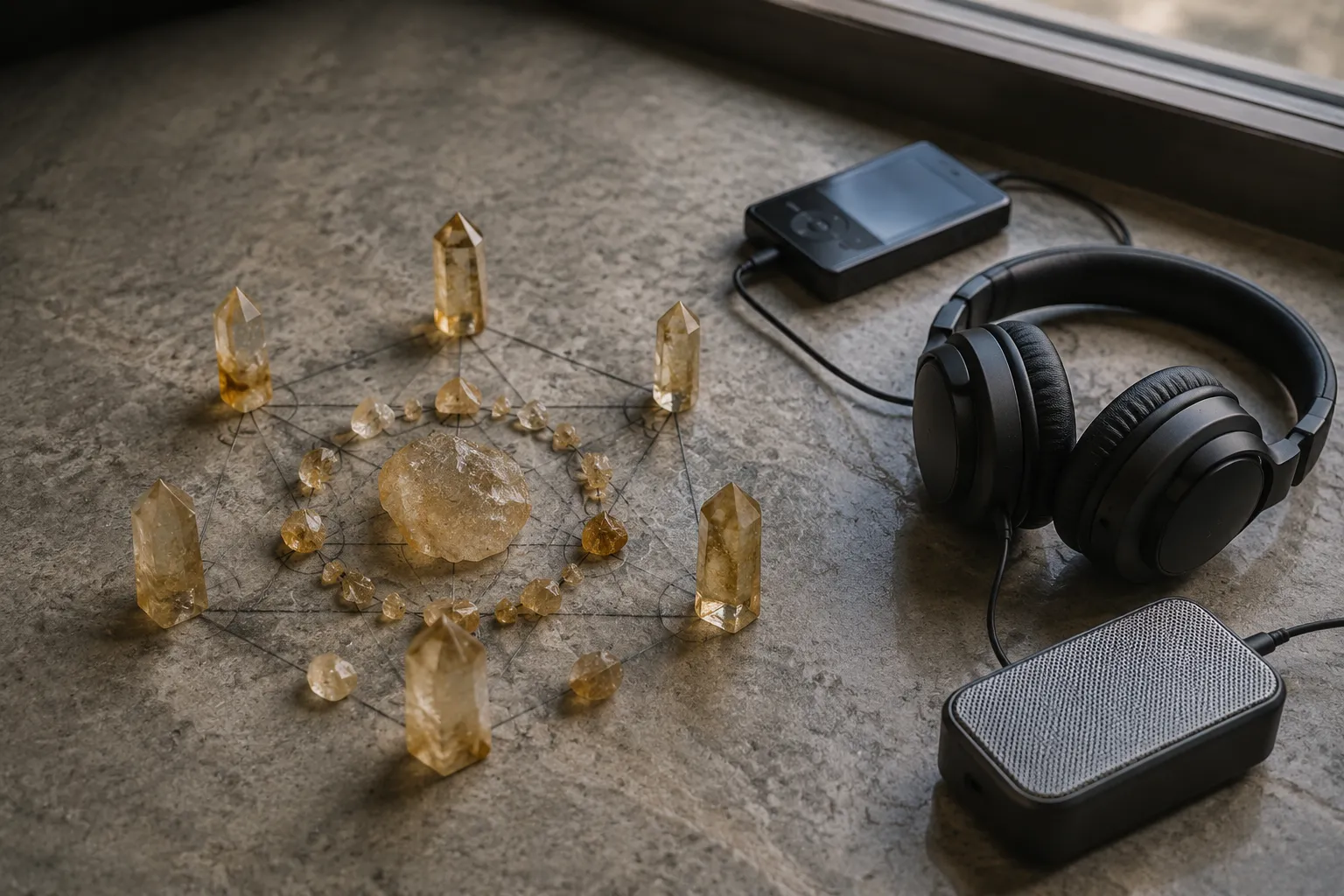
A track labeled Acoustic Brainwave Entrainment Soundscapes can accompany a citrine-grid practice, but it should be treated as part of the listening environment, not as a way to change the stone or grid. Choose the audio by its intended role: 432 Hz if you prefer that musical-tuning reference, 528 Hz if its symbolic association suits your ritual language, or binaural beats if you specifically want that listening format.
No supplied source establishes that any of these options activates, charges, cleanses, amplifies, or physically modifies citrine. The practical question is narrower: which sound makes the session feel coherent and comfortable while keeping musical tuning, brainwave terminology, and crystal meaning in separate categories?
broader context
Start with the main citrine page
This narrower page works best after the broader citrine reference page.
Start With the Audio Role
A citrine grid is a physical arrangement of stones used within a personal or symbolic practice. The soundscape is an accompanying auditory choice. You can use both together without assuming that the audio acts on the mineral.
Before choosing a frequency, decide what role the track has in the session:
- quiet background sound;
- a marker for beginning or ending the practice;
- an aid to sustained attention;
- a consistent atmosphere;
- a personally meaningful tone or musical reference.
These describe intention and subjective experience. They do not establish a measurable change in the citrine, the grid, or the listener.
The phrase “acoustic brainwave entrainment” can also blur several different categories. A musical tuning value, a single tone, a binaural beat, and a measured brainwave are not interchangeable. The label on a track does not tell you which of these you are actually hearing.
Read the seller or platform description beside the audio format. “Frequency” may be used as a broad market category rather than a precise scientific description. A cleaner personal description is: “This is a soundscape I use alongside my citrine grid.” That wording does not turn a listening preference into a claim about the stone.
What 432 Hz Means
In this context, 432 Hz refers to a musical-tuning reference. It is not automatically a brainwave frequency, a binaural beat, or a special frequency for citrine.
A PubMed-indexed double-blind cross-over pilot study compared music tuned to 432 Hz and 440 Hz. That supports a limited statement: these tuning references have been examined in a controlled comparison. It does not establish a universal response across listeners, recordings, or ritual settings. The study is not evidence that either tuning changes a crystal grid.
The distinction matters because wellness language often compresses several meanings into one number. “432 Hz music” may describe the tuning used for a recording, while “binaural beats” describes how tones are presented to the ears. Neither label, by itself, establishes a dependable mental, physical, or crystal-related outcome.
If you are choosing between a 432 Hz-tuned recording and a more familiar 440 Hz-tuned recording, use musical preference, availability, and ritual consistency as your decision points. You may prefer the sound of one recording, its instrumentation, or the meaning you attach to the tuning reference.
“432 Hz is my chosen musical-tuning reference for this session.”
That keeps the choice specific. It does not make a statement about citrine authenticity, value, or physical behavior.
Where 528 Hz Fits
528 Hz is a familiar search term in wellness and soundscape contexts, but the supplied research does not support it as a special frequency for citrine grids. There is no source in the current evidence set establishing that 528 Hz activates a grid, changes a stone, amplifies intention, or produces a dependable listener outcome.
You can still select a 528 Hz track as a personal or symbolic listening option. The boundary lies in the wording. “I associate this track with the purpose of the session” describes your ritual language. “This frequency has an established effect on citrine” goes beyond the page evidence.
The same distinction applies to words such as grounding, clarity, abundance, openness, or renewal. They can describe the atmosphere you want from a piece of music or the intention you bring to a session. They should not be presented as established consequences of the number 528 or of the crystal arrangement.
Search visibility is not verification. The fact that people look for a relationship between 528 Hz and citrine does not establish one.
Binaural Beats Are a Listening Format
Binaural beats are not simply another name for any track carrying a frequency label. They generally use different tones presented separately to the two ears, creating a perceived beat-like difference. The relevant systematic review examines binaural beats, brain oscillatory activity, and brain-network findings, while also noting variation in research methods and outcomes.
That evidence supports careful terminology rather than a guaranteed result. Research involving neural activity does not show that every listener will experience the same response, and it does not show that binaural beats interact with citrine or alter a grid.
For a citrine-grid session, choose binaural beats only if you want that particular format and can listen comfortably. Headphones may be needed for the intended left-right presentation, depending on the recording. If headphones are distracting or you want the stones and room to remain the focus, a conventional ambient track may suit the session better.
Keep these three ideas distinct:
- Musical tuning: a reference used to organize the pitch of a musical recording.
- Binaural beats: an audio format that presents tones separately to the ears.
- Brainwave evidence: measurements and interpretations produced by specific research methods.
A track described with one term should not automatically be treated as all three. Neural-activity research also should not be extended into claims about a crystal's properties.
A Simple Selection Process
You do not need a large frequency library. A short, repeatable process is enough.
1. Name the role of the sound
Decide whether the track is background music, a ritual marker, part of a concentration routine, or simply something you enjoy hearing beside the grid. This keeps the frequency label from carrying more meaning than the session requires.
2. Choose one format
Select a 432 Hz-tuned recording, a 528 Hz-associated track, a binaural-beat recording, or an ambient piece without a frequency label. Keeping one format per session makes it easier to notice your own preference.
3. Check what the label describes
Look for whether the description refers to musical tuning, tone generation, binaural presentation, or a general marketing category. If the description is vague, leave it vague. Do not replace an unclear label with a stronger interpretation.
4. Keep the stone observations separate
Record the grid's arrangement, the visible color and clarity of the stones, and any seller or documentation language separately from your response to the audio. A soundscape cannot replace gemological verification, treatment disclosure, or provenance information.
If a piece is sold as natural citrine, the seller's wording and the audio used beside it remain separate matters. Sound does not authenticate natural material, identify treatment, or establish value.
5. Manage volume and listening time
Frequency choice does not remove the need to manage sound level and exposure duration. The World Health Organization's Safe Listening guidance provides the relevant public-health boundary. Use a comfortable level, take breaks, and reduce exposure if the sound feels harsh or leaves your ears uncomfortable.
The number attached to a track does not make it protective. Safe listening depends on how loud and how long you listen.
Common Confusions
“432 Hz is a brainwave frequency.”
In the cited comparison, 432 Hz is a musical-tuning reference. That is a different category from a measured brainwave frequency.
“Binaural beats establish neural entrainment for everyone.”
The systematic review is relevant to neural oscillatory activity and related terminology, but variation in methods and outcomes does not support a dependable result for every recording or listener.
“A lower or higher number is automatically better for citrine.”
No supplied source establishes a preferred frequency for citrine, a grid, or a particular quartz variety.
“A subjective ritual response shows that the sound changed the crystal.”
A session may feel meaningful, focused, calm, or aesthetically coherent. Those observations belong to personal experience and ritual interpretation. They do not verify a physical change in the stone.
“The frequency label tells me the track is safe.”
Hearing safety relates to sound level and exposure duration, not to the symbolic number attached to a recording.
These boundaries do not remove meaning from the practice. They place symbolic meaning after material facts, so a personal interpretation is not mistaken for gemological evidence or scientific support.
The Short Decision Rule
- Choose 432 Hz when you want a recording built around that musical-tuning reference and understand that the available comparison evidence is narrow.
- Choose 528 Hz when its personal or symbolic meaning fits the session. Describe it as a preference, not as an evidence-backed mechanism for citrine.
- Choose binaural beats when you specifically want that listening format and can use it comfortably. Treat claims about neural entrainment as an area with variable findings, not as a dependable promise.
- Choose another ambient recording when the number distracts from the grid or the description makes claims you cannot verify.
For every option, keep the soundscape separate from the stone's identity. The available evidence can clarify musical tuning, binaural-beat terminology, and listening boundaries. It does not confirm that sound changes citrine or makes a grid more powerful. That is the practical line between a personal listening choice and a claim that the page evidence cannot support.